
Chef Juliette
Ordinary or White Consommé
Beef shin, lean beef, and fowl begin in cold water and rise slowly toward a tremble. Skim before the boil, and you learn the quiet discipline that gives every clear French broth its backbone.
A cooking platform built around craft, culture, and the stories behind what we eat.
Created by Chef Juliette
Based on No. 60, Aurore Sauce, from Le Guide Culinaire (1907) by Auguste Escoffier
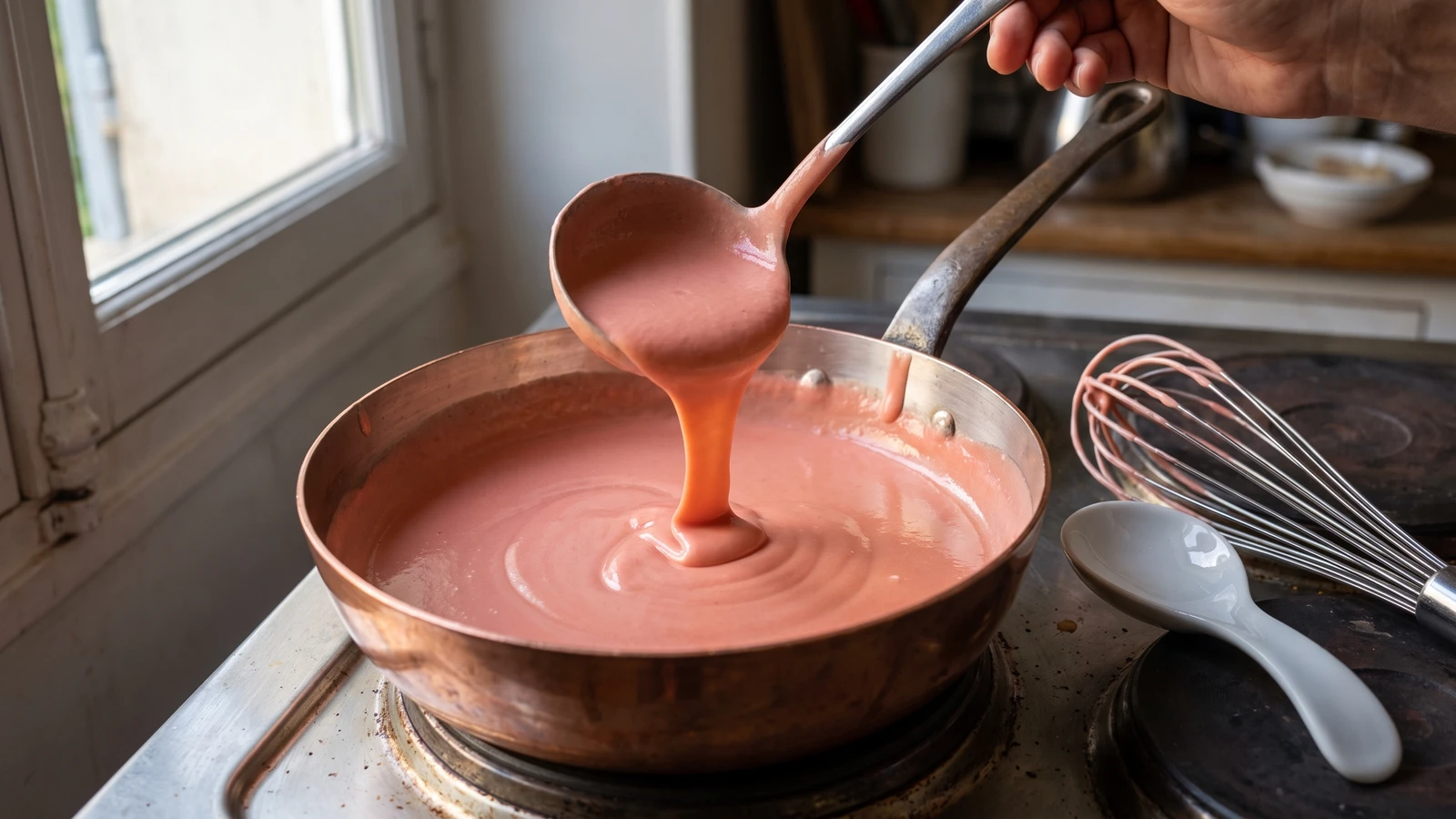
Sauce Aurore is the lesson in disciplined color: equal parts pale velouté and vivid tomato, boiled only once, strained fine, then mounted off the heat until dawn-pink and glossy.
Sauce Aurore (dawn-blush velouté) teaches restraint at the precise moment heat has done its work. Equal parts pale velouté and vivid tomato must meet at a brief boil, but the butter belongs away from the flame. Boil after mounting and the gloss breaks while the rose dulls toward brick. The one true thing is simple: boil once, then finish off the fire.
The original kitchen assumed a saucier at the stove, stock never off the fire, and a tammy waiting beside great pans of finished sauce. Your honest equivalent is two completed foundations, one saucepan, and a fine-mesh sieve. The referenced four-quart tomato production remains in its own entry; here the working quantity is scaled to about two quarts. The brigade's constant holding is scaffolding and can go. Equal volumes, the brief boil, straining, and real butter are the dish, so all four stay. One cook, one stove, one evening.
You are after the color of early light, a soft blush rather than a red tomato sauce, and a texture that coats without sitting heavily. Keep a little unbuttered sauce aside before the finish, because it becomes your rebuilding base if the emulsion separates. Most of all, keep the pan off the heat while the butter goes in. That final mounting decides the sauce.
Sauce Aurore belongs to the codified national repertoire of French sauce kitchens rather than to a single regional larder; its name comes from the rosy light of dawn, echoed by tomato tinting a pale velouté. It traveled from the professional saucier's station to bourgeois dining rooms as a companion to eggs, poached poultry, quenelles, and delicate fish. Many household formulas build it on béchamel, but this version keeps the book's velouté foundation, equal measure of very red tomato purée, fine straining, and generous butter finish.
Quantity
3½ cups (830 ml / 850 g)
Quantity
3½ cups (830 ml / 850 g) Tomato Sauce (No. 29)
prepared in its purée form and finished smooth
Quantity
1 cup plus 1½ tablespoons (275 ml / 250 g)
cut into small cubes
| Ingredient | Quantity |
|---|---|
| velouté | 3½ cups (830 ml / 850 g) |
| very red Tomato Sauceprepared in its purée form and finished smooth | 3½ cups (830 ml / 850 g) Tomato Sauce (No. 29) |
| cold unsalted buttercut into small cubes | 1 cup plus 1½ tablespoons (275 ml / 250 g) |
Put the velouté in a heavy 4-quart saucepan and bring it to a controlled boil over medium heat, whisking across the base and into the corners. It must be properly boiling when the tomato enters, but it must not catch. If you smell scorching, immediately pour the clean sauce into another pan without scraping the bottom; the unburned portion is still sound.
Whisk the very red Tomato Sauce (No. 29) into the boiling velouté in a steady stream. Equal volume is the rule. Bring the mixture back to a boil, whisking continuously, then let it bubble gently for 2 minutes, just long enough for the two sauces to become one. The color should settle into a soft rose, not darken toward brick; prolonged reduction concentrates the tomato and misses the point.
Set a fine-mesh sieve over a clean saucepan and pass the hot sauce through it, working in batches and pressing gently with the back of a ladle. Scrape the smooth sauce clinging beneath the sieve into the pan. The fine-mesh sieve is the honest home equivalent of the tammy used at the sauce station: less ceremony, the same silken result.
Ladle ½ cup (120 ml / about 120 g) of the unbuttered sauce into a heatproof jug and keep it warm. Hold back the final 2 tablespoons (30 ml / 30 g) of butter. Take the saucepan completely off the heat and wait until active bubbling stops, then whisk in the remaining cold butter a few cubes at a time, letting each addition disappear before the next. If the sauce stays smooth, whisk the reserved sauce back in and finish with the final butter. If oily droplets appear, stop. Put the reserved unbuttered sauce in a clean pan and slowly whisk the broken sauce into it one ladleful at a time, then add the final butter away from the heat. Ça se rattrape.
The finished Aurore should fall from the ladle in a broad ribbon, coat the back of a spoon, and gleam without any butter floating on its surface. Transfer it to a warm sauceboat or spoon it directly over poached eggs, delicate fish, quenelles, or poultry. If service waits, hold the pan over barely warm water for no more than 15 minutes and whisk occasionally. Never return the mounted sauce to a boil. À table!
1 serving (about 60g)
Culinary guides, cultural storytelling, and the editorial depth that makes cooking meaningful.
Discover Culinary ExplorerChef Juliette
Beef shin, lean beef, and fowl begin in cold water and rise slowly toward a tremble. Skim before the boil, and you learn the quiet discipline that gives every clear French broth its backbone.

Chef Juliette
Break the veal bones small, then give them eight hours at a bare tremble. This pale, gelatinous fond becomes the quiet foundation beneath velouté, blanquette, and every sauce that must stay light.

Chef Juliette
Sauce Orientale concentrates lobster-rich American Sauce with curry, then folds in cream away from the fire: a glossy, gently spiced derivative made for lobster, crayfish, and firm fish.

Chef Juliette
An old lesson in sauce families: Sauce Allemande takes mushroom liquor, then butter, lemon, and parsley, becoming a glossy Poulette for sheep's trotters, leeks, cauliflower, and anything needing gentle richness with a bright edge.