
Chef Juliette
Bouillabaisse à la Marseillaise
Marseille's great fish stew, saffron-gold and garlic-scented, proves that a hard boil can be the careful choice: it binds olive oil into broth before the whole pot meets bread.
A cooking platform built around craft, culture, and the stories behind what we eat.
Created by Chef Juliette
Based on No. 597, Consommé Parisienne, from Le Guide Culinaire (1907) by Auguste Escoffier
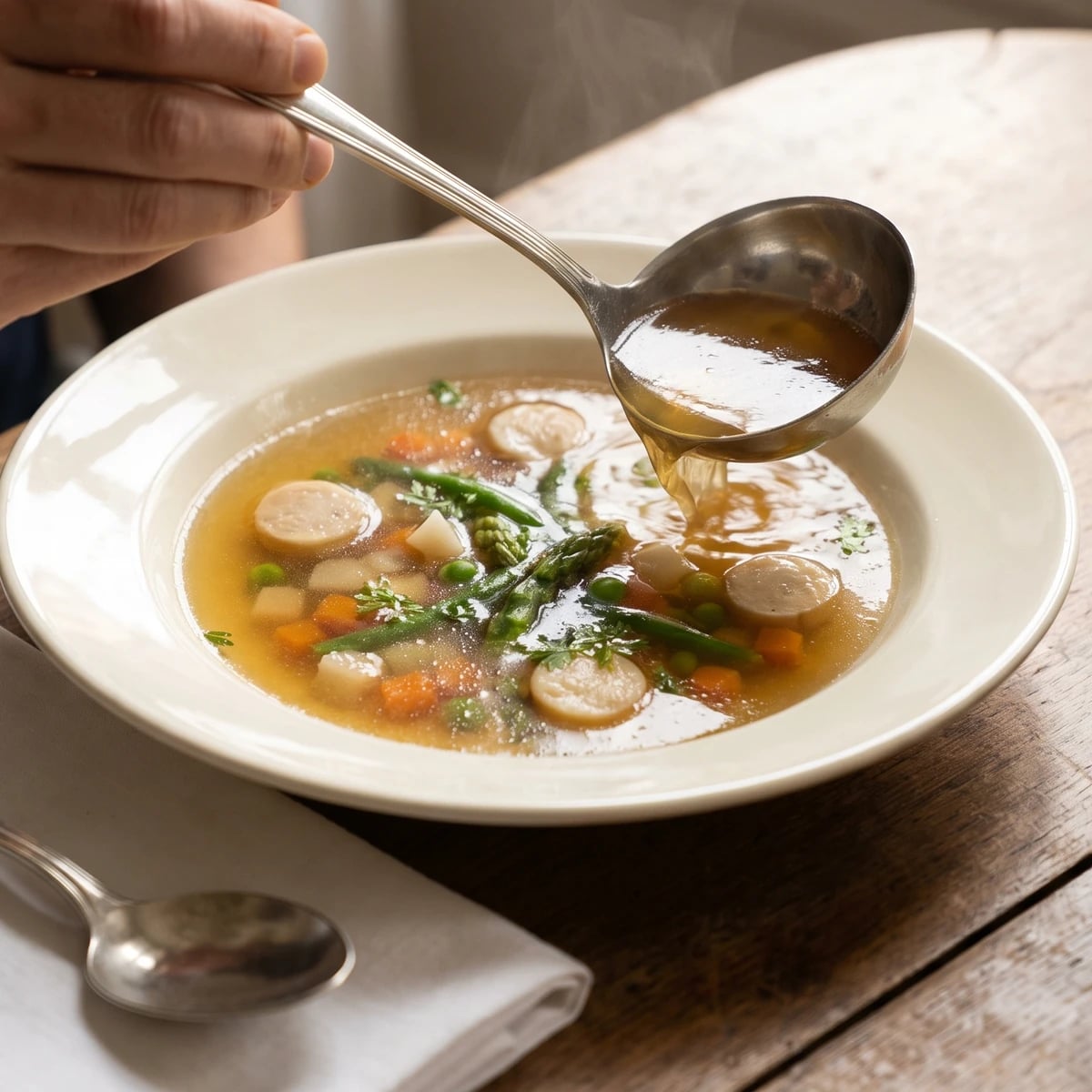
Consommé Parisienne makes clarity the lesson: brilliant chicken broth poured over silky julienne royale and a precise macédoine of spring vegetables, every element cooked separately so each tastes clean and keeps its shape.
Consommé Parisienne (clear chicken consommé with julienne royale and spring vegetables) teaches the discipline behind every garnished consommé: cook each element apart, then unite them only at the table. The one true thing to know before touching a pan is that clarity is protected by separation. If the vegetables or royale simmer in the broth, their starch, egg, and cut surfaces dull what the consommé worked so hard to become.
The source begins with one quart of chicken consommé already brilliant and hot, two dariole moulds, a saucier tending stock never off the fire, and several hands free to shape five vegetables. This version makes the required two-quart home tureen, doubling every garnish in exact proportion. Four small ramekins replace the dariole moulds, and an ordinary knife may replace the tiny grooved vegetable scoop. The brigade scaffolding was extra hands and specialized moulds. Separate cooking and the last-minute pour are the dish, and they stay. One cook, one stove, one evening.
Done properly, the broth arrives glass-clear and amber-gold, carrying pale royale roundels and a bright scatter of spring vegetables, every color and cut still itself. The step that matters most is the royale's gentle bain-marie: keep the water below a boil and the custard will set smoothly enough to slice without shedding into the soup.
Consommé Parisienne belongs to the Parisian grand-kitchen repertoire, where brilliant consommé became the clear setting for highly ordered garnishes. Parisienne here names the composition rather than the birthplace of the chicken broth: a julienne-flavored royale, a macédoine of spring vegetables, and chervil pluches. Carried onto bourgeois dinner tables in a soup tureen, it kept the grand kitchen's decisive practice: the hot consommé is poured over the garnish only at service, so every color and cut remains distinct.
Quantity
2 quarts (8 cups / 1.9 L / about 1.9 kg)
divided
Quantity
2 tablespoons (30 ml / 20 g)
cut into fine julienne
Quantity
2 tablespoons (30 ml / 20 g)
cut into fine julienne
Quantity
2 tablespoons (30 ml / 15 g)
cut into fine julienne
Quantity
1 tablespoon (15 ml / 10 g)
thinly sliced
Quantity
1 tablespoon (15 ml / 8 g)
cut into fine julienne
Quantity
1
Quantity
2
Quantity
1 teaspoon (5 ml / 5 g)
softened, for the moulds
Quantity
2 heaped tablespoons (about 40 ml / 35 g)
cut into 5 mm beads or dice
Quantity
2 heaped tablespoons (about 40 ml / 40 g)
cut into 5 mm beads or dice
Quantity
2 tablespoons (30 ml / 30 g)
fresh or frozen
Quantity
2 tablespoons (30 ml / 25 g)
cut into 1 cm lozenges
Quantity
2 tablespoons (30 ml / 25 g)
Quantity
1 tablespoon (15 ml / 18 g)
for the blanching water, plus more only if needed
Quantity
1 tablespoon, loosely packed (15 ml / 2 g)
| Ingredient | Quantity |
|---|---|
| prepared chicken consommédivided | 2 quarts (8 cups / 1.9 L / about 1.9 kg) |
| carrot for the royalecut into fine julienne | 2 tablespoons (30 ml / 20 g) |
| turnip for the royalecut into fine julienne | 2 tablespoons (30 ml / 20 g) |
| white leek for the royalecut into fine julienne | 2 tablespoons (30 ml / 15 g) |
| onion for the royalethinly sliced | 1 tablespoon (15 ml / 10 g) |
| celery for the royalecut into fine julienne | 1 tablespoon (15 ml / 8 g) |
| large egg | 1 |
| large egg yolks | 2 |
| unsalted buttersoftened, for the moulds | 1 teaspoon (5 ml / 5 g) |
| carrot for the macédoinecut into 5 mm beads or dice | 2 heaped tablespoons (about 40 ml / 35 g) |
| turnip for the macédoinecut into 5 mm beads or dice | 2 heaped tablespoons (about 40 ml / 40 g) |
| small peasfresh or frozen | 2 tablespoons (30 ml / 30 g) |
| fine French beanscut into 1 cm lozenges | 2 tablespoons (30 ml / 25 g) |
| small asparagus tips | 2 tablespoons (30 ml / 25 g) |
| fine sea saltfor the blanching water, plus more only if needed | 1 tablespoon (15 ml / 18 g) |
| fine chervil pluches | 1 tablespoon, loosely packed (15 ml / 2 g) |
Measure ¼ cup (60 ml / 60 g) of the chicken consommé into a small saucepan. Add the julienned carrot, turnip, leek, onion, and celery. Julienne means fine matchsticks, though these will be puréed, so even thinness matters more than perfect length. Cover and hold at a bare simmer for 12 to 15 minutes, adding a spoonful of consommé only if the pan dries, until every vegetable collapses beneath a spoon. Purée until smooth, press through a fine sieve, and measure ½ cup (120 ml / about 120 g). If there is too much, reduce it gently; if there is too little, loosen it with consommé. Cool completely before adding the eggs.
Heat the oven to 150°C / 300°F. Butter four straight-sided 2-ounce (60 ml) ramekins or silicone muffin cups. Whisk the whole egg and yolks only until blended, then stir in the cold julienne purée. Royale is a savory custard, and trapped air leaves holes, so let any foam settle and spoon it away before dividing the mixture among the moulds. Set them in a small roasting pan, add hot water to come halfway up their sides, and bake for 20 to 25 minutes, until the centers tremble slightly and reach 71°C / 160°F. If the water begins bubbling or the edges puff, lift out the pan, replace a little bath water with cool water, and lower the oven slightly. Ça se rattrape. The finished royale should be smooth, moist, and entirely unbrowned.
Prepare the macédoine, the mixture of small spring vegetables. Use a tiny grooved scoop or 6 mm melon baller for the garnish carrots and turnips if you own one; otherwise cut tidy 5 mm dice with a sharp knife. The fluting was presentation scaffolding, but equal size is essential because it controls cooking. Cut the French beans diagonally into 1 cm lozenges, small diamond shapes, and trim the asparagus tips to a similar scale. Keep every vegetable separate.
Bring a medium saucepan of water to a boil and add the measured salt. Use this single pan in sequence, blanching the carrots for 3 to 4 minutes, turnips for 2 to 3 minutes, French beans for about 2 minutes, asparagus tips for 60 to 90 seconds, and peas for 30 to 60 seconds. Lift each vegetable into cold water as soon as it is tender with a little resistance, then drain it separately. Cooking them all together saves a pan but loses the dish: their colors bleed, their cooking times quarrel, and the macédoine becomes muddled.
Let the royale cool for at least 15 minutes, then run a thin knife around each mould and invert it gently. If one clings, dip the base in warm water for five seconds and try again; never pry at the custard. Cut each cylinder crosswise into regular roundels about 5 mm thick. A warm royale smears, so chill it briefly before cutting if the blade does not pass through cleanly.
Pass the remaining chicken consommé through a rinsed fine-mesh sieve into a clean saucepan if any sediment has settled. Heat it slowly without whisking or vigorous stirring, skim away any film that rises, and bring it just to the boil at serving time. Taste carefully. The consommé should be clear, deeply chicken-scented, and seasoned enough to remain vivid once the unseasoned royale and vegetables enter it.
Warm a soup tureen with hot water, then empty and dry it. Return the macédoine briefly to boiling water for about 20 seconds, drain it thoroughly, and arrange it in the tureen with the royale roundels. Pour the boiling consommé over everything only when the guests are ready, then scatter on the chervil pluches, the fine tender leaves reserved for soup. Ladle gently so the custard stays whole and the vegetables remain distinct. À table!
1 serving (about 275g)
Culinary guides, cultural storytelling, and the editorial depth that makes cooking meaningful.
Discover Culinary Explorer
Chef Juliette
Marseille's great fish stew, saffron-gold and garlic-scented, proves that a hard boil can be the careful choice: it binds olive oil into broth before the whole pot meets bread.

Chef Juliette
Waterzoi asks fresh, bone-in river fish to thicken its own buttery broth, with parsley root and pepper for company. No flour, no stockpot, just a brisk simmer watched closely.

Chef Juliette
Queue de Bœuf en Hochepot gathers oxtail, pig's trotter and ear, cabbage, roots, and grilled chipolatas around a clear, gelatin-rich broth whose quiet simmer keeps every piece tender and distinct.

Chef Juliette
Beef shoulder larded with bacon, sharpened by red wine and vinegar, then sealed with garlic, vegetables, and dry lemon peel until the low oven turns it yielding and the gravy darkly glossy.