
Chef Juliette
Ordinary or White Consommé
Beef shin, lean beef, and fowl begin in cold water and rise slowly toward a tremble. Skim before the boil, and you learn the quiet discipline that gives every clear French broth its backbone.
A cooking platform built around craft, culture, and the stories behind what we eat.
Created by Chef Juliette
Based on No. 58, American Sauce, from Le Guide Culinaire (1907) by Auguste Escoffier
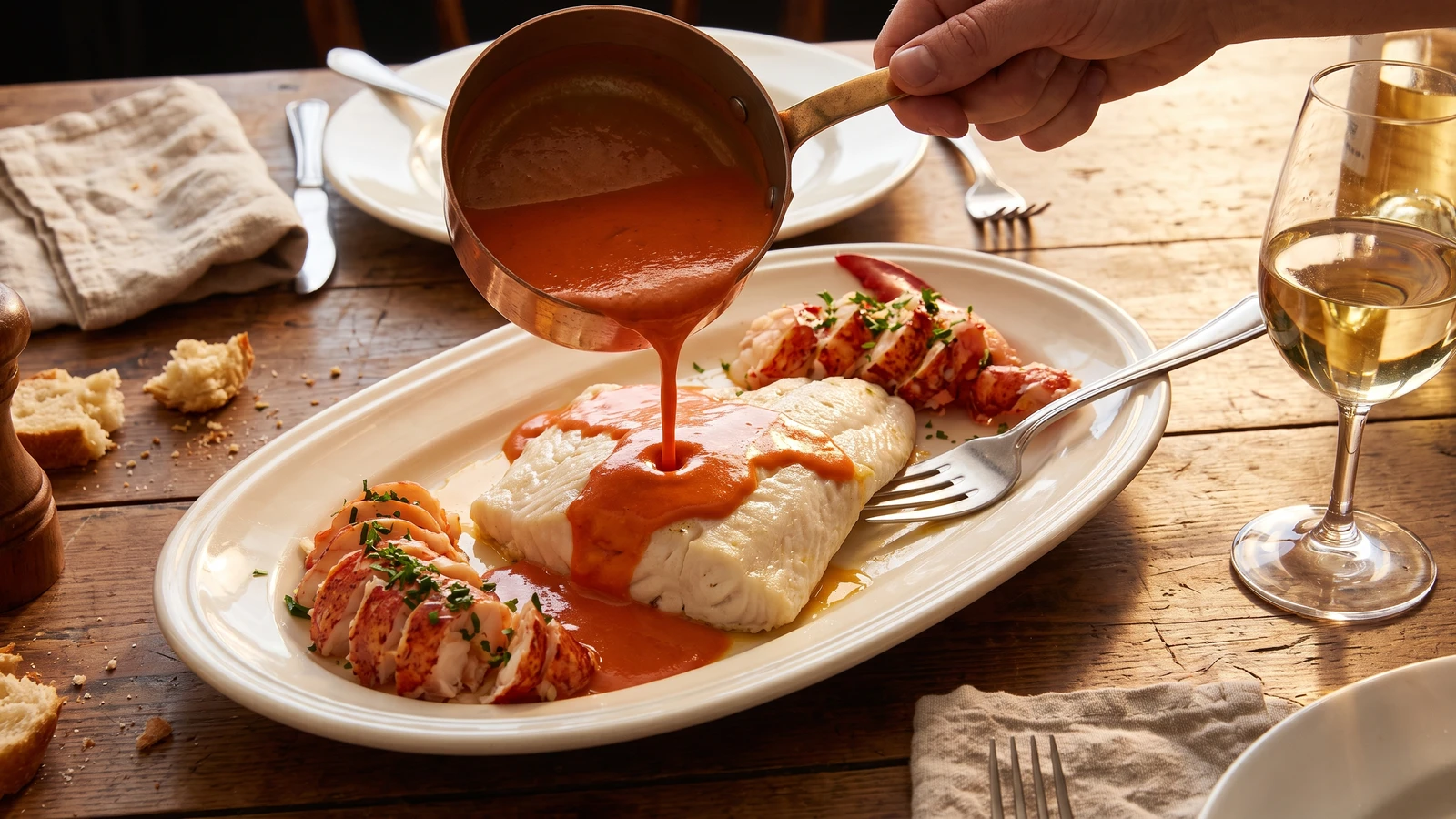
Sauce Américaine is lobster distilled into sauce: shellfish cooking liquor sharpened with wine, brandy, tomato, and cayenne, then enriched off the heat with coral and butter until glossy.
Sauce Américaine (lobster, wine, tomato, and butter sauce) teaches one severe and useful principle: the shellfish does not merely accompany the sauce, it creates it. Its cooking liquor, coral, and final butter belong to one continuous preparation. Start without that lobster foundation and you may make a pleasant tomato fish sauce, but you have not made Sauce Américaine.
The classical entry assumed Homard à l’Américaine (No. 939) already moving through the kitchen, a saucier on staff, fumet in a stockpot never off the fire, and meat glaze ready by the spoonful. A salamander has no place in this formula, so there is no broiler trick to imitate. At home, prepare the one referenced component at the required scale, reserve the claw and tail meat for garnish, and collect its sauce in a clean saucepan. The separate sauce station was brigade scaffolding and can go. The lobster cooking, reduction, coral, and butter finish are the dish and must stay. One cook, one stove, one evening.
The one true thing to know before touching the pan is this: once the coral and final butter have entered, the sauce must never boil. Gentle heat keeps it glossy and joined. If it separates, do not pour it away. Ça se rattrape, and the rescue is waiting in the method.
Sauce Américaine belongs to the Parisian classical repertoire and is inseparable from Homard à l’Américaine (No. 939), whose concentrated cooking liquor became a sauce for fish as well as for the lobster itself. The later name armoricaine encouraged a Breton origin story, but the canonical title américaine does not describe an American pantry sauce; it names the lobster preparation from which the sauce is taken. Classical service wastes nothing: the sauce cloaks the fish, while the sliced claw and tail meat become its garnish.
Quantity
1 full recipe, scaled to about 2 quarts (1.9 L / about 2 kg) finished sauce
complete according to its own formula, reserving the claw and tail meat
Quantity
up to 1/4 cup (60 ml / 60 g)
for loosening or rescuing the emulsion only
| Ingredient | Quantity |
|---|---|
| Homard à l’Américaine (No. 939)complete according to its own formula, reserving the claw and tail meat | 1 full recipe, scaled to about 2 quarts (1.9 L / about 2 kg) finished sauce |
| warm water (optional)for loosening or rescuing the emulsion only | up to 1/4 cup (60 ml / 60 g) |
Set a clean heavy saucepan, a warmed fine-mesh strainer, a whisk, and the serving vessel beside the stove before beginning. The finished butter emulsion will tolerate gentle holding, but it should not wait while tools are hunted down. Warm the serving vessel with hot water, then dry it thoroughly.
Prepare Homard à l’Américaine (No. 939) completely according to its separate formula, scaling the preparation without changing its flavorings, sequence, or ratios. Its shellfish foundation, prescribed reduction, coral enrichment, and off-heat butter finish must remain intact. Bought bisque or tomato purée loosened with stock cannot stand in for this preparation.
When the referenced preparation yields its cooked claw and tail meat, keep that meat covered and warm rather than assembling the lobster presentation. Slice the tail crosswise into generous medallions and leave the claw meat whole or in large pieces. Do not simmer the cooked meat in the finished sauce, or it tightens and loses its sweetness.
Collect the completed sauce through the warmed fine-mesh strainer into the clean saucepan. Let it pass naturally and press the residue only lightly; forcing every solid through muddies both its color and texture. The sauce should be coral-red, glossy, and fine enough to coat a spoon in a translucent film before falling in a smooth sheet.
Keep the sauce between 140°F and 158°F (60°C and 70°C), over the lowest heat or in a barely warm water bath. It may quiver, but it must not bubble. If a greasy ring appears or the sauce separates, remove it from the heat immediately. Put 1 tablespoon (15 ml / 15 g) warm water in a clean saucepan, then whisk in the broken sauce one spoonful at a time until the gloss returns. Ça se rattrape. If the sauce is merely too thick, whisk in warm water by the teaspoon.
Arrange the warm lobster meat over or beside the prepared fish. Spoon on enough Sauce Américaine to cloak the fish without drowning it, about 1/4 cup (60 ml) per serving, and finish with the chopped, blanched parsley allotted by the referenced preparation. Serve the remaining sauce warm at the table. À table!
1 serving (about 60g)
Culinary guides, cultural storytelling, and the editorial depth that makes cooking meaningful.
Discover Culinary ExplorerChef Juliette
Beef shin, lean beef, and fowl begin in cold water and rise slowly toward a tremble. Skim before the boil, and you learn the quiet discipline that gives every clear French broth its backbone.

Chef Juliette
Break the veal bones small, then give them eight hours at a bare tremble. This pale, gelatinous fond becomes the quiet foundation beneath velouté, blanquette, and every sauce that must stay light.

Chef Juliette
Sauce Orientale concentrates lobster-rich American Sauce with curry, then folds in cream away from the fire: a glossy, gently spiced derivative made for lobster, crayfish, and firm fish.

Chef Juliette
An old lesson in sauce families: Sauce Allemande takes mushroom liquor, then butter, lemon, and parsley, becoming a glossy Poulette for sheep's trotters, leeks, cauliflower, and anything needing gentle richness with a bright edge.