
Chef Juliette
Smelt (Éperlans)
Tiny éperlans, lightly floured and fried until their tails stand crisp, arrive in a generous heap on a napkin with fried parsley and grooved lemon, a weeknight lesson in heat and restraint.
A cooking platform built around craft, culture, and the stories behind what we eat.
Created by Chef Juliette
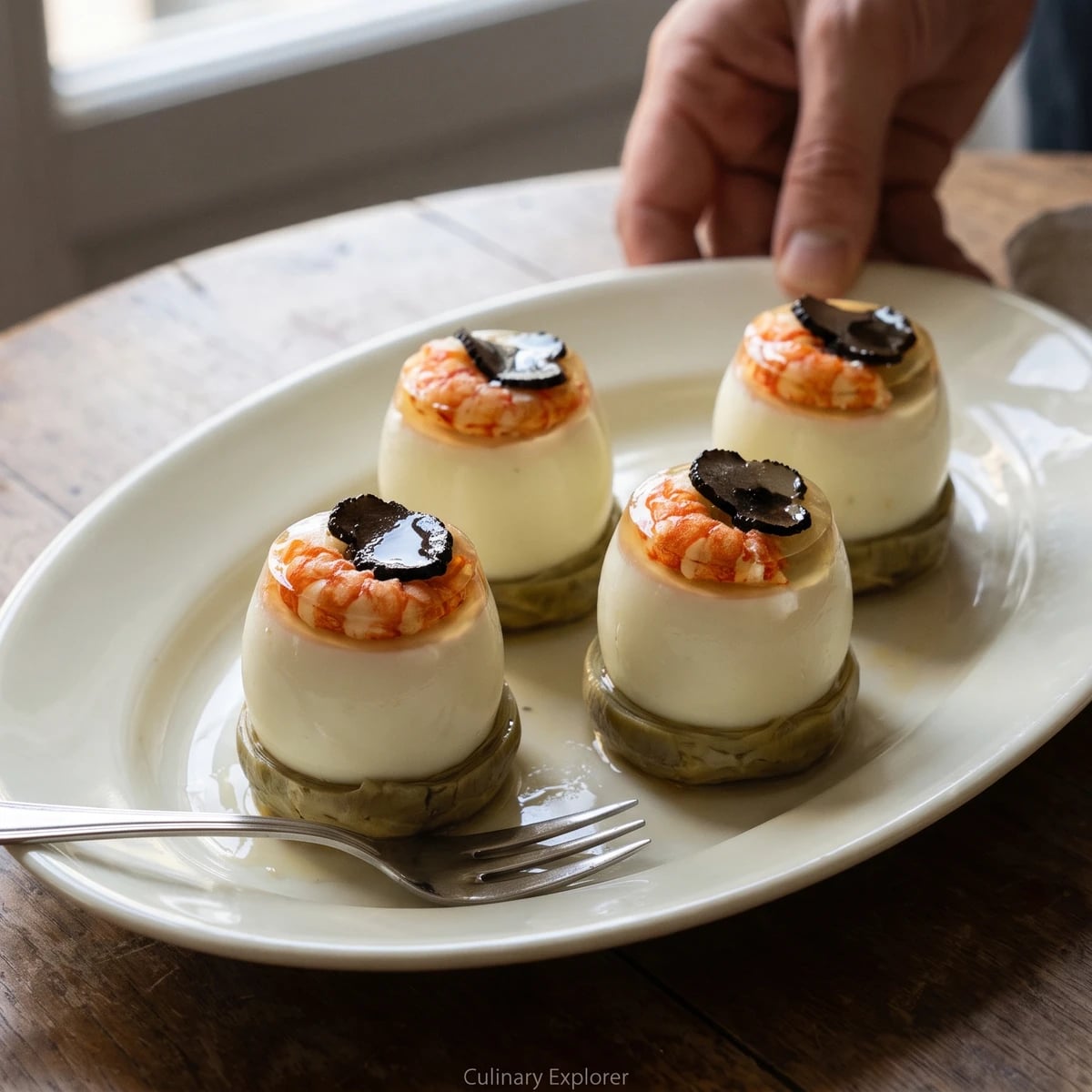
Based on No. 535, Cold Eggs à la Nantua, from Le Guide Culinaire (1907) by Auguste Escoffier
Barrel-cut eggs hold crayfish tails in a coral-bright coulis, crowned with truffle and aspic, then stand on artichoke bottoms: a precise cold hors d'œuvre made possible for one attentive home cook.
Œufs froids à la Nantua (cold eggs with crayfish) teaches one true lesson before you touch a pan: the tail is the garnish, but the body is the sauce. Twelve crayfish serve twice. Their tails fill and crown the eggs, while the bodies, shells, and coral are pounded with cream into the coulis that gives the dish its depth. Throw away the shells and Nantua disappears.
The original entry assumed a cold-pantry cook, thick mayonnaise and clear jelly already waiting, and a tammy through which someone had time to rub every last spoonful of crayfish. Here six eggs become four and eighteen crayfish become twelve, with every ratio kept. A cloth-lined fine sieve replaces the tammy, a half cup of clear stock set with gelatin replaces the standing pan of jelly, and a spoonful of thick mayonnaise replaces making a brigade batch for two teaspoons. Those preparations were scaffolding. The barrel shape, shell coulis, tail rosette, truffle, aspic glaze, and artichoke base are the dish, so all of them stay. One cook, one stove, one evening.
Cold is the discipline here. Every component must be thoroughly chilled before the mayonnaise binds the tails and before the aspic touches the eggs, or the filling loosens and the glaze slides away. Have everything cold before assembly. That is the step that decides the dish.
À la Nantua points to Nantua in Ain, northeast of Lyon, where lake and river crayfish became the defining flavor of the local table and of the sauce served with Lyonnais quenelles. In classical naming it signals a crayfish treatment, not proof that every dish bearing the name began in a Nantua household. These eggs belong to the formal cold hors d'œuvre repertoire, carrying that regional signature into a coral coulis, aspic glaze, and artichoke bottoms rather than the warm cream sauce many cooks expect.
Quantity
4
Quantity
12 (about 14 oz / 400 g total)
rinsed
Quantity
1 tablespoon (15 ml / 14 g)
Quantity
1/2 small (about 1 oz / 30 g)
finely diced
Quantity
1 small (about 1 oz / 25 g)
finely diced
Quantity
1 small clove
lightly crushed
Quantity
1 teaspoon (5 ml / 5 g)
Quantity
1 tablespoon (15 ml / 14 g)
Quantity
1/2 cup (120 ml / 120 g)
Quantity
3/4 cup (180 ml / 180 g)
divided
Quantity
1 small
Quantity
1/2 teaspoon (2.5 ml / 3 g)
divided
Quantity
1/8 teaspoon (0.6 ml / 0.3 g)
Quantity
2 tablespoons (30 ml / 30 g)
Quantity
2 teaspoons (10 ml / 10 g)
Quantity
1 teaspoon (5 ml / 3 g)
Quantity
1 tablespoon (15 ml / 15 g)
Quantity
4 (about 6 oz / 170 g drained)
drained and patted dry
Quantity
1 small (about 1/2 oz / 14 g)
drained
| Ingredient | Quantity |
|---|---|
| large eggs | 4 |
| whole raw crayfishrinsed | 12 (about 14 oz / 400 g total) |
| unsalted butter | 1 tablespoon (15 ml / 14 g) |
| carrotfinely diced | 1/2 small (about 1 oz / 30 g) |
| shallotfinely diced | 1 small (about 1 oz / 25 g) |
| garliclightly crushed | 1 small clove |
| tomato paste | 1 teaspoon (5 ml / 5 g) |
| Cognac | 1 tablespoon (15 ml / 14 g) |
| dry white wine | 1/2 cup (120 ml / 120 g) |
| clear unsalted fish stockdivided | 3/4 cup (180 ml / 180 g) |
| bouquet garni of parsley stems, thyme, and bay | 1 small |
| fine sea saltdivided | 1/2 teaspoon (2.5 ml / 3 g) |
| finely ground white pepper | 1/8 teaspoon (0.6 ml / 0.3 g) |
| heavy cream, at least 36 percent fat | 2 tablespoons (30 ml / 30 g) |
| thick mayonnaise, homemade or well made | 2 teaspoons (10 ml / 10 g) |
| unflavored powdered gelatin | 1 teaspoon (5 ml / 3 g) |
| cold water | 1 tablespoon (15 ml / 15 g) |
| cooked whole artichoke bottoms packed in waterdrained and patted dry | 4 (about 6 oz / 170 g drained) |
| preserved black truffledrained | 1 small (about 1/2 oz / 14 g) |
Bring a medium saucepan of water to a gentle boil. Lower in the eggs, hold the water at a steady simmer for 11 minutes, then transfer them directly to ice water until cold through. The whites must be completely firm or they will tear during shaping, but a violent boil makes them rubbery and knocks them against the pan. Refrigerate the unpeeled eggs while you cook the crayfish.
Melt the butter in a lidded saucepan over medium-low heat. Add the carrot and shallot and cook for 4 minutes without browning, then add the garlic and tomato paste and stir for 30 seconds. Add the crayfish, half the salt, and the white pepper; turn them through the aromatic butter until their shells begin to redden. Pull the pan from the heat before adding the Cognac, then return it to the stove and pour in the wine and 1/4 cup (60 ml / 60 g) of the fish stock. Add the bouquet garni, cover, and simmer for 6 to 8 minutes, turning the crayfish once, until the shells are bright red and the tail meat is opaque. Cool them in their liquor, then refrigerate until thoroughly cold. This wine, Cognac, tomato, and aromatic cooking is the crayfish preparation à la Bordelaise.
Sprinkle the gelatin over the cold water and leave it for 5 minutes to swell. Warm the remaining 1/2 cup (120 ml / 120 g) fish stock just until hot, then whisk in the softened gelatin until completely dissolved. Taste and add only as much of the remaining salt as the stock needs. Set the bowl over ice and stir until the aspic begins to feel lightly syrupy, then refrigerate it. If it becomes firm before glazing, stand the bowl briefly in lukewarm water and stir until it loosens; do not let it become warm.
Peel the cold eggs carefully. Cut a thin slice, about 1/8 inch (3 mm), from each narrow end so the eggs stand upright, then remove a slightly thicker slice, about 1/4 inch (6 mm), from each broad end to expose the yolk. Slip a narrow spoon between yolk and white and lift the yolk out in pieces, working only through the broad opening and leaving the base intact. You want four hollow white barrels with walls thick enough to hold the filling. Reserve the yolks for another dish, brush away loose crumbs, and return the barrels to the refrigerator.
Lift the cold crayfish from their liquor and reserve the liquor. Remove all 12 tails and pull out any dark intestinal threads. Set aside two whole tails for each egg, eight tails in all, and split each lengthwise to make 16 neat half-tail petals. Dice the remaining four tails finely and keep them cold. Break up the heads, bodies, claws, and tail shells, retaining any orange coral or soft shellfish matter but discarding the dark stomach sacs and feathery gills. Pound the remains very finely in a heavy mortar, adding the cream gradually, or pulse them cautiously in a sturdy mini processor. Press the mixture firmly through a fine sieve lined with two layers of damp cheesecloth. Whisk the smooth coral-colored extract with the mayonnaise. If it is too thick to spoon, loosen it with one teaspoon of the cold cooking liquor; if it seems loose, chill it for 15 minutes and use only enough to bind the tails.
Reserve 2 teaspoons (10 ml / 10 g) of the crayfish coulis for the artichoke bottoms. Fold the diced four tails with just enough of the remaining coulis, about 2 tablespoons (30 ml / 30 g), to bind them without drowning their texture. Spoon the mixture into the egg barrels, filling each cavity and building a small rounded dome above the rim. Cut 16 small lozenges from the truffle. Crown each dome with four half-tail petals and four truffle lozenges arranged alternately as a compact rosette. Chill the filled eggs for 15 minutes so the garnish fixes itself in place.
Set the cold eggs on a rack over a tray. Stir the aspic until it has the consistency of unbeaten egg white, then brush it over the crayfish rosettes and exposed egg whites in two or three thin coats, chilling for 5 minutes between coats. If the glaze slides off, the eggs are too warm or the aspic is too loose. Chill both for another 5 minutes and try again. Ça se rattrape. Spread 1/2 teaspoon of the reserved crayfish coulis inside each cold artichoke bottom, stand a glazed egg upon it, and arrange the four in a circle on a chilled platter. Refrigerate for at least 45 minutes, then let the platter stand for 10 minutes before serving so the coulis can show its full flavor. À table!
1 serving (about 165g)
Culinary guides, cultural storytelling, and the editorial depth that makes cooking meaningful.
Discover Culinary Explorer
Chef Juliette
Tiny éperlans, lightly floured and fried until their tails stand crisp, arrive in a generous heap on a napkin with fried parsley and grooved lemon, a weeknight lesson in heat and restraint.

Chef Juliette
Brandade de Morue turns salt cod, warm olive oil, and milk into a pale, silky emulsion: keep everything warm and add the oil slowly, then crown the generous dome with butter-fried bread.

Chef Juliette
Salt cod worked warm with cream, one patient spoonful at a time, until the rough flakes become a glossy Nîmes paste, domed generously and ringed with butter-fried croutons for the table.

Chef Juliette
Wine-poached char packed in its earthenware crock beneath butter gold: a make-ahead first course that turns careful cooling, thorough boning, and one unbroken seal into quiet abundance.