
Chef Juliette
Omelette à l’Écossaise
A creamy omelette aux fines herbes closes around smoked-salmon-wrapped herring milts, gently poached in butter. Have the filling ready, then roll the eggs while they still shine.
A cooking platform built around craft, culture, and the stories behind what we eat.
Created by Chef Juliette
Based on No. 511, Omelet à la Nantua, from Le Guide Culinaire (1907) by Auguste Escoffier
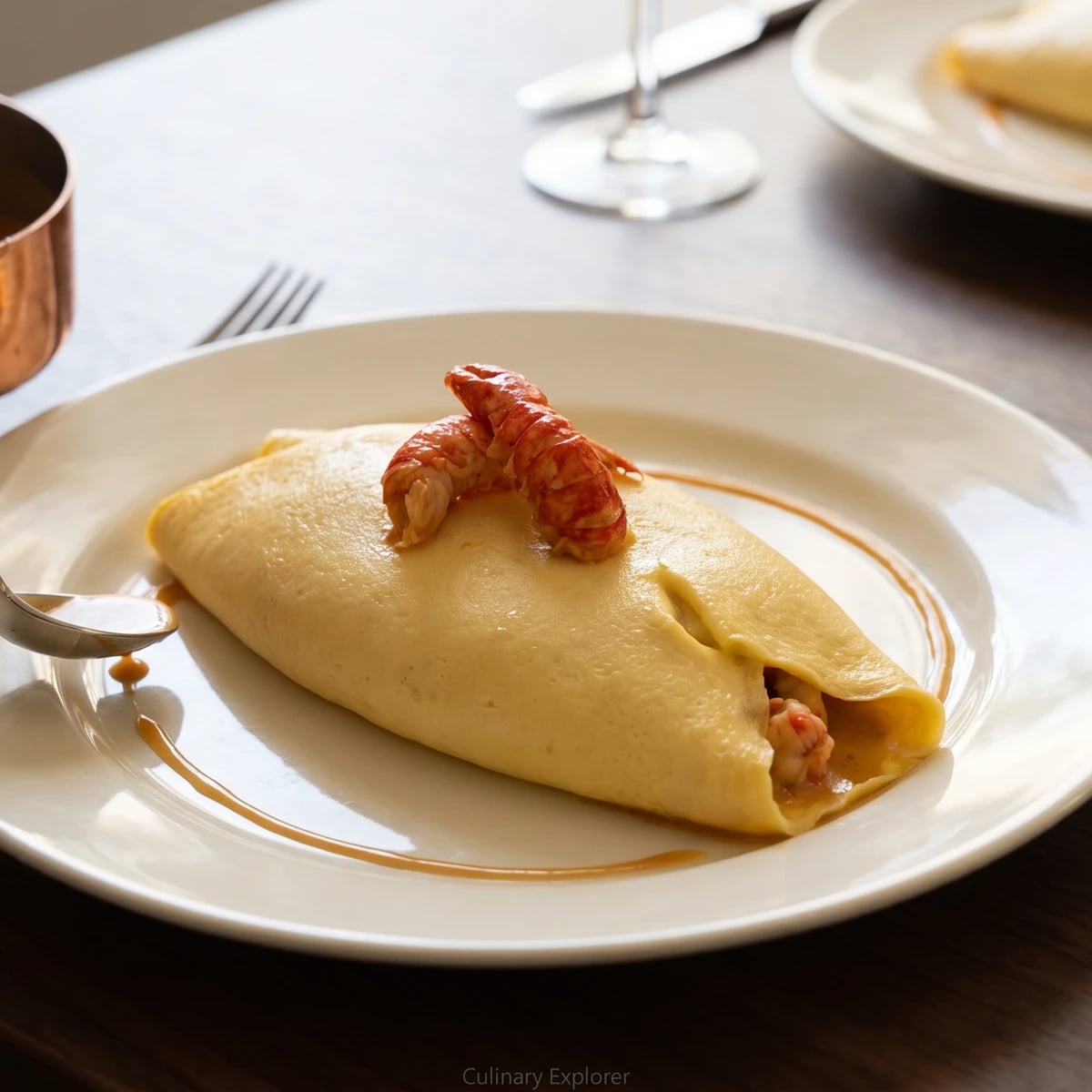
Crayfish country folded into a tender French omelet: six tails cut small and bound with coral-red Nantua sauce, two fine tails touching on top, and a glossy thread around the plate.
Omelet à la Nantua (a soft French omelet filled with crayfish in its coral-red sauce) teaches one uncompromising lesson: the filling must be ready before the eggs touch butter. A baveuse omelet, soft and barely set at the center, won't wait while you cut tails or search for a warm sauce spoon.
The original entry assumes a saucier beside the range, a stockpot never off the fire, and a salamander at the pass. At home, reach for prepared Nantua sauce, warm the plates gently, and cook four individual three-egg omelets one after another. Rebuilding the sauce during egg cookery and maintaining fierce holding heat are brigade scaffolding and can go. The book's proportions stay: six small tails per omelet, each cut into three and lightly bound with sauce, then two fine whole tails touching thick-end to thick-end on top and a thread of sauce around the rim.
That restraint matters. Too much sauce smothers the eggs, while cold filling arrests their tender set. Have every tail portioned and the sauce warm before the butter enters the pan. That is the step that decides the dish.
Nantua lies in Haut-Bugey, in the Ain northeast of Lyon, where the lake and surrounding waterways made freshwater crayfish the town's defining larder. Classical kitchens carried that local flavor into Nantua sauce, then used the sauce with quenelles, fish, and finely made egg dishes. The preparation is often called Lyonnais by association because Lyon embraced the sauce with quenelles, but the name and its crayfish identity belong to Nantua.
Quantity
12
Quantity
24 tails (about 6 oz / 170 g)
each cut into 3 pieces
Quantity
8 tails (about 2¼ oz / 65 g)
kept whole for the top
Quantity
½ cup (120 ml / about 125 g)
divided
Quantity
4 tablespoons (60 ml / 57 g)
divided
Quantity
¾ teaspoon (3.75 ml / 4.5 g)
Quantity
¼ teaspoon (1.25 ml / 0.5 g)
| Ingredient | Quantity |
|---|---|
| large eggs | 12 |
| small cooked, peeled crayfish tailseach cut into 3 pieces | 24 tails (about 6 oz / 170 g) |
| large, well-shaped cooked, peeled crayfish tailskept whole for the top | 8 tails (about 2¼ oz / 65 g) |
| prepared Nantua saucedivided | ½ cup (120 ml / about 125 g) |
| unsalted butterdivided | 4 tablespoons (60 ml / 57 g) |
| fine sea salt | ¾ teaspoon (3.75 ml / 4.5 g) |
| finely ground white pepper | ¼ teaspoon (1.25 ml / 0.5 g) |
Warm four dinner plates in a 200°F (95°C) oven for 5 minutes, then switch the oven off. The plates should feel gently warm, never hot enough to continue cooking the eggs. Divide the cut tails into four equal portions of six tails each, and keep the eight fine whole tails separate. Set the omelet pan, butter, beaten-egg bowl, spatula, sauce spoon, and plates within reach before proceeding.
Warm the prepared Nantua sauce over the lowest heat until it becomes fluid and glossy, without letting it boil. Add the eight whole tails for about 30 seconds, just long enough to warm them, then lift them onto a warm saucer and cover lightly. Reserve ¼ cup (60 ml / about 62 g) of the sauce for finishing. Fold the cut tails into the sauce remaining in the pan, warm them for 1 minute, and take the pan off the heat. If the sauce tightens, loosen it with 1 teaspoon (5 ml) hot water; if oily streaks appear, remove it from the heat and whisk in 1 teaspoon (5 ml) cold water until smooth. The sauce should cling lightly to the crayfish, not bury it.
Work one omelet at a time. Beat 3 eggs with one-quarter of the salt and white pepper until the whites and yolks are completely joined but not frothy. Air makes a puffy, dry omelet; this one should be close-grained, supple, and tender.
Heat the 8-inch (20 cm) omelet pan over medium-high heat. Add 1 tablespoon (15 ml / 14 g) butter and swirl as it foams. Before the butter colors, pour in the eggs. Stir rapidly with the spatula while shaking the pan for 10 to 15 seconds, drawing the setting egg toward the center, then stop stirring and smooth the curds into an even layer. The bottom should be set and pale while the surface remains glossy and baveuse. If the eggs seize into large dry curds, lift the pan from the heat at once and keep it moving; the gentler residual heat will finish the surface without hardening it further.
Spoon one-quarter of the sauced cut tails in a narrow band just below the center of the omelet. Fold the far third toward the middle, tilt the pan over a warm plate, and roll the omelet out so the final fold tucks underneath. Shape it gently into a plump oval with the spatula. If the tender surface tears, tuck the opening underneath and restore the oval with the spatula. Ça se rattrape, and the finished garnish will draw the eye where it belongs.
Wipe the pan clean and repeat with the remaining eggs, seasonings, butter, and filling. Work briskly, but don't hold the finished omelets under the broiler or return them to the oven; the warm plates are enough. Lay two whole crayfish tails over each omelet with their thicker ends touching, exactly as the entry directs. Spoon about 1 tablespoon (15 ml / 15 g) warm Nantua sauce in a fine thread around each omelet, keeping the tender golden surface visible. Serve at once. À table!
1 serving (about 240g)
Culinary guides, cultural storytelling, and the editorial depth that makes cooking meaningful.
Discover Culinary Explorer
Chef Juliette
A creamy omelette aux fines herbes closes around smoked-salmon-wrapped herring milts, gently poached in butter. Have the filling ready, then roll the eggs while they still shine.

Chef Juliette
Four tender herbs, hot butter, and two eggs per pan: this rolled omelette teaches the quick hand and good judgment that keep the outside pale and the center creamy.

Chef Juliette
Four batters, one lesson: let the flour drink deeply before cooking, then spread the batter thinly in butter for crêpes and pannequets that bend without becoming tough.

Chef Juliette
Crêpes au Couvent trap ripe Williams pear dice between two thin pours of sweet batter, then turn in one clean toss and reach the table butter-gold, powdered, and burning hot.