
Chef Juliette
Ordinary or White Consommé
Beef shin, lean beef, and fowl begin in cold water and rise slowly toward a tremble. Skim before the boil, and you learn the quiet discipline that gives every clear French broth its backbone.
A cooking platform built around craft, culture, and the stories behind what we eat.
Created by Chef Juliette
Based on No. 49, Ordinary Poivrade Sauce, from Le Guide Culinaire (1907) by Auguste Escoffier
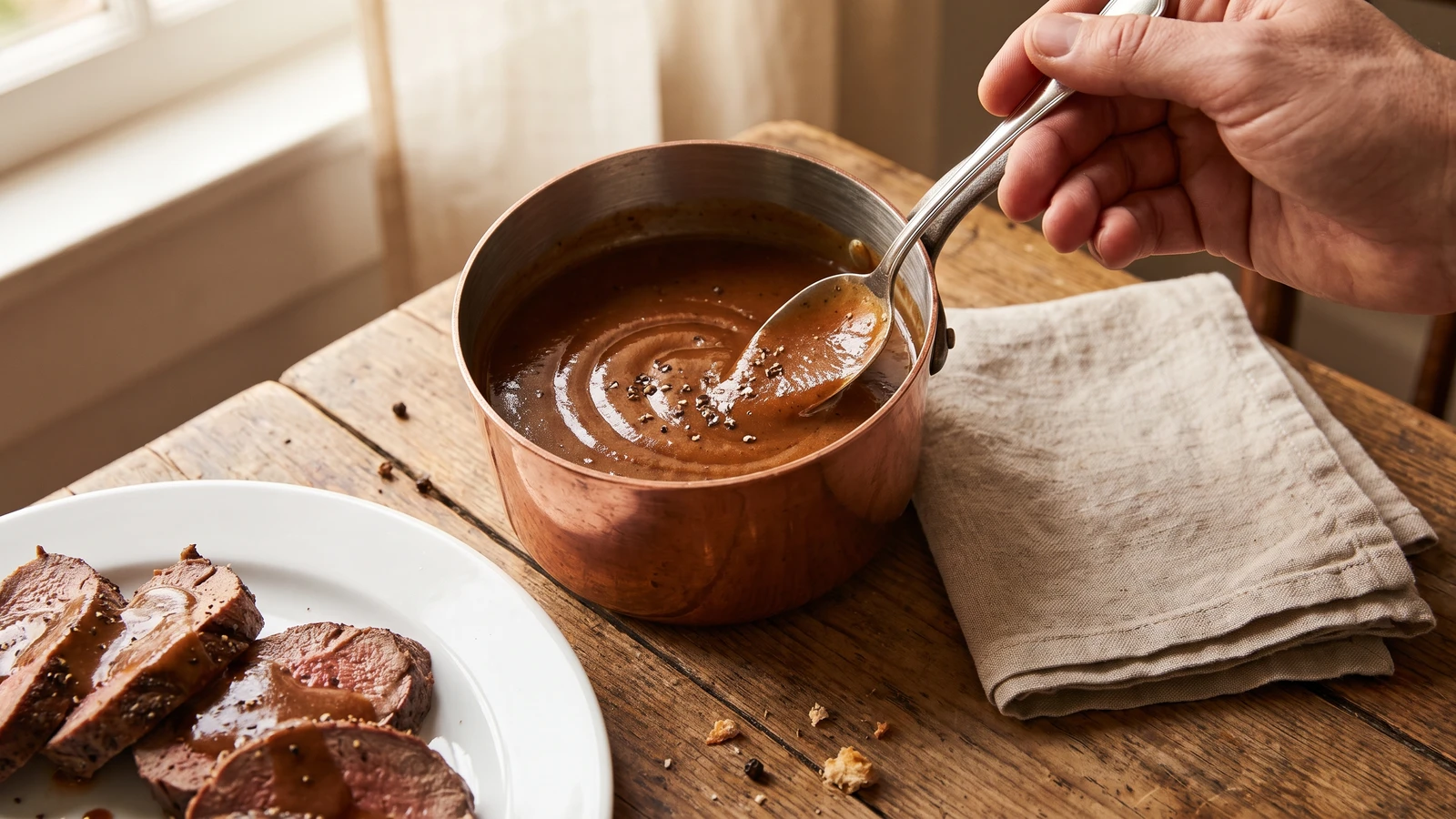
Browned mirepoix, sharp vinegar, deep Espagnole, and peppercorns added only at the end: poivrade for the game table, glossy with butter, lively without bitterness, and manageable in one home pot.
Sauce poivrade ordinaire (ordinary pepper sauce) teaches a clean lesson: pepper gives fragrance and bite only when it arrives late. Let crushed peppercorns simmer from the beginning and their warmth turns woody and bitter; add them for the final ten minutes and the sauce remains dark, bright, and alive. The one true thing to know before touching the pan is this: the clock on the pepper matters more than the quantity.
The original kitchen assumed a saucier at the pan, Espagnole fed by stock never off the fire, prepared Mirepoix (No. 228), Raw Marinade for Butcher’s Meat or Venison (No. 169), and a cloth tammy for the final polish. At home, a well-made Espagnole and those two finished components do the same work, while a fine-mesh sieve replaces the tammy. The service is recast around one six-quart saucepan yielding about two quarts. The standing stockpot and cloth filtration are brigade scaffolding; browning the mirepoix, reducing the acids, adding pepper late, and mounting with real butter are the dish, so they stay.
Brown the mirepoix until its diced edges are mahogany, not merely soft. That colour carries the sauce after the vinegar flashes and the Espagnole settles everything into a deep gloss. Keep the peppercorns beside the stove but out of the pan until the final ten minutes. That late addition decides the poivrade.
Sauce poivrade belongs to the French game table and the Parisian grand-kitchen repertoire, where pepper, vinegar, marinade, and brown sauce answered the richness of venison and roasted joints. It carried older pepper-and-vinegar accompaniments into the disciplined classical system through browned aromatics, Espagnole, reduction, and a final butter finish. Sauce grand veneur is its enriched derivative, not its synonym; ordinary poivrade contains neither cream nor redcurrant jelly.
Quantity
1 cup (240 ml / 225 g)
divided into two equal portions
Quantity
7 cups (1.65 L / 910 g) Mirepoix (No. 228)
Quantity
1 cup plus 3 tablespoons (285 ml / 285 g)
Quantity
4¾ cups (1.14 L / 1.14 kg) Raw Marinade for Butcher’s Meat or Venison (No. 169)
divided into two equal portions
Quantity
4¾ cups (1.14 L / 1.2 kg)
Quantity
2 teaspoons (10 ml / 5 g)
coarsely crushed just before use
| Ingredient | Quantity |
|---|---|
| unsalted butterdivided into two equal portions | 1 cup (240 ml / 225 g) |
| prepared Mirepoix | 7 cups (1.65 L / 910 g) Mirepoix (No. 228) |
| wine vinegar | 1 cup plus 3 tablespoons (285 ml / 285 g) |
| Raw Marinade for Butcher’s Meat or Venisondivided into two equal portions | 4¾ cups (1.14 L / 1.14 kg) Raw Marinade for Butcher’s Meat or Venison (No. 169) |
| prepared Espagnole Sauce | 4¾ cups (1.14 L / 1.2 kg) |
| black peppercornscoarsely crushed just before use | 2 teaspoons (10 ml / 5 g) |
Melt half the butter in a heavy six- to eight-quart saucepan over medium heat. When the foam subsides, add the Mirepoix (No. 228) and spread it across the pan. Cook for 25 to 30 minutes, stirring often enough to prevent burning but leaving it undisturbed long enough to take colour. Its moisture will first soften the vegetables, then evaporate; keep going until the pieces are richly mahogany and the pan floor wears a dark brown fond.
Pour in the wine vinegar and 2⅜ cups (570 ml) of the Raw Marinade for Butcher’s Meat or Venison (No. 169), scraping the pan floor until every brown deposit dissolves. Bring to a lively simmer and reduce the liquid to two-thirds of its starting volume, about 2⅜ cups (570 ml). The raw sting of vinegar should soften into a deep, appetizing sharpness. If the fond begins catching before it burns, draw the pan from the heat, loosen it with a ladleful of the measured liquid, and scrape firmly. Ça se rattrape. If any patch turns black and smells acrid, transfer the unburned mixture to a clean pan and leave that patch behind.
Stir in the prepared Espagnole Sauce and bring the poivrade to a bare simmer. Cook uncovered for 35 minutes, stirring across the bottom every few minutes and skimming away any foam or excess fat that gathers at the surface. Keep the movement gentle. A hard boil muddies the sauce and drives fat through it instead of letting that fat rise where you can remove it.
Crush the peppercorns coarsely only now, add them to the sauce, and simmer for exactly 10 minutes more. This timing is the principle of poivrade: the peppercorns have enough time to release their fragrance and clean heat, but not enough to turn the sauce bitter. Earlier is not deeper here; earlier is simply harsher.
Pass the sauce through a sturdy strainer into a clean saucepan. Press the mirepoix and other aromatics firmly with the back of a ladle until the pulp is nearly dry; the source intends that flavour to be extracted, not left in the sieve. Discard the spent solids.
Add the remaining 2⅜ cups (570 ml) Raw Marinade for Butcher’s Meat or Venison (No. 169) and return the sauce to a bare simmer. Dépouiller means to clarify through gentle simmering and careful skimming; do this for 15 minutes, removing foam and beads of oil as they collect. If the surface looks greasy, do not whisk that fat back into the sauce. Lower the heat and skim patiently until the gloss looks deep rather than oily.
Pass the sauce through a clean fine-mesh sieve without pressing, which gives the home cook the polish once supplied by a cloth tammy. Return it to the clean pan and check the consistency: it should coat the back of a spoon, then fall from it in a smooth sheet. Reduce briefly if it is thin; if it has tightened too far, whisk in hot water one tablespoon at a time. Remove the pan from the heat and hold back one cube from the remaining cold butter. Whisk in the rest piece by piece until the sauce gleams, then add the final cube. Never boil it after mounting. If oily streaks appear, whisk two tablespoons of warm sauce with that reserved cold butter in a clean pan, then feed the split sauce into it slowly. Ça se rattrape. Serve at once with roasted or braised joints, marinated or not. À table!
1 serving (about 60g)
Culinary guides, cultural storytelling, and the editorial depth that makes cooking meaningful.
Discover Culinary ExplorerChef Juliette
Beef shin, lean beef, and fowl begin in cold water and rise slowly toward a tremble. Skim before the boil, and you learn the quiet discipline that gives every clear French broth its backbone.

Chef Juliette
Break the veal bones small, then give them eight hours at a bare tremble. This pale, gelatinous fond becomes the quiet foundation beneath velouté, blanquette, and every sauce that must stay light.

Chef Juliette
Sauce Orientale concentrates lobster-rich American Sauce with curry, then folds in cream away from the fire: a glossy, gently spiced derivative made for lobster, crayfish, and firm fish.

Chef Juliette
An old lesson in sauce families: Sauce Allemande takes mushroom liquor, then butter, lemon, and parsley, becoming a glossy Poulette for sheep's trotters, leeks, cauliflower, and anything needing gentle richness with a bright edge.