
Chef Juliette
Omelette à l’Écossaise
A creamy omelette aux fines herbes closes around smoked-salmon-wrapped herring milts, gently poached in butter. Have the filling ready, then roll the eggs while they still shine.
A cooking platform built around craft, culture, and the stories behind what we eat.
Created by Chef Juliette
Based on No. 409, Eggs à la Portugaise, from Le Guide Culinaire (1907) by Auguste Escoffier
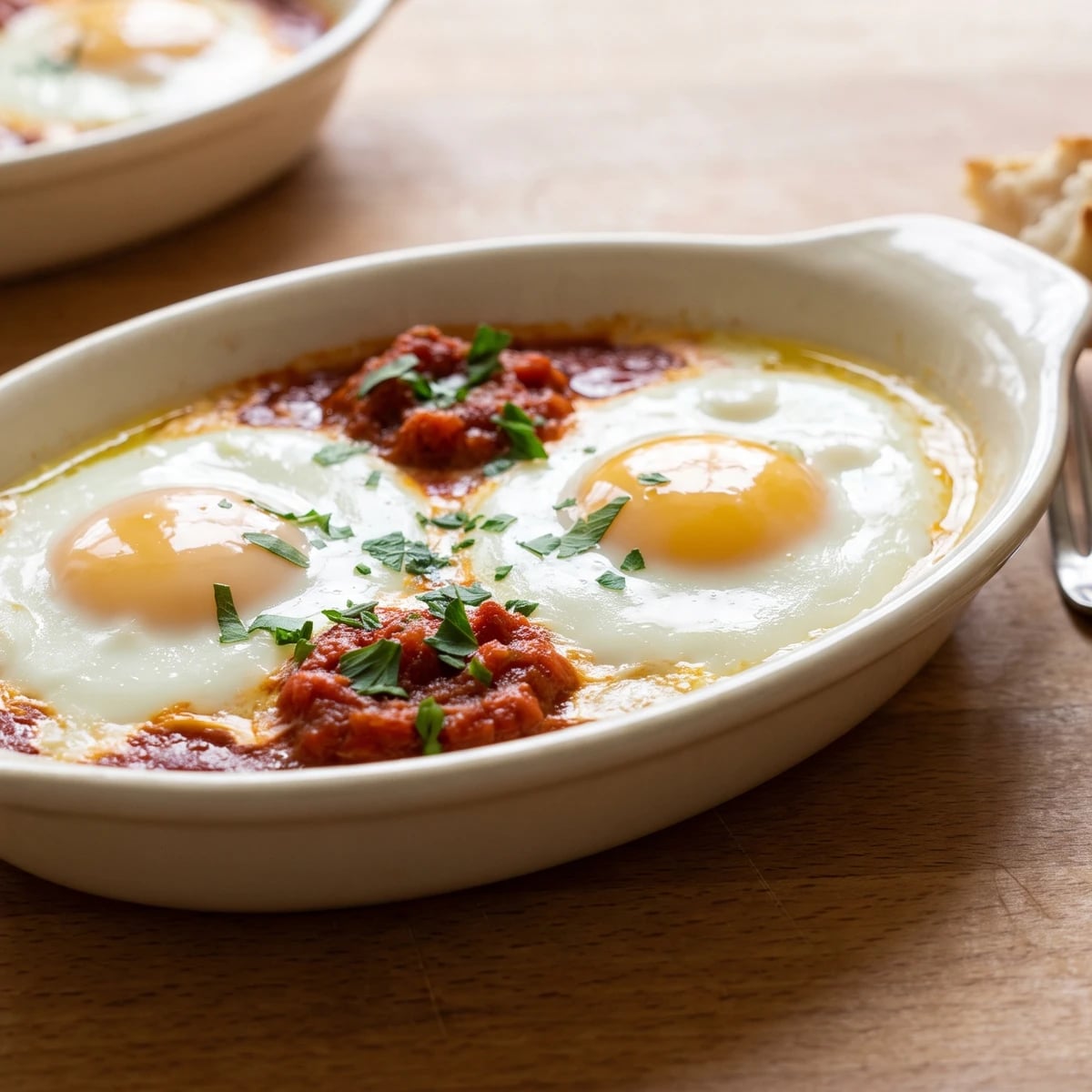
Œufs à la portugaise sets tender baked eggs over deep-red tomato fondue, then repeats the fondue in parsley-topped heaps: a brisk lesson in reduction, gentle baking, and classical clarity.
Œufs à la portugaise (eggs baked over tomato fondue) teaches one true thing: the tomato must be thick enough to stand in a little heap before an egg goes anywhere near it. Fondue here means tomatoes reduced to a concentrated pulp, not cheese. Leave it watery and the whites swim; reduce it properly and the eggs settle over a deep-red foundation that tastes far larger than its short ingredient list.
The service kitchen behind this entry assumed a saucier with tomato fondue held ready, individual egg dishes, and a salamander, a fierce overhead broiler, that set the whites in minutes. At home, one small saucepan, four shallow dishes, and a hot conventional oven do the work. Preparing the fondue ahead was brigade scaffolding, but its concentration and the three final heaps are the dish, so those stay exactly where the source puts them. One cook, one stove, one evening.
The finished eggs should have tender white, loose golden yolks, and three bright spoonfuls of tomato, one between the eggs and one at each end, each marked with parsley. Reduce the fondue until a spoon leaves a clean path across the saucepan and a teaspoonful holds its shape. That is the step that decides everything.
Œufs à la portugaise belongs to the Parisian classical kitchen, where à la portugaise signaled a tomato-based garnish rather than claiming the plate came intact from a Portuguese breakfast table. In the egg repertoire, the name traveled from grand-kitchen service into household manuals as a compact formula: eggs cooked on tomato fondue, then marked again with tomato and parsley. That repeated fondue is not decoration; it reflects the classical habit of making a garnish identify its dish at first glance.
Quantity
1 cup (240 ml / 240 g)
crushed
Quantity
1½ tablespoons (22 ml / 21 g)
divided
Quantity
¾ teaspoon (3.75 ml / 4.5 g)
divided
Quantity
⅛ teaspoon (0.6 ml / 0.3 g)
Quantity
8
Quantity
1 tablespoon (15 ml / 4 g)
finely chopped
| Ingredient | Quantity |
|---|---|
| drained canned whole peeled tomatoescrushed | 1 cup (240 ml / 240 g) |
| unsalted butterdivided | 1½ tablespoons (22 ml / 21 g) |
| fine sea saltdivided | ¾ teaspoon (3.75 ml / 4.5 g) |
| freshly ground white pepper | ⅛ teaspoon (0.6 ml / 0.3 g) |
| large eggs | 8 |
| flat-leaf parsleyfinely chopped | 1 tablespoon (15 ml / 4 g) |
Melt 1 tablespoon of the butter in a small heavy saucepan over medium-low heat. Add the crushed tomatoes and ¼ teaspoon of the salt, then cook uncovered for 12 to 15 minutes, stirring often, until reduced to ½ cup (120 ml / about 130 g). The fondue is ready when a spoon drawn across the pan leaves a clean path and a teaspoonful stands in a soft heap. If liquid still runs around the pulp after fifteen minutes, raise the heat one notch and stir constantly until it disappears. If the bottom catches, don't scrape it up; lift the clean fondue into another pan and continue gently. Ça se rattrape.
Heat the oven to 375°F (190°C) with a rack just above the center. Set four shallow individual gratin dishes on a rimmed baking sheet and brush them with the remaining butter. Spoon 1 tablespoon of tomato fondue into each dish and spread it into a small bed. Reserve the remaining fondue, covered, for the final heaps.
Crack each egg first into a small cup, then slip two eggs side by side over the fondue in each dish. This catches shell and lets you replace a broken yolk before it reaches the serving dish. Season the whites evenly with the remaining salt and the white pepper, keeping the yolks clean and golden.
Bake for 8 to 11 minutes, rotating the sheet once, until the whites are opaque at the edges and just set around the yolks while the yolks remain glossy and loose. If a thin clear veil of white remains on top, cover the dishes loosely with foil and return them to the oven for 1 minute. Enclosed heat will finish the white gently. Pull the eggs before the yolks look fully cooked, since the hot dishes continue the cooking at the table.
Rewarm the reserved tomato fondue briefly if necessary. On each dish, place three little heaps of fondue exactly as the source directs: one between the eggs and one at each end. Drop a pinch of chopped parsley onto every heap. Serve immediately in the dishes, while the whites are tender and the yolks still run into the tomato. À table!
1 serving (about 145g)
Culinary guides, cultural storytelling, and the editorial depth that makes cooking meaningful.
Discover Culinary Explorer
Chef Juliette
A creamy omelette aux fines herbes closes around smoked-salmon-wrapped herring milts, gently poached in butter. Have the filling ready, then roll the eggs while they still shine.

Chef Juliette
Four tender herbs, hot butter, and two eggs per pan: this rolled omelette teaches the quick hand and good judgment that keep the outside pale and the center creamy.

Chef Juliette
Four batters, one lesson: let the flour drink deeply before cooking, then spread the batter thinly in butter for crêpes and pannequets that bend without becoming tough.

Chef Juliette
Crêpes au Couvent trap ripe Williams pear dice between two thin pours of sweet batter, then turn in one clean toss and reach the table butter-gold, powdered, and burning hot.