Culinary Explorer
A cooking platform built around craft, culture, and the stories behind what we eat.
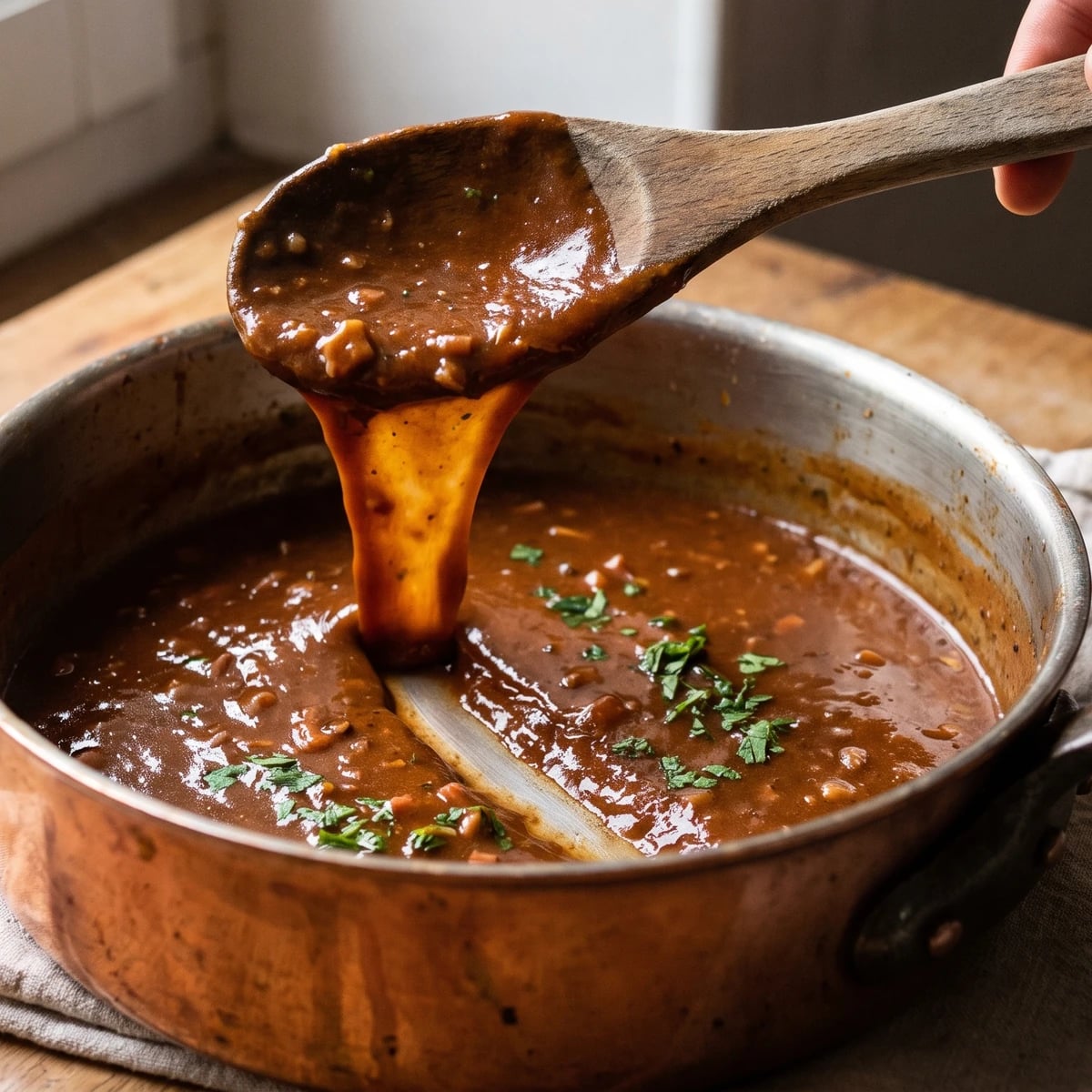
Italian Sauce
Created by Chef Juliette
Sauce italienne proves a derivative sauce lives or dies by its foundations: dry duxelles, lean ham, and tomatoed demi-glace boiled together, then brightened with three herbs at the very last moment.
Sauce italienne (French tomatoed demi-glace with duxelles and ham) teaches the discipline of the derivative sauce. Its one true principle is simple: every flavor must sharpen the glaze, never cloud it. The duxelle must be dry, the cooked ham very lean and cut brunoise-fashion into tiny dice, and the herbs held until the final moment.
The original formula assumed a saucier with Ordinary or Dry Duxelle (No. 223) already prepared and a tomatoed half-glaze never far from the fire. At home, those foundations remain separate preparations, made ahead and brought together in one heavy saucepan. That brigade organization is scaffolding and can go. The ten-minute boil and last-second herb finish are the dish, so they stay exactly where the source puts them.
The source gives a compact service formula. This version multiplies its proportions fourfold to produce the requested home sauce yield of about two quarts, enough to portion and freeze, without changing the ratio or sequence. One cook, one stove, one evening. Keep the sauce moving during its ten-minute boil, because a concentrated glaze can catch quickly; if it does, ça se rattrape, and the rescue is waiting in the method.
Ingredients
Ordinary or Dry Duxelle (No. 223)
Quantity
1½ cups (360 ml / 320 g)
finished and well drained
very lean cooked ham
Quantity
1½ cups (360 ml / 225 g)
cut brunoise-fashion into very small dice
half-glaze tomatée
Quantity
8 cups (1.9 L / 2 kg)
| Ingredient | Quantity |
|---|---|
| Ordinary or Dry Duxelle (No. 223)finished and well drained | 1½ cups (360 ml / 320 g) |
| very lean cooked hamcut brunoise-fashion into very small dice | 1½ cups (360 ml / 225 g) |
| half-glaze tomatée | 8 cups (1.9 L / 2 kg) |
Where cooking meets culture.
Culinary guides, cultural storytelling, and the editorial depth that makes cooking meaningful.
Discover Culinary Explorer