
Chef Juliette
Ordinary or White Consommé
Beef shin, lean beef, and fowl begin in cold water and rise slowly toward a tremble. Skim before the boil, and you learn the quiet discipline that gives every clear French broth its backbone.
A cooking platform built around craft, culture, and the stories behind what we eat.
Created by Chef Juliette
Based on No. 377, American Relishes, from Le Guide Culinaire (1907) by Auguste Escoffier
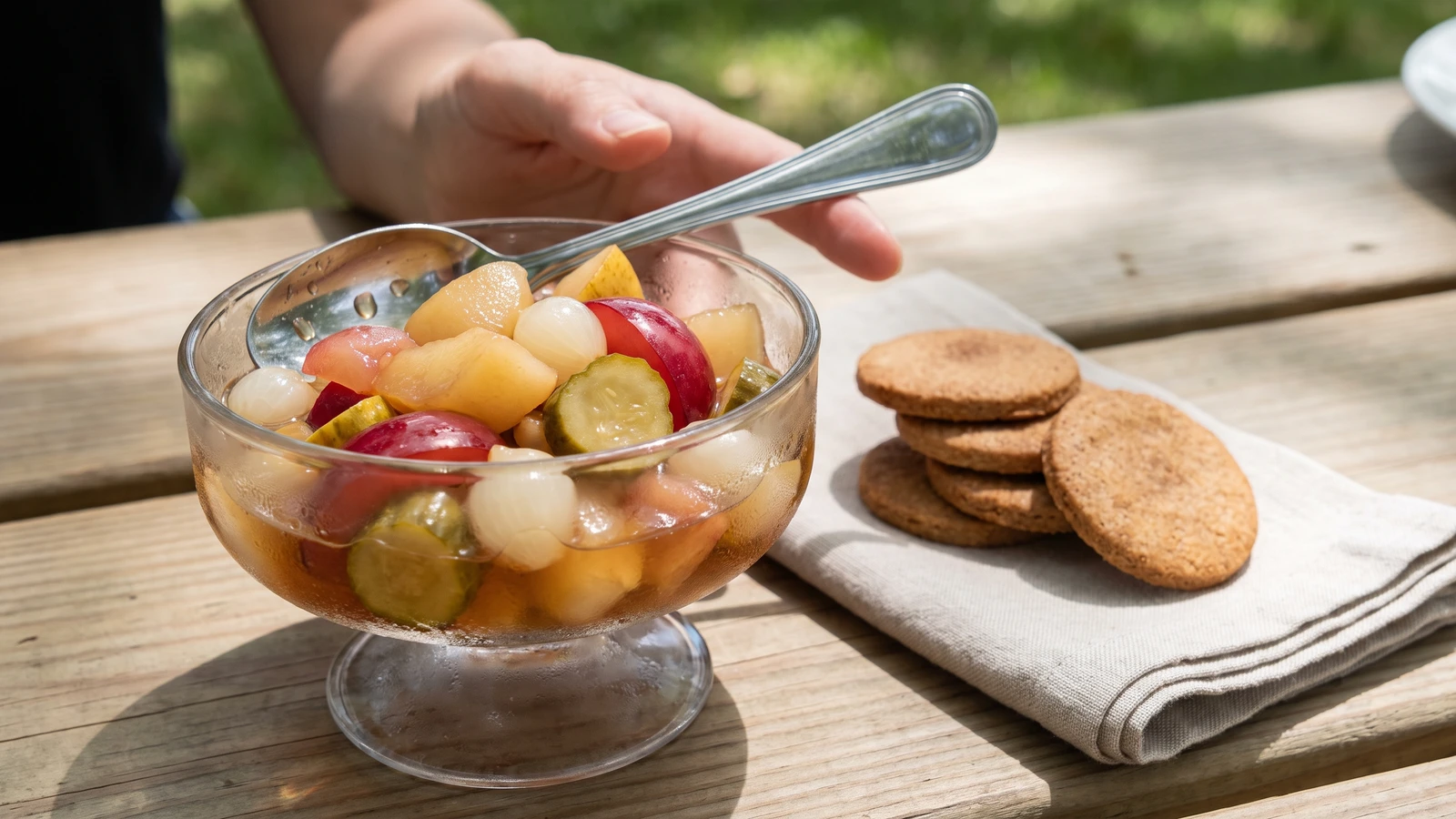
Relishes à l’Américaine balance firm fruit, pearl onions, and gherkins in cinnamon-scented sweet-sour vinegar, with cayenne at the finish. The lesson is timing: each piece must keep its own bite.
Relishes à l’Américaine (American sweet-sour preserves) teach the discipline of staggered cooking. The vinegar must be bold, but pear, apple, plum, onion, and gherkin must still taste and feel like themselves. Before you touch the pan, know this one thing: don't add them all at once. The syrup can be corrected; fruit cooked to softness cannot be made firm again.
The classical service could draw the relish and its special cinnamon biscuits from separate pantry work, then keep a replenished dish on the table throughout the meal. Your honest equivalent is one nonreactive pot, four refrigerator jars, and crisp cinnamon biscuits supplied separately. Here the batch is scaled to about two quarts and cooked in one pot. The separate brigade handling is scaffolding; vinegar, sugar, cinnamon, cayenne, and the careful order of cooking are the dish and must stay.
When it is right, clear amber liquid clings lightly to jewel-like pieces of fruit, the onions yield without collapsing, and the gherkins remain crisp under the teeth. Stagger the additions and stop while every piece still offers resistance. That is the step that decides the relish.
Relishes à l’Américaine belong not to Lyon, Normandy, or another French region, but to the classical French hors-d’œuvre table: the title records how that kitchen understood an American sweet pickle. Its entry explicitly compares the mixture of fruit, onions, gherkins, sugar, cinnamon, vinegar, and cayenne with Italian aceto-dolce. Unlike a small pickle removed after the opening course, this relish remained on the table throughout the meal and was accompanied by cinnamon biscuits.
Quantity
2 medium, about 1¼ cups (300 ml / 200 g) prepared
peeled, cored, and cut into ½-inch pieces
Quantity
1 large, about 1¼ cups (300 ml / 160 g) prepared
peeled, cored, and cut into ½-inch pieces
Quantity
3, about 1 cup (240 ml / 170 g) prepared
pitted and cut into ½-inch pieces
Quantity
20, about 1 cup (240 ml / 160 g)
peeled and left whole
Quantity
4 to 5, about 1½ cups (360 ml / 225 g)
cut into ¼-inch rounds
Quantity
3 cups (720 ml / 720 g)
divided
Quantity
1½ cups (360 ml / 300 g)
Quantity
3
Quantity
½ teaspoon (2.5 ml / 1 g)
Quantity
12 biscuits (about 150 g)
for serving
| Ingredient | Quantity |
|---|---|
| firm pearspeeled, cored, and cut into ½-inch pieces | 2 medium, about 1¼ cups (300 ml / 200 g) prepared |
| tart applepeeled, cored, and cut into ½-inch pieces | 1 large, about 1¼ cups (300 ml / 160 g) prepared |
| firm red plumspitted and cut into ½-inch pieces | 3, about 1 cup (240 ml / 170 g) prepared |
| small pearl onionspeeled and left whole | 20, about 1 cup (240 ml / 160 g) |
| fresh gherkins or small Kirby pickling cucumberscut into ¼-inch rounds | 4 to 5, about 1½ cups (360 ml / 225 g) |
| white wine vinegar with at least 5% aciditydivided | 3 cups (720 ml / 720 g) |
| granulated sugar | 1½ cups (360 ml / 300 g) |
| cinnamon sticks | 3 |
| ground cayenne | ½ teaspoon (2.5 ml / 1 g) |
| crisp cinnamon biscuitsfor serving | 12 biscuits (about 150 g) |
Wash four 1-pint jars and their lids in hot soapy water, rinse them well, and keep the jars warm. Blanch the pearl onions in simmering water for 3 minutes, drain them, trim the root ends, and slip off the skins. Dry the pot, then prepare the pears, apple, plums, and gherkins, keeping each kind separate so it can enter the vinegar at the proper moment.
Reserve ¼ cup (60 ml / 60 g) of the vinegar. Combine the remaining vinegar with the sugar, cinnamon sticks, and cayenne in a 5-quart nonreactive pot. Bring the aigre-doux, the sweet-sour preserving liquid, to a gentle boil, stirring until the sugar dissolves, then simmer for 5 minutes. It should smell rounded and spicy but remain loose, not sticky. If it begins coating the pot like candy, take it off the heat and stir in a spoonful of the reserved vinegar.
Add the blanched onions and simmer gently for 6 minutes. Add the pears and cook for 4 minutes, then add the apple and cook for 2 minutes. Finally add the plums and gherkins, return the liquid just to a simmer, and remove the pot from the heat. Begin each timing when the liquid returns to its gentle simmer. If the plum skins start slipping or the apple edges begin collapsing, lift those pieces out immediately and spread them on a plate while the firmer ingredients finish. Ça se rattrape. You cannot make softened fruit firm again, but you can stop it going further.
Using a slotted spoon, divide the fruit, onions, and gherkins evenly among the warm jars. Leave the cinnamon sticks in the pot and return the liquid to a lively simmer for 3 to 5 minutes, until it looks clear and lightly glossy but still pours freely. Stir in whatever remains of the reserved vinegar and simmer for 1 minute. Remove the cinnamon sticks, pour the hot liquid over the relish, and leave ½ inch (1 cm) of headspace. Release trapped bubbles with a clean knife, cap the jars, cool them on a towel for no more than 2 hours, and refrigerate. These are refrigerator relishes, not a shelf-stable preserve.
Chill the relish for at least 12 hours before serving so the cinnamon settles into the fruit and the cayenne reaches the finish rather than the first bite. Spoon a modest amount with its amber liquid into a clear serving bowl and accompany it with the crisp cinnamon biscuits. Replenish the bowl from the chilled jar as the meal goes on, returning leftovers to the refrigerator within 2 hours. À table!
1 serving (about 180g)
Culinary guides, cultural storytelling, and the editorial depth that makes cooking meaningful.
Discover Culinary ExplorerChef Juliette
Beef shin, lean beef, and fowl begin in cold water and rise slowly toward a tremble. Skim before the boil, and you learn the quiet discipline that gives every clear French broth its backbone.

Chef Juliette
Break the veal bones small, then give them eight hours at a bare tremble. This pale, gelatinous fond becomes the quiet foundation beneath velouté, blanquette, and every sauce that must stay light.

Chef Juliette
Sauce Orientale concentrates lobster-rich American Sauce with curry, then folds in cream away from the fire: a glossy, gently spiced derivative made for lobster, crayfish, and firm fish.

Chef Juliette
An old lesson in sauce families: Sauce Allemande takes mushroom liquor, then butter, lemon, and parsley, becoming a glossy Poulette for sheep's trotters, leeks, cauliflower, and anything needing gentle richness with a bright edge.