Culinary Explorer

A cooking platform built around craft, culture, and the stories behind what we eat.
Discover Culinary Explorer
Fennel à la Grecque

Fennel à la Grecque

Created by Chef Juliette

Based on No. 347, Fennel à la Grecque, from Le Guide Culinaire (1907) by Auguste Escoffier

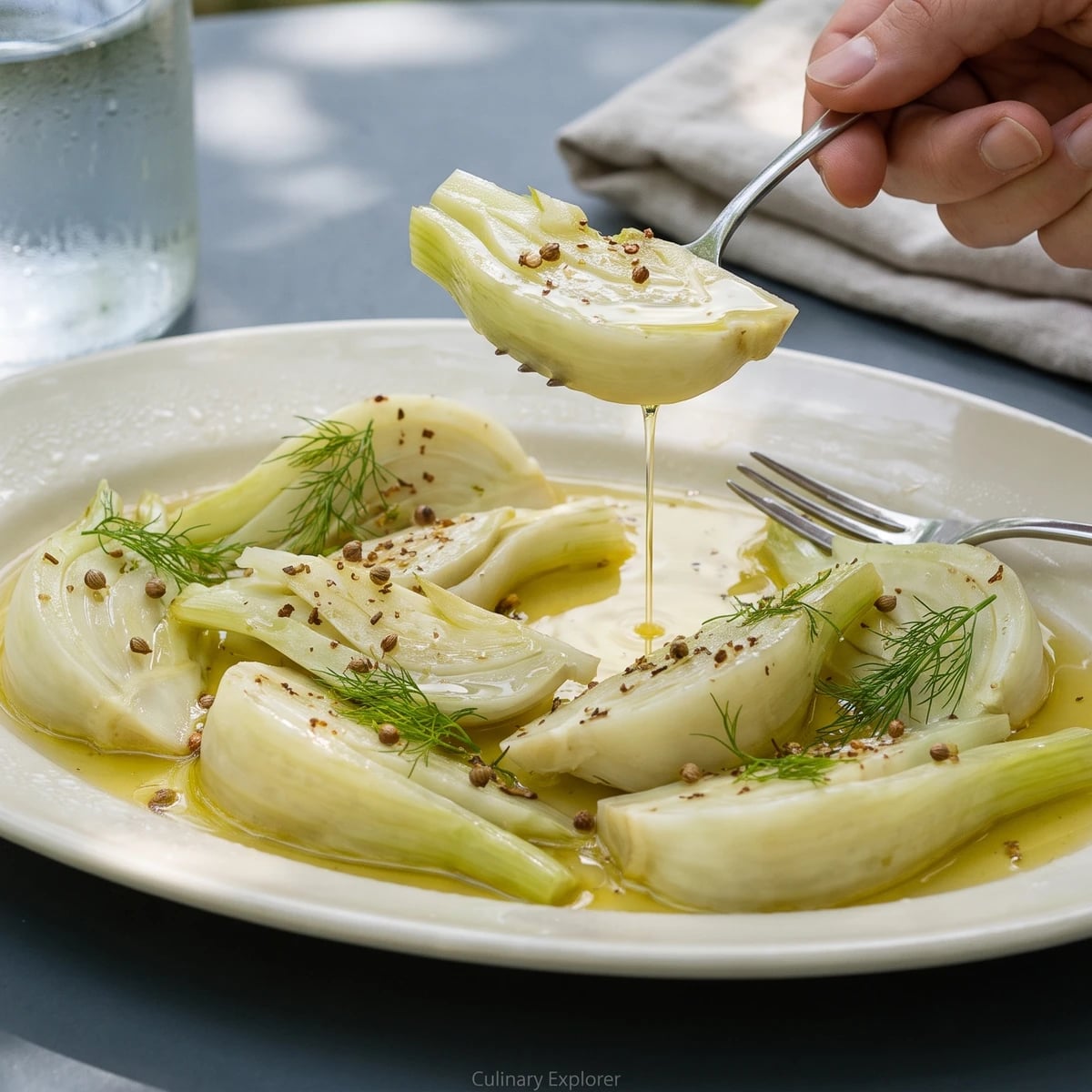
Cool fennel wedges glistening in lemon, olive oil, and crushed coriander, tender at the edges and firm at the heart. The lesson is simple: the cooking liquor becomes the marinade.

Salads
French
Make Ahead
Dinner Party
Picnic
20 min
Active Time
30 min cook3 hr 10 min total
Yield4 servings

Fenouil à la Grecque (fennel cooked and chilled in a lemon, olive oil, and coriander liquor) teaches one true thing: à la grecque is a cooking method before it is a dressing. The fennel must cool in the liquor that cooked it, while its warm layers are still taking in citrus, spice, and oil. Drain it and dress it later, and you have a pleasant fennel salad, but not this dish. The word carries the technique.

The original entry is a cross-reference: use the same process as for artichokes and celery à la Grecque. That assumes a brigade moving several vegetables through the kitchen, a saucier maintaining the liquor, and a service rondeau large enough for the quantities. At home, one wide lidded sauté pan does the rondeau's work, and one small batch of liquor is made fresh for four people. The shared batch and extra hands were scaffolding, so they go. The parboil, gentle second cooking, and cooling in the liquor stay, because they are the dish. One cook, one stove, one evening.

You are after fennel that bends under the fork but still holds a clean wedge, its sweetness sharpened by lemon and its aniseed character meeting the warm perfume of coriander. Parboil only until the outer layers begin to yield. If the fennel becomes fully tender before it reaches the liquor, the spice can perfume only the surface, so stopping at half-tender is the step that matters most.

Fenouil à la Grecque belongs to the Parisian classical hors-d'oeuvre repertoire, where artichokes, celery, mushrooms, and fennel were simmered in the same family of olive oil, lemon, and coriander cooking liquors, then presented cold. Despite the name, à la grecque is not a claim that the dish comes directly from a Greek household; it is the French kitchen's term for a Mediterranean-minded vegetable preparation sharpened with citrus and spice. It moved easily from the grand kitchen's hors-d'oeuvre tray to the bourgeois table because cooling the vegetable in its own liquor simplified service and deepened the flavor.

The technique, the tradition, and the story behind every dish.

Discover Culinary Explorer

Ingredients

small fennel bulbs

Quantity

4 (about 2 lb / 900 g total)

stalks removed, a few fronds reserved; bulbs quartered lengthwise with the cores intact

water, for parboiling

Quantity

8 cups (1.9 liters / 1.9 kg)

fine sea salt, for the parboiling water

Quantity

2 tablespoons (30 ml / 36 g)

water, for the cooking liquor

Quantity

1 cup plus up to 1/4 cup (240 to 300 ml / 240 to 300 g)

fruity olive oil

Quantity

1/2 cup (120 ml / 110 g)

fresh lemon juice

Quantity

1/3 cup (80 ml / 82 g)

from 2 to 3 large lemons

coriander seeds

Quantity

1 tablespoon (15 ml / 6 g)

lightly crushed

black peppercorns

Quantity

1 teaspoon (5 ml / 3 g)

lightly crushed

small bouquet garni

Quantity

1

made with 2 parsley stems, 1 thyme sprig, and 1 bay leaf

fine sea salt

Quantity

1 teaspoon (5 ml / 6 g), plus more to finish

Equipment Needed

  • 4-quart (3.8-liter) saucepan
  • 12-inch (30-cm) nonreactive sauté pan with a lid
  • Shallow 2-quart (1.9-liter) glass or ceramic dish
  • Colander and slotted spoon

Instructions

  1. 1

    Prepare the fennel

    Cut away the stalks and reserve a few tender fronds. Remove only bruised or stringy outer layers, then quarter each bulb lengthwise through its core. Trim the dark end of each core without cutting it away; that small piece holds the layered wedges together through two cookings. Rinse between the outer layers if there is any grit, then drain.

  2. 2

    Parboil to half-tender

    Bring the 8 cups (1.9 liters) water and 2 tablespoons (36 g) salt to a full boil in a large saucepan. Add the fennel, let the water return to the boil, and cook for 4 to 6 minutes. Test through the thick base with a small knife: the blade should enter the outer layers but meet clear resistance near the core. Drain without rinsing. If a wedge has already softened too far, lift all the fennel immediately and spread it out so the cooking stops, then shorten its second cooking to a two-minute turn in the liquor. Ça se rattrape, though the wedges will need gentle handling.

    Keep the cores intact. Loose fennel layers cook unevenly and become difficult to serve, while a quartered bulb stays composed on the platter.
  3. 3

    Make the liquor

    Combine 1 cup (240 ml) water, the olive oil, lemon juice, crushed coriander, crushed peppercorns, bouquet garni, and 1 teaspoon (6 g) salt in a wide nonreactive sauté pan. Bring the liquor to a bare simmer and let it murmur for 5 minutes, just long enough for the coriander and herbs to open. Beads of oil will remain visible. This liquor is not meant to be a stable emulsion, so separation is correct.

  4. 4

    Cook at a tremble

    Arrange the parboiled fennel in the liquor in one snug layer, cut sides down. Cover and hold at the gentlest simmer for 12 to 18 minutes, turning the wedges once, until a knife slips through the thick base with only slight resistance and every wedge still holds its shape. If the liquor drops too low before the fennel is tender, add the reserved hot water a tablespoon at a time, up to 1/4 cup (60 ml). If the fennel becomes tender while the liquor still tastes watery, lift the wedges out and reduce the liquor alone for 3 to 5 minutes, then pour it back over them. Never sacrifice the vegetable merely to finish the liquid.

  5. 5

    Cool in the liquor

    Discard the bouquet garni and transfer the fennel, coriander seeds, and every drop of liquor to a shallow glass or ceramic dish. Let the fierce heat subside for 15 minutes, then refrigerate the dish uncovered. Once cold, cover it and chill for at least 2 hours, turning the wedges after the first hour so both cut faces spend time in the marinade. Do not drain them. Cooling in this liquor is what makes the preparation à la grecque rather than fennel with dressing.

  6. 6

    Temper and serve

    Take the dish from the refrigerator 20 to 30 minutes before serving. Cold olive oil may look cloudy or slightly thickened; set the base of the dish in barely warm water for a minute and stir the liquor gently, and its pale-gold gloss will return without warming the fennel through. Taste the liquor, correct the salt if needed, and arrange the wedges loosely on a shallow platter. Spoon over enough marinade to pool around them, scatter the reserved fennel fronds, and leave the coriander seeds where they fall. Serve cool, not numbingly cold. À table!

Chef Tips

  • Choose small, tight fennel bulbs that feel heavy for their size, with pale, crisp layers and no cottony hollows at the base. Large old bulbs can be fibrous; if those are all the market offers, peel away the toughest outer layer and give the wedges another minute in the parboiling water.
  • Crack the coriander seeds with the side of a knife or one turn of a mortar. Powder muddies the liquor and gives up all its perfume at once; broken seeds release their spice gradually as the fennel cools.
  • Use stainless steel, enamel, glass, or ceramic wherever the lemon liquor sits. Bare aluminum or unlined copper can react with the acid, dulling the fennel's color and lending the marinade a metallic edge.
  • A dry Muscadet is very good beside the fennel because its brisk acidity meets the lemon without crowding the aniseed flavor. For a picnic, crusty bread and a firm goat cheese make this composed salad into lunch.

Advance Preparation

  • Make the dish 8 to 24 hours ahead when possible. The coriander becomes rounder and the fennel absorbs the lemon more evenly overnight; keep every wedge submerged or turn them once during storage.
  • The finished fennel keeps for up to 3 days, covered and refrigerated in its liquor. Its texture softens gradually, so the first and second days give the cleanest wedges.
  • For a picnic, transport the fennel cold in a tightly sealed container with its marinade and keep it against an ice pack. Let it lose the refrigerator chill for about 20 minutes before serving.

Frequently Asked Questions

Nutrition Information

1 serving (about 315g)

Calories
325 calories
Total Fat
28 g
Saturated Fat
4 g
Trans Fat
0 g
Unsaturated Fat
24 g
Cholesterol
0 mg
Sodium
1100 mg
Total Carbohydrates
19 g
Dietary Fiber
8 g
Sugars
9 g
Protein
3 g

Note: Chef personas and recipes are created with AI assistance. Cook with care: follow safe food-handling practices, check doneness with a thermometer when needed, and adapt for allergies and your kitchen.

Where cooking meets culture.

Culinary guides, cultural storytelling, and the editorial depth that makes cooking meaningful.

Discover Culinary Explorer

More from Hors-d’Œuvres

Browse the full collection