
Chef Juliette
Smelt (Éperlans)
Tiny éperlans, lightly floured and fried until their tails stand crisp, arrive in a generous heap on a napkin with fried parsley and grooved lemon, a weeknight lesson in heat and restraint.
A cooking platform built around craft, culture, and the stories behind what we eat.

Created by Chef Juliette
Based on No. 324, Lucile Toast, from Le Guide Culinaire (1907) by Auguste Escoffier
Toast Lucile turns five ingredients into a lesson in precision: crisp oval bread, ochre mustard butter, a ruby tongue border, white chicken at its heart, and black truffle set squarely in the centre.
Toast Lucile (oval toast with mustard butter, tongue, chicken, and truffle) teaches that arrangement can be part of flavour. Each bite moves from sharp mustard butter through salty cured tongue, mild chicken, and earthy truffle, but the contrasts work only when the three colours remain distinct. Chop finely, keep everything dry, and use a steady hand.
The original assumed a garde-manger with cooked tongue, white chicken meat, and truffle already waiting, plus enough hands to cut and dress a banquet tray of identical ovals. Your honest equivalent is eight oven-toasted pieces, a few slices of tongue from the delicatessen, and one cooked chicken breast. The brigade quantities and advance preparation are scaffolding, so they can go. The oval shape, mustard butter, red border, white centre, and black final pinch are the dish, and they stay exactly where the recipe puts them.
No saucier, stockpot, or salamander belongs here. The foundation is beurre de moutarde (mustard butter), spread over toast that has cooled completely. That cooling is the step that matters most: warm bread melts the butter, loosens the chopped garnishes, and blurs the clean geometry before the tray reaches the table.
Toast Lucile belongs to the Parisian repertoire of named canapés, small cold hors-d'oeuvre assembled for reception trays and formal dinners. Unlike a regional tartine, it is defined by geometry and colour: red tongue surrounding white chicken, with black truffle marking the centre. Such toasts also gave domestic cooks an elegant use for small remnants of cooked meats and costly truffle, each needed only by the spoonful.
Quantity
8 slices (about 8 oz / 225 g)
each at least 4 by 3 inches
Quantity
4 tablespoons (60 ml / 57 g)
softened
Quantity
1 tablespoon (15 ml / 15 g)
Quantity
1/2 cup (120 ml / 75 g)
chilled and finely chopped
Quantity
3/4 cup (180 ml / 105 g)
chilled and finely chopped
Quantity
2 teaspoons (10 ml / 6 g)
finely chopped
| Ingredient | Quantity |
|---|---|
| pain de mie (fine-crumb white sandwich bread)each at least 4 by 3 inches | 8 slices (about 8 oz / 225 g) |
| unsalted buttersoftened | 4 tablespoons (60 ml / 57 g) |
| smooth Dijon mustard | 1 tablespoon (15 ml / 15 g) |
| cooked cured red beef tonguechilled and finely chopped | 1/2 cup (120 ml / 75 g) |
| cooked skinless chicken breastchilled and finely chopped | 3/4 cup (180 ml / 105 g) |
| fresh black truffle or well-drained preserved black trufflefinely chopped | 2 teaspoons (10 ml / 6 g) |
Heat the oven to 350°F (175°C). Cut one neat oval, about 3 1/2 by 2 1/4 inches, from each bread slice with an oval cutter or a paper template and a small sharp knife. Set the ovals on a baking sheet and toast for 8 to 10 minutes, turning once, until dry, crisp, and pale gold rather than deeply browned. Transfer them to a rack and let them cool completely.
Beat the softened butter and Dijon together until the beurre de moutarde is smooth, creamy, and evenly ochre. If it turns shiny and greasy, the butter is too warm; chill it for 5 minutes, then beat again until it holds soft ridges.
Keep the tongue, chicken, and truffle in separate bowls. Chop each by hand into fine, distinct pieces, about 1/8 inch, without working the meat into paste. Blot the tongue and chicken before assembly because moisture loosens the butter and makes the coloured fields run together. If either looks damp after chopping, spread it over a clean towel for 5 minutes. Ça se rattrape.
Spread each cooled toast with an even layer of beurre de moutarde, reaching cleanly to the edge. Use about 1 1/2 teaspoons per toast. If the toast is still warm enough to melt the butter, stop and cool it longer; if one has already melted, chill that toast briefly and spread it again.
Form a narrow, continuous border of chopped red tongue around each oval, using the mustard butter to hold it in place. Fill the open middle with white chicken, keeping the layer level and the tongue border visible. Drop a compact pinch of chopped truffle precisely in the centre, then use the tip of a small knife to tidy any wandering pieces. Press only enough to secure the garnish, not enough to flatten it into paste.
Arrange the Toasts Lucile on a platter with enough room for their oval outlines to show. Serve promptly, while the bread is crisp and the beurre de moutarde is soft enough to release its flavour. Cooking well is not cooking fancy. Here, it is simply cutting cleanly and stopping when the three colours are in place. À table!
1 serving (about 115g)
Culinary guides, cultural storytelling, and the editorial depth that makes cooking meaningful.
Discover Culinary ExplorerChef Juliette
Tiny éperlans, lightly floured and fried until their tails stand crisp, arrive in a generous heap on a napkin with fried parsley and grooved lemon, a weeknight lesson in heat and restraint.

Chef Juliette
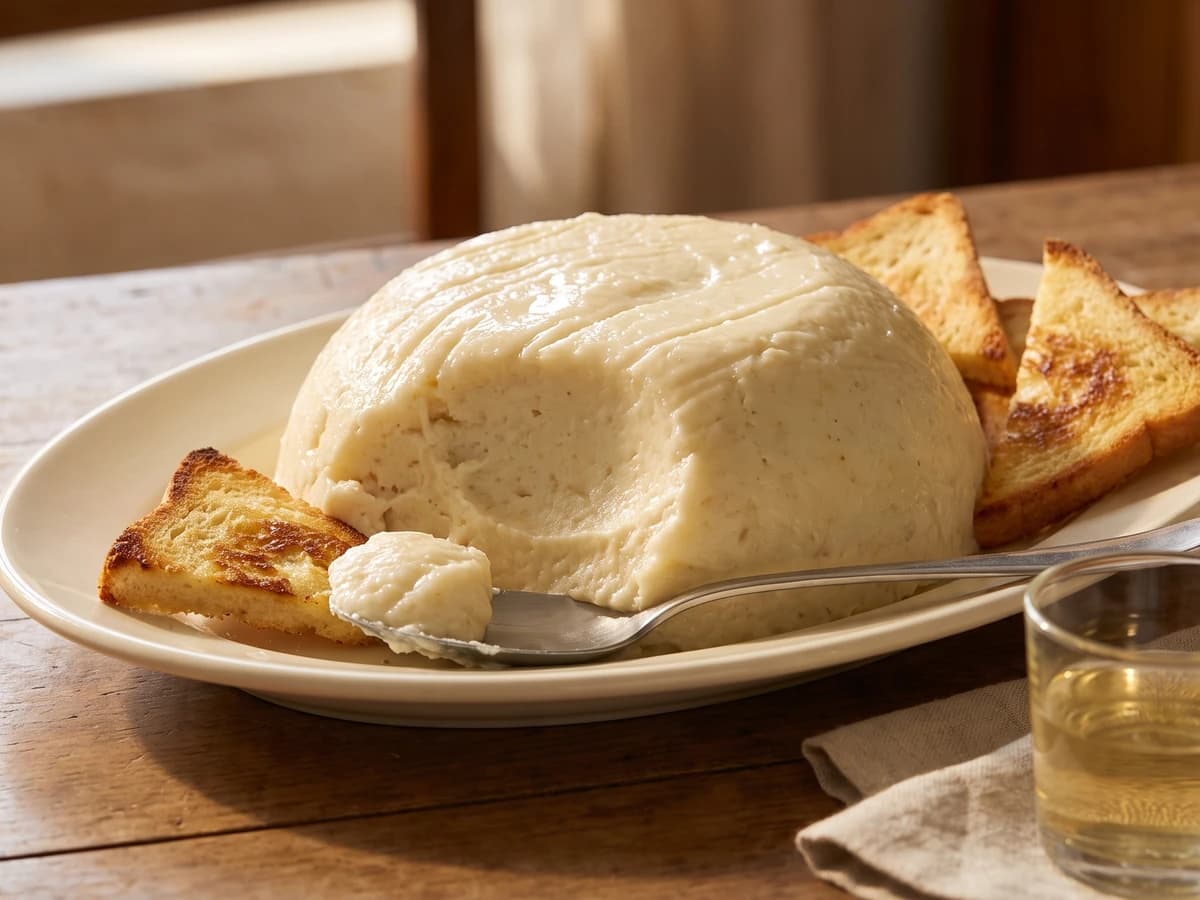
Brandade de Morue turns salt cod, warm olive oil, and milk into a pale, silky emulsion: keep everything warm and add the oil slowly, then crown the generous dome with butter-fried bread.
Chef Juliette
Salt cod worked warm with cream, one patient spoonful at a time, until the rough flakes become a glossy Nîmes paste, domed generously and ringed with butter-fried croutons for the table.

Chef Juliette
Wine-poached char packed in its earthenware crock beneath butter gold: a make-ahead first course that turns careful cooling, thorough boning, and one unbroken seal into quiet abundance.