
Chef Juliette
Smelt (Éperlans)
Tiny éperlans, lightly floured and fried until their tails stand crisp, arrive in a generous heap on a napkin with fried parsley and grooved lemon, a weeknight lesson in heat and restraint.
A cooking platform built around craft, culture, and the stories behind what we eat.
Created by Chef Juliette
Based on No. 320, City Toast, from Le Guide Culinaire (1907) by Auguste Escoffier
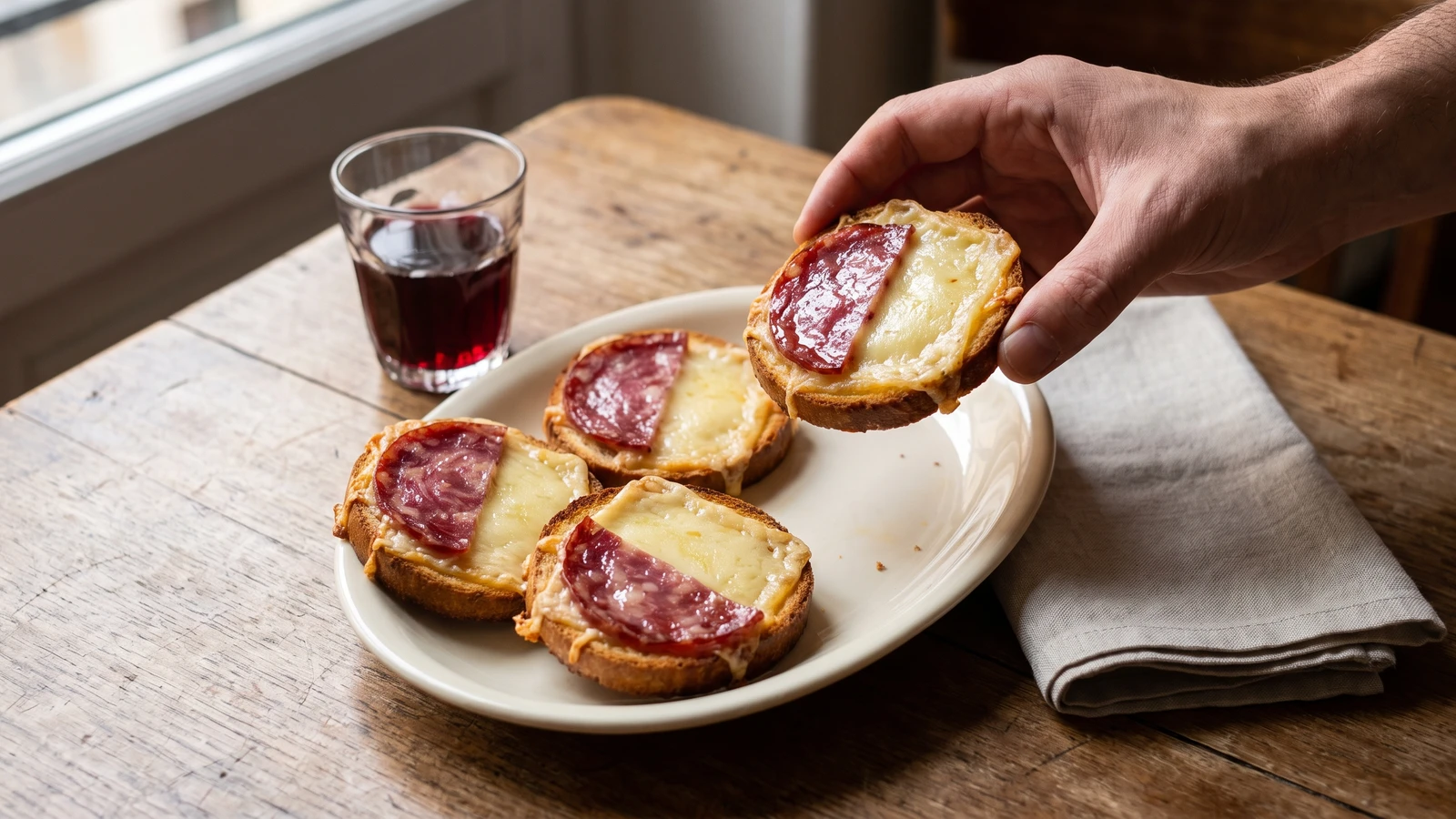
Toast de Ville makes geometry delicious: crisp bread, thick Gruyère-Parmesan butter, and equal halves of Lyon sausage and cheese, flashed under the broiler until the edges gleam.
Toast de Ville (City Toast) teaches that precision can be generous. The one true thing to know before you touch the pan is this: the sausage half-disc and the Gruyère half-disc must have the same diameter and thickness, so they close into one neat round over the toast. This isn't plating theater. It lets both toppings warm at the same pace while the cheese butter beneath bubbles into the bread.
The source assumed a brigade cutting identical pieces for service and a salamander fierce enough to finish them without slowly warming the bread. A round cutter and a thoroughly heated home broiler do the same work. The beurre composé (compound butter) formula is halved exactly for six toasts, keeping its 2:1:1 ratio of butter, Gruyère, and Parmesan by weight. The topping amounts follow the source's geometry because it specifies size rather than weight. Bulk cutting is scaffolding and can go; the thick coating and paired half-discs are the dish, and they stay. One cook, one stove, one evening.
The finished Toast de Ville should be crisp underneath, lush through the middle, and glossy on top, with the sausage occupying one half and softened Gruyère the other. Cut the paired half-discs before mixing the butter, and make them truly equal. That is the step that decides the dish.
Toast de Ville belongs to the cosmopolitan hot-canapé repertory of French dining rooms rather than to one rural province. Its precise regional note is saucisson de Lyon, a broad, firm sausage from Lyon's charcuterie table; Gruyère brings the Alpine cheese trade, while Parmesan shows how comfortably the classical pantry used imported hard cheese. Though often grouped beside crostini and bruschetta, its thick beurre composé, symmetrical topping, and salamander finish make it a French composed toast, not an Italian one.
Quantity
6 slices (about 5 oz / 140 g total)
cut about ⅜ inch (1 cm) thick
Quantity
¼ cup (60 ml / 57 g)
softened but still cool
Quantity
¼ cup loosely packed (60 ml / 28 g)
finely grated
Quantity
⅓ cup loosely packed (80 ml / 28 g)
finely grated
Quantity
1 teaspoon (5 ml / 5 g)
Quantity
⅟₁₆ teaspoon (0.3 ml / 0.4 g), or only as needed
Quantity
1 pinch, about ⅟₃₂ teaspoon (0.15 ml / 0.05 g)
Quantity
3 thin rounds (about 1 oz / 28 g total)
ready to eat; cut ⅛ inch (3 mm) thick, then halved
Quantity
3 thin rounds (about 1 oz / 28 g total)
cut to match the sausage rounds in diameter and thickness, then halved
| Ingredient | Quantity |
|---|---|
| firm pain de miecut about ⅜ inch (1 cm) thick | 6 slices (about 5 oz / 140 g total) |
| fresh unsalted buttersoftened but still cool | ¼ cup (60 ml / 57 g) |
| Gruyère for the beurre composéfinely grated | ¼ cup loosely packed (60 ml / 28 g) |
| Parmesanfinely grated | ⅓ cup loosely packed (80 ml / 28 g) |
| heavy cream | 1 teaspoon (5 ml / 5 g) |
| fine salt | ⅟₁₆ teaspoon (0.3 ml / 0.4 g), or only as needed |
| cayenne | 1 pinch, about ⅟₃₂ teaspoon (0.15 ml / 0.05 g) |
| saucisson de Lyon (Lyons sausage)ready to eat; cut ⅛ inch (3 mm) thick, then halved | 3 thin rounds (about 1 oz / 28 g total) |
| Gruyère for the toppingcut to match the sausage rounds in diameter and thickness, then halved | 3 thin rounds (about 1 oz / 28 g total) |
Set an oven rack about 5 inches (13 cm) below the broiler and preheat it for a full 10 minutes. Choose a round cutter that matches the diameter of the saucisson de Lyon, usually 2 to 2½ inches (5 to 6 cm), and cut six bread rounds. Stamp three rounds from the thin Gruyère sheets, then halve both the cheese and sausage rounds cleanly. Lay one sausage half beside one cheese half to check the fit: their straight edges should meet and their curved edges should form a complete circle. Equal thickness is part of the cooking, not decoration.
Arrange the bread rounds on an unlined, broiler-safe metal sheet. Broil for 45 to 75 seconds per side, watching continuously, until both faces are dry and pale gold but not deeply browned. They will meet the heat again. Transfer the rounds to a rack and cool them completely; warm toast melts the butter before the top has time to color.
Work the softened butter, grated Gruyère, and Parmesan together with a flexible spatula until evenly combined. Beat in the cream, cayenne, and salt, tasting before all the salt goes in because both cheeses carry their own. Spread one-sixth over each cooled toast in a thick, even layer reaching the edge, about 3⁄16 inch (5 mm) deep. If the mixture turns shiny or begins to slump, the butter is too warm. Don't add more cheese. Chill it for five minutes and work it again. Ça se rattrape.
Set one half-disc of saucisson and one half-disc of Gruyère over each coated toast. Bring their straight edges together at the center and align the curved edges with the bread beneath. Press only enough to seat them in the beurre composé; crushing the coating makes it leak. Refrigerate the assembled toasts uncovered for 10 minutes. This brief chill replaces the immediate, fierce finish a salamander once supplied.
Return the chilled toasts to the unlined metal sheet and place them under the fully heated broiler. Cook for 1½ to 3 minutes, rotating the sheet once, until the Gruyère half softens and takes a few bronze freckles, the saucisson gleams, and a narrow ring of beurre composé bubbles at the edge. Stay beside the oven. If the butter runs before the top colors, pull the sheet out immediately, nudge any clean pooled mixture back onto the toast, and chill the rounds for five minutes. Move the rack one notch closer, then finish them in short bursts. Ça se rattrape.
Let the Toasts de Ville settle for one minute, just long enough for the topping to hold without losing its gloss. Arrange them on a room-temperature platter and serve while the bread remains crisp and the cheese butter is still soft beneath its split crown. À table!
1 serving (about 50g)
Culinary guides, cultural storytelling, and the editorial depth that makes cooking meaningful.
Discover Culinary ExplorerChef Juliette
Tiny éperlans, lightly floured and fried until their tails stand crisp, arrive in a generous heap on a napkin with fried parsley and grooved lemon, a weeknight lesson in heat and restraint.

Chef Juliette
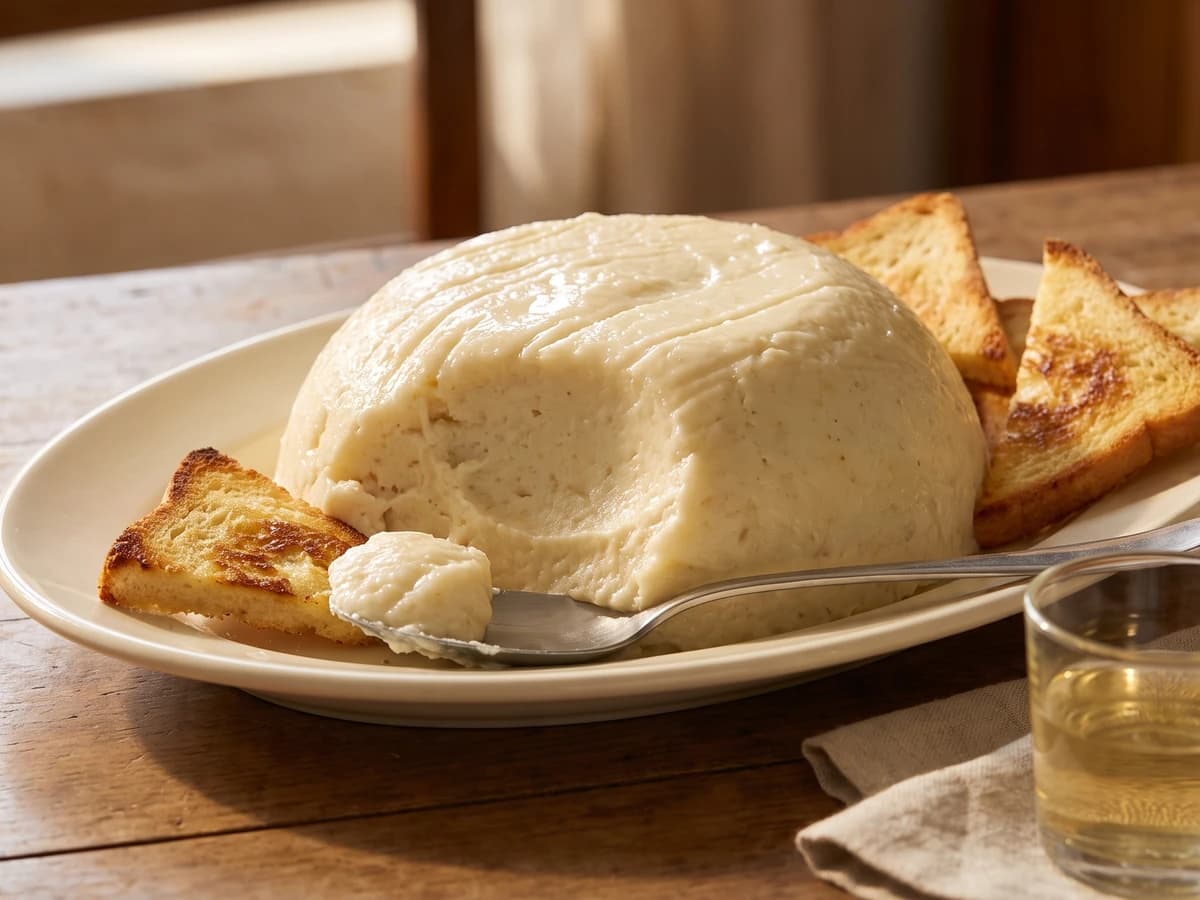
Brandade de Morue turns salt cod, warm olive oil, and milk into a pale, silky emulsion: keep everything warm and add the oil slowly, then crown the generous dome with butter-fried bread.
Chef Juliette
Salt cod worked warm with cream, one patient spoonful at a time, until the rough flakes become a glossy Nîmes paste, domed generously and ringed with butter-fried croutons for the table.

Chef Juliette
Wine-poached char packed in its earthenware crock beneath butter gold: a make-ahead first course that turns careful cooling, thorough boning, and one unbroken seal into quiet abundance.