
Chef Juliette
Smelt (Éperlans)
Tiny éperlans, lightly floured and fried until their tails stand crisp, arrive in a generous heap on a napkin with fried parsley and grooved lemon, a weeknight lesson in heat and restraint.
A cooking platform built around craft, culture, and the stories behind what we eat.
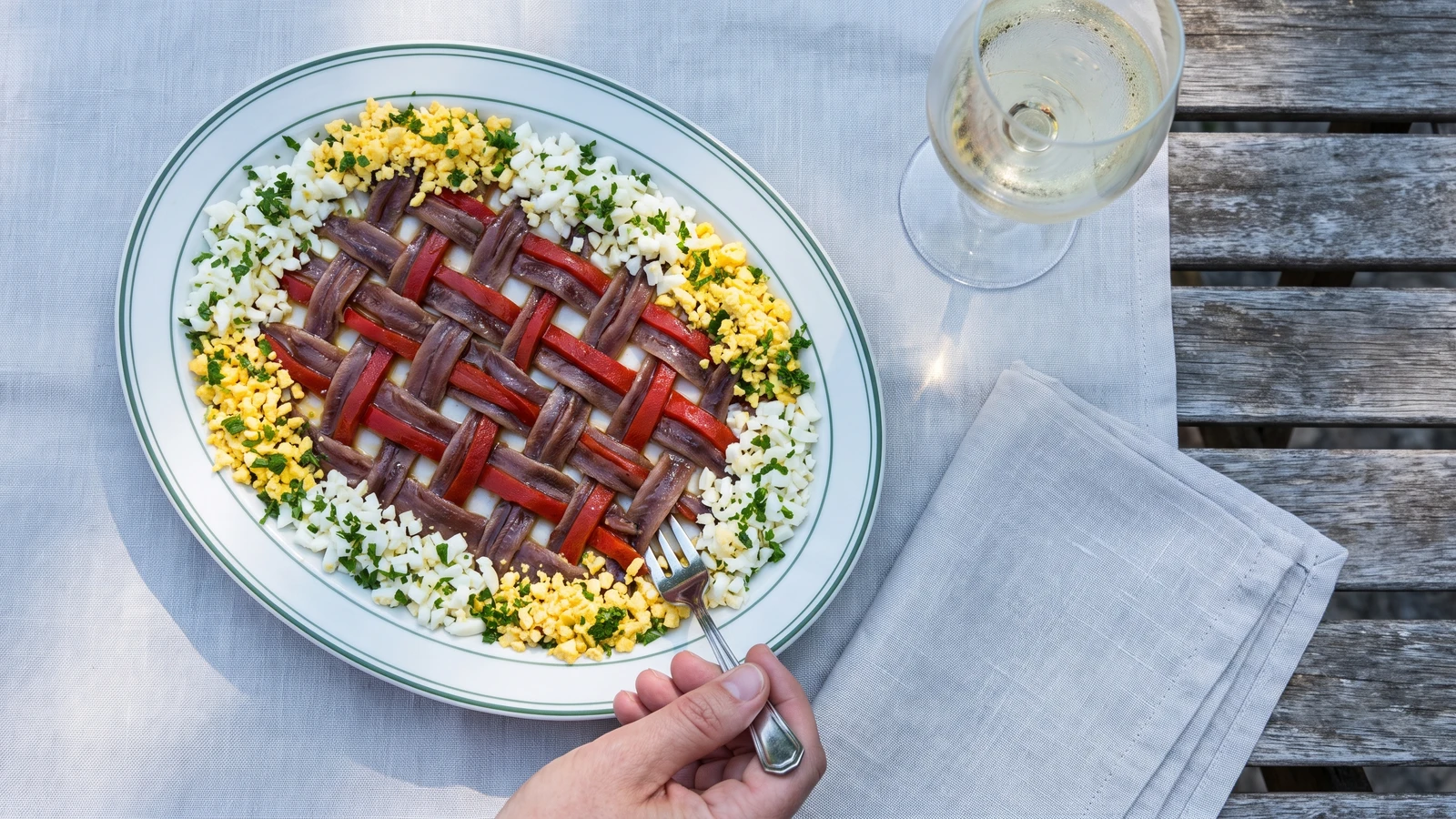
Created by Chef Juliette
Based on No. 306, Anchovy with Pimentos, from Le Guide Culinaire (1907) by Auguste Escoffier
Anchois aux piments turns four pantry ingredients into a precise cold hors d'oeuvre: salty brown fillets, sweet scarlet pepper, and three neat colors of egg and parsley around the lattice.
Anchois aux piments teaches the discipline of the garde-manger, the cold kitchen: precision must supply what heat cannot. Salty mahogany fillets and sweet red pepper should remain two clear flavors and two clean colors, while egg and parsley frame the lattice rather than bury it. Cooking well is not cooking fancy.
The original entry assumed a pantry cook with oil-prepared anchovies, peeled pimento fillets, hard-cooked eggs, and enough hands to repeat the pattern across a full service. Your honest home equivalent is one jar each of oil-packed anchovies and whole roasted pimentos, one egg, and one small platter. I have reduced the quantity to four appetizer servings because the old repeated platter work is brigade scaffolding and can go; the equal anchovy-to-pimento pattern, the lattice, and the three separate garnishes are the dish and must stay. One cook, one stove, one evening.
Before the egg pan goes on, know this: blot the anchovies and pimentos thoroughly. Surface moisture makes the lattice slide and lets scarlet pepper juice stain the egg; once the components are dry, the assembly becomes calm and exact. That blotting is the one step that decides the plate.
Anchois aux piments belongs to the classical Parisian cold hors-d'oeuvre table, where preserved fish, peppers, eggs, and herbs were arranged in small geometric dishes before the main meal. Its pantry ingredients carried it easily from the hotel larder to the bourgeois dining room and picnic basket, with chopped white, yolk, and parsley supplying the formal three-color border. The anchovy-and-red-pepper pairing may suggest Provence, but this codified lattice is not a Provençal regional specialty; its identity lies in classical cold service and exact garnish.
Quantity
12 fillets (about 42 g drained), plus 1 teaspoon (5 ml / 5 g) packing oil
fillets gently blotted dry and packing oil reserved
Quantity
2 whole pimentos (about ¾ cup / 140 g drained)
blotted dry and cut into 12 strips matching the anchovies
Quantity
1
Quantity
1 tablespoon (15 ml / 4 g)
finely chopped
| Ingredient | Quantity |
|---|---|
| oil-packed anchovy filletsfillets gently blotted dry and packing oil reserved | 12 fillets (about 42 g drained), plus 1 teaspoon (5 ml / 5 g) packing oil |
| whole jarred roasted red pimentosblotted dry and cut into 12 strips matching the anchovies | 2 whole pimentos (about ¾ cup / 140 g drained) |
| large egg | 1 |
| flat-leaf parsleyfinely chopped | 1 tablespoon (15 ml / 4 g) |
Lower the egg carefully into a small saucepan of gently boiling water and cook it for 10 minutes, then transfer it immediately to very cold water. Peel when cool, separate the white from the yolk, and chop each finely, keeping them in different bowls. If the yolk has acquired a grey-green rim, it is overcooked but not lost; pare away the discolored outer film before chopping.
Lift the anchovy fillets from their oil, reserving 1 teaspoon, and press them gently between paper towels until no loose oil remains on the surface. Drain and blot the pimentos with equal care, then cut 12 straight strips as close as possible to the length and width of the anchovies. If a pepper strip tears, overlap two shorter pieces where a crossing strip will conceal the join. Ça se rattrape.
On a small oval platter, lay six anchovy fillets and six pimento strips in one close parallel row, alternating brown and red. Cross these at right angles with the remaining six anchovies and six pimento strips, again alternating the ingredients. Work from the center outward, lifting every other base strip as each cross strip enters and reversing the pattern on the next row. If an anchovy threatens to split, lay that strip neatly across instead of forcing the weave; clean geometry matters more than textile heroics.
Touch the completed lattice with just enough reserved anchovy oil to restore a quiet sheen. Arrange the chopped egg white in a narrow band along one side and the yolk along the opposite side, then place the parsley in two small mounds at the ends. Keep all three garnishes separate and off the lattice. Their white, gold, and green frame is part of the classical design, not something to scatter from a height.
Cover the platter without letting the covering touch the lattice and chill it for 20 minutes, or for up to 4 hours. Let it stand out of the cold for 10 minutes before serving so the anchovy oil loosens and the flavors wake up. Bring it to the table with small forks and let the red-and-brown pattern announce itself. À table!
1 serving (about 60g)
Culinary guides, cultural storytelling, and the editorial depth that makes cooking meaningful.
Discover Culinary ExplorerChef Juliette
Tiny éperlans, lightly floured and fried until their tails stand crisp, arrive in a generous heap on a napkin with fried parsley and grooved lemon, a weeknight lesson in heat and restraint.

Chef Juliette
Brandade de Morue turns salt cod, warm olive oil, and milk into a pale, silky emulsion: keep everything warm and add the oil slowly, then crown the generous dome with butter-fried bread.
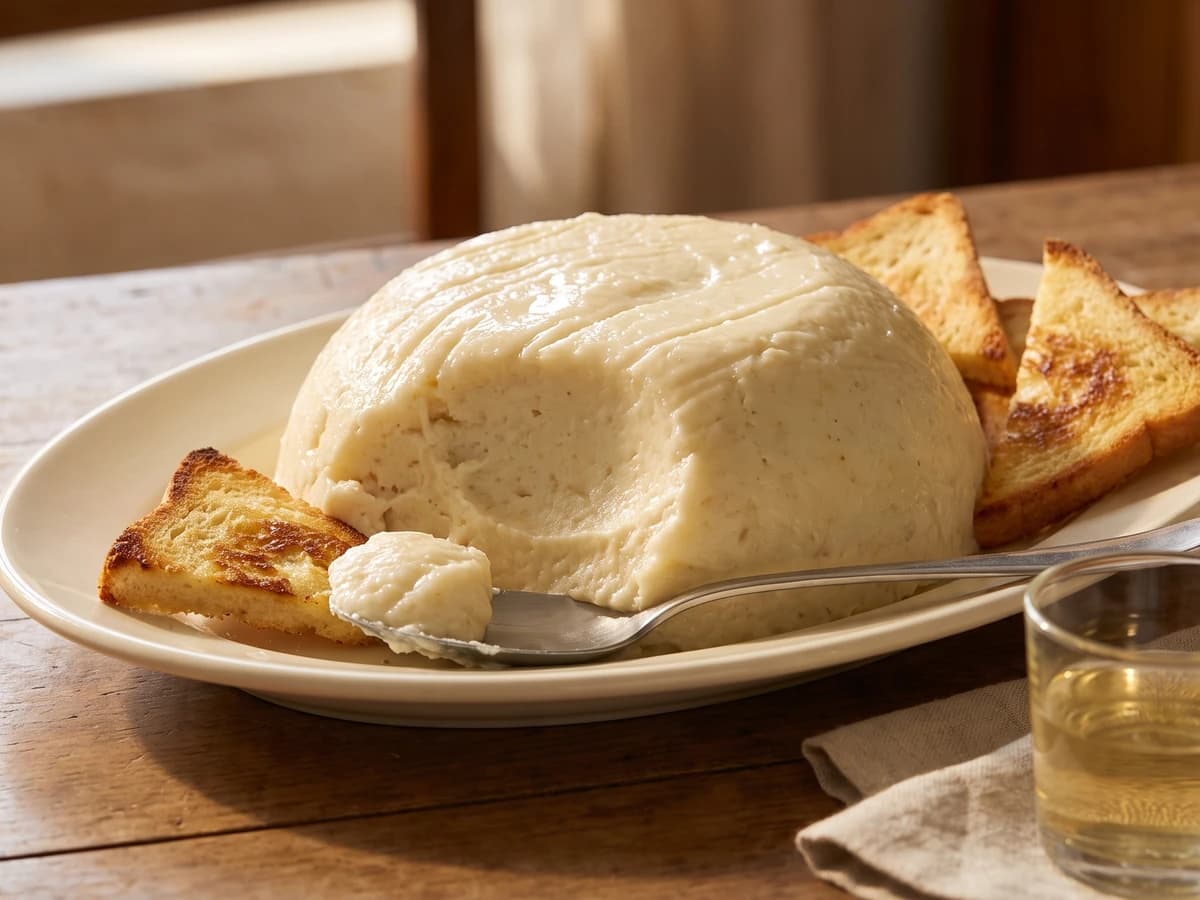
Chef Juliette
Salt cod worked warm with cream, one patient spoonful at a time, until the rough flakes become a glossy Nîmes paste, domed generously and ringed with butter-fried croutons for the table.

Chef Juliette
Wine-poached char packed in its earthenware crock beneath butter gold: a make-ahead first course that turns careful cooling, thorough boning, and one unbroken seal into quiet abundance.