
Chef Juliette
Ordinary or White Consommé
Beef shin, lean beef, and fowl begin in cold water and rise slowly toward a tremble. Skim before the boil, and you learn the quiet discipline that gives every clear French broth its backbone.
A cooking platform built around craft, culture, and the stories behind what we eat.
Created by Chef Juliette
Based on No. 2970, Orange Jelly, from Le Guide Culinaire (1907) by Auguste Escoffier
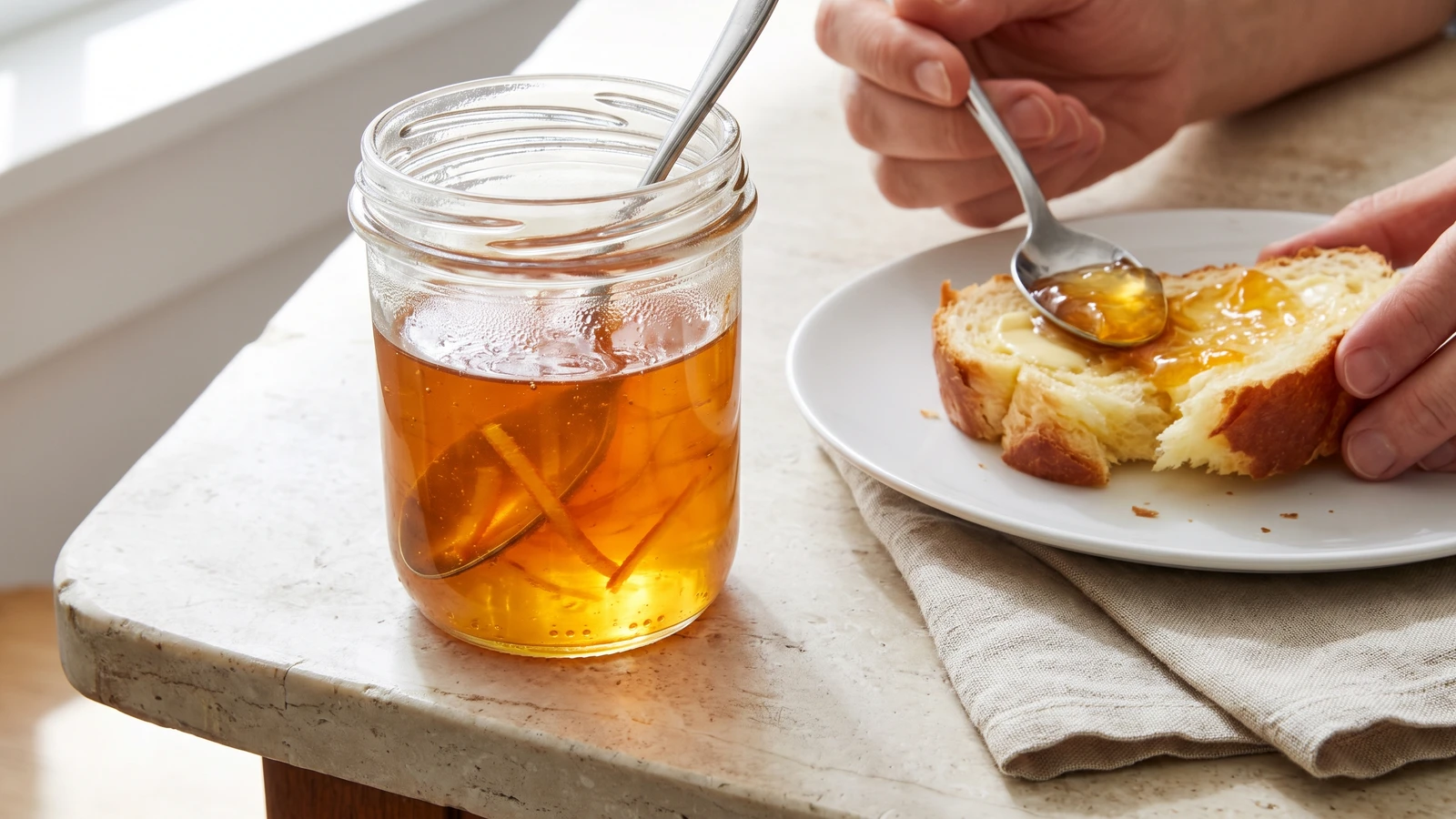
A clear, softly set gelée built on pressed orange juice and apple’s quiet pectin, finished after the boil with orange sugar so the rind’s perfume stays vivid in every spoonful.
Gelée d’orange (orange jelly) teaches the central truth of fruit preserves: the boil builds the set, but aroma is handled off the fire. Apple juice brings natural pectin, orange juice brings acidity and color, and the orange sugar goes in after the heat has done its rough work, so the peel’s perfume stays alive.
The old formula assumed loaf sugar, a jelly bag already hung, and a cook who judged the set from a cold drop. Your kitchen gets granulated sugar, a muslin-lined sieve, a chilled saucer, and a thermometer. The book’s one-quart quantity is already an honest home batch, so this version keeps its proportions, replaces obsolete loaf sugar with the same weight of granulated sugar, and translates the hard-knife orange sugar into zest rubbed through sugar. Loaf sugar and the hard knife were scaffolding. Thorough filtration, the apple-juice proportion, and the off-fire finish are the dish. One cook, one stove, one evening.
Filter patiently and boil decisively. Cloudy juice cannot make clear gelée, while a timid simmer spends the orange’s perfume before the pectin reaches its set. Watch the cold-saucer test more closely than the clock; that small wrinkle is the step that decides the jar.
Gelée d’orange belongs to French confiture practice, with a natural home at preserving tables in Provence and along the Côte d’Azur, where sweet and bitter citrus found distinct uses. From the household preserving pan it passed into the classical sweet pantry, where stricter filtration made it clear and apple juice supplied pectin without masking the orange. Unlike marmalade, gelée is defined by strained juice rather than peel suspended throughout; the rind returns as perfume, or as a few candied strips, not as the body of the preserve.
Quantity
12, about 5 oz (140 g) each; enough for 3½ cups (830 ml / 850 g) filtered juice
finely grate the zest from 2 before juicing, then press and thoroughly filter the juice
Quantity
¾ cup (190 ml / 195 g)
filtered through damp muslin
Quantity
2¼ cups (540 ml / 454 g)
Quantity
2 teaspoons (10 ml / 10 g)
for dampening the sugar
Quantity
1 tablespoon (15 ml / 13 g)
rubbed thoroughly with the finely grated orange zest
Quantity
¼ cup (60 ml / 50 g)
cut into fine short strips
| Ingredient | Quantity |
|---|---|
| medium sweet orangesfinely grate the zest from 2 before juicing, then press and thoroughly filter the juice | 12, about 5 oz (140 g) each; enough for 3½ cups (830 ml / 850 g) filtered juice |
| fresh-pressed unsweetened tart apple juicefiltered through damp muslin | ¾ cup (190 ml / 195 g) |
| granulated sugar | 2¼ cups (540 ml / 454 g) |
| waterfor dampening the sugar | 2 teaspoons (10 ml / 10 g) |
| additional granulated sugar for orange sugarrubbed thoroughly with the finely grated orange zest | 1 tablespoon (15 ml / 13 g) |
| candied orange rind (optional)cut into fine short strips | ¼ cup (60 ml / 50 g) |
Wash four 8-ounce (240 ml) heatproof jars and their lids in hot soapy water, rinse well, and keep the jars warm by filling them with hot water. Put two small saucers in the freezer for testing the set. This version treats the old instruction to pour the gelée into pots as refrigerated preserving; hot filling alone does not make a jar safe for pantry storage.
Before juicing, finely grate only the bright outer zest from 2 oranges into the additional tablespoon of sugar. Rub zest and sugar firmly between your fingertips until the sugar is damp, vivid orange, and intensely fragrant, then cover it and set it aside. Stop before the white pith, which brings bitterness. This orange sugar replaces rubbing loaf sugar against the rind and grating it with a hard knife; the equipment changes, the extraction does not.
Press the oranges thoroughly without grinding the bitter pith into the juice. Pass the juice through a fine sieve, then through a damp muslin-lined sieve or jelly bag under its own weight until you have 3½ cups (830 ml / 850 g). Do not squeeze the cloth, tempting though it is; pressure forces pulp through and clouds the gelée. Filter the apple juice in the same way. If the oranges give a little extra juice, refrigerate it for loosening an over-firm batch.
Put the 2¼ cups (454 g) sugar in a wide nonreactive pan and scatter the water over it. Warm very gently for about 30 seconds, turning the pan until the damp crystals begin to look translucent but take no color. Immediately pour in the filtered orange and apple juices. Stir over low heat until every sugar crystal dissolves, then stop stirring. If crystals cling to the sides, cover the pan for one minute so condensation washes them down, or brush them away with a clean wet pastry brush. Ça se rattrape; loose crystals left above the syrup are what can seed a grainy jar.
Raise the heat and bring the mixture to a full rolling boil, one that continues even when the pan is moved. Boil briskly, skimming only heavy foam, until it reaches 219 to 221°F (104 to 105°C), about 18 to 25 minutes. Remove the pan from the heat while you test: drop a teaspoonful onto a frozen saucer, wait 30 seconds, then push it with a fingertip. It is ready when the surface wrinkles softly and the path stays open. If it floods back together, boil for two more minutes and test again. A thermometer guides you, but the wrinkle gives the verdict; repeated short boils rescue an under-set gelée without cooking away all its brightness.
Take the pan off the heat, skim away the remaining foam, and leave the gelée undisturbed for 10 minutes. Stir in the reserved orange sugar until its crystals disappear, then fold in the candied rind if using. This pause is the dish: the gelée remains hot enough to dissolve the perfumed sugar but is no longer boiling away the oils in the zest. If the candied strips rise immediately, wait two minutes and stir once more; the slightly thickened gelée will hold them in suspension.
Empty and dry the warm jars, then ladle in the gelée, leaving about ½ inch (1 cm) at the top. Wipe the rims, close the lids, cool for no longer than one hour, and refrigerate for at least 12 hours before judging the set. If it remains pourable after a full chill, return it to the pan and boil again until the cold-saucer test wrinkles properly. If it sets too firmly, rewarm it gently with 1 tablespoon (15 ml) of reserved filtered orange juice for each cup (240 ml) of gelée. Ça se rattrape.
1 serving (about 300g)
Culinary guides, cultural storytelling, and the editorial depth that makes cooking meaningful.
Discover Culinary ExplorerChef Juliette
Beef shin, lean beef, and fowl begin in cold water and rise slowly toward a tremble. Skim before the boil, and you learn the quiet discipline that gives every clear French broth its backbone.

Chef Juliette
Break the veal bones small, then give them eight hours at a bare tremble. This pale, gelatinous fond becomes the quiet foundation beneath velouté, blanquette, and every sauce that must stay light.

Chef Juliette
Sauce Orientale concentrates lobster-rich American Sauce with curry, then folds in cream away from the fire: a glossy, gently spiced derivative made for lobster, crayfish, and firm fish.

Chef Juliette
An old lesson in sauce families: Sauce Allemande takes mushroom liquor, then butter, lemon, and parsley, becoming a glossy Poulette for sheep's trotters, leeks, cauliflower, and anything needing gentle richness with a bright edge.