
Chef Juliette
Ordinary or White Consommé
Beef shin, lean beef, and fowl begin in cold water and rise slowly toward a tremble. Skim before the boil, and you learn the quiet discipline that gives every clear French broth its backbone.
A cooking platform built around craft, culture, and the stories behind what we eat.
Created by Chef Juliette
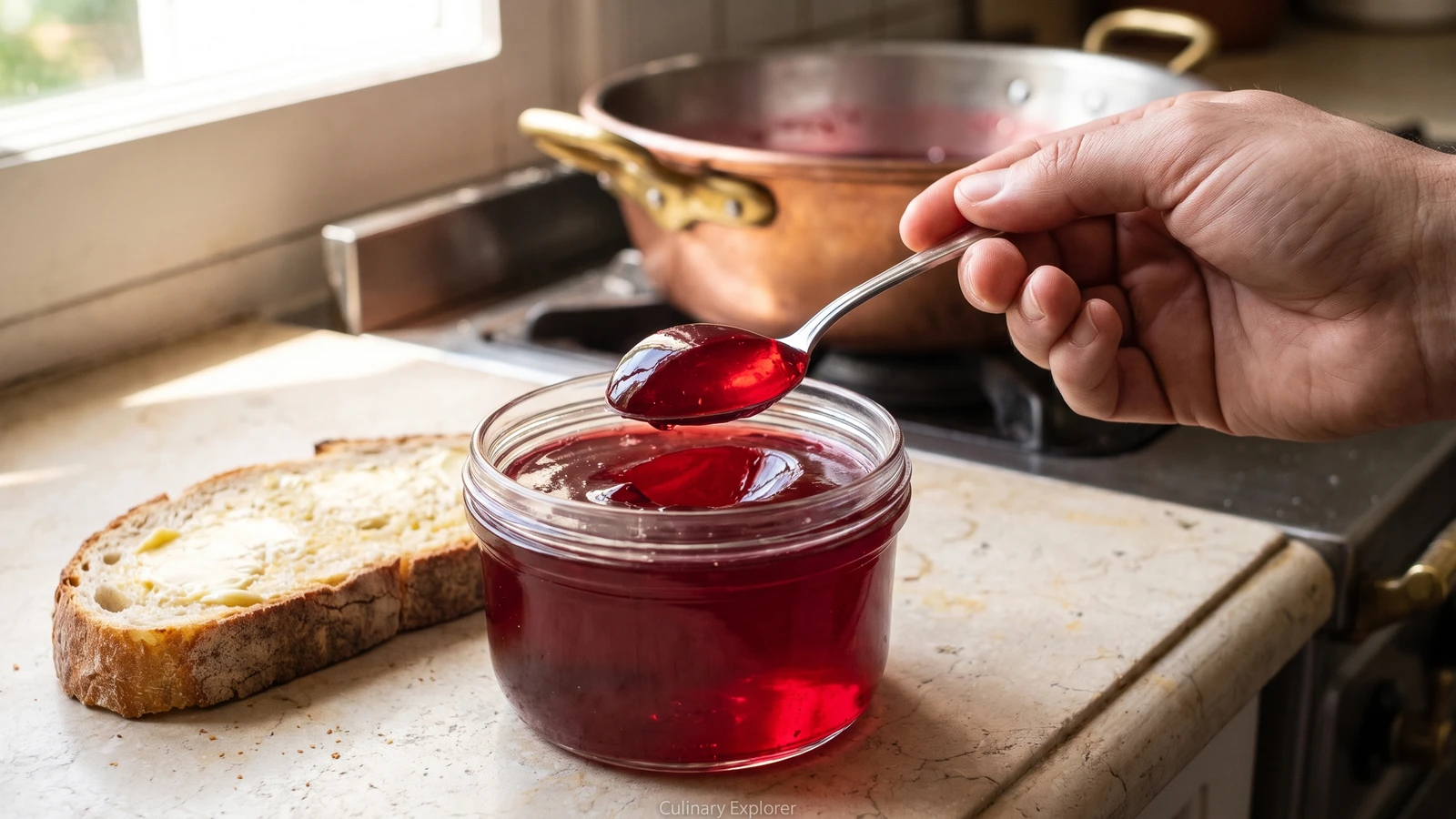
Based on No. 2966, Red-currant Jelly (Method B), from Le Guide Culinaire (1907) by Auguste Escoffier
Gelée de groseilles takes the gentler road: equal red currants, white currants, and raspberries, briefly warmed and left to drain untouched, then boiled with sugar into a clear garnet jelly with a tender set.
Gelée de groseilles, méthode B (red-currant jelly, Method B) teaches one quiet but decisive principle: clear jelly comes from patience at the sieve. Press the fruit and you gain a little juice but drive pulp through with it; leave gravity to work and the color stays bright, the flavor composed, and the finished gel almost translucent.
The original recipe assumed a broad preserving pan, a gentle place at the side of the stove, loaf sugar, and a wineglass used as a measure. One cook needs none of that scaffolding. A wide nonreactive pan over the lowest burner replaces the side of the range, ¼ cup replaces each wineglassful, and fine granulated sugar replaces loaf sugar because both are fully refined. The batch is scaled to three pounds of fruit, but its governing proportions remain untouched: equal weights of red currants, white currants, and raspberries, ¼ cup water per pound of fruit, then twelve ounces of sugar per pound of drained juice.
The fruit receives only ten to twelve minutes of gentle heat before it drains, enough to release the juice without muddying its fresh garnet color. The old equipment may go; that brief cooking, the unpressed sieve, and the measured sugar ratio are the dish itself. When the fruit reaches the sieve, leave it alone. That is the step that decides the gelée.
Gelée de groseilles belongs to the household preserving tradition of Lorraine and other cooler currant-growing parts of northern and eastern France, where tart garden fruit was put by for winter tables. Bar-le-Duc's celebrated gelée épépinée removes each currant seed with a goose quill and is a different preparation entirely; this mixed currant-and-raspberry formula belongs to the practical confiturier's repertoire. Method B trades pressing for patient gravity, yielding a little less juice but a cleaner color and finer set.
Quantity
about 4 cups (960 ml / 454 g)
leaves and stems removed
Quantity
about 4 cups (960 ml / 454 g)
leaves and stems removed
Quantity
about 3⅔ cups (880 ml / 454 g)
Quantity
¾ cup (180 ml / 180 g)
Quantity
about 3½ cups (840 ml / 700 g), using exactly 12 oz (340 g) for every 1 lb (454 g) strained juice
| Ingredient | Quantity |
|---|---|
| red currantsleaves and stems removed | about 4 cups (960 ml / 454 g) |
| white currantsleaves and stems removed | about 4 cups (960 ml / 454 g) |
| raspberries | about 3⅔ cups (880 ml / 454 g) |
| cold water | ¾ cup (180 ml / 180 g) |
| fine granulated sugar | about 3½ cups (840 ml / 700 g), using exactly 12 oz (340 g) for every 1 lb (454 g) strained juice |
Wash five half-pint jars, lids, and bands, then keep the jars hot while you make the jelly. Pick over all three fruits carefully, discarding leaves, stems, shriveled berries, and anything spoiled. Rinse the fruit in cold water without bruising it, then let it drain well. Keep the three fruits equal by weight; their volumes differ, and the scale tells the truth.
Put the red currants, white currants, raspberries, and cold water into a wide nonreactive preserving pan. Set it over low heat and cook gently for 10 to 12 minutes, stirring only enough to prevent catching, until the currant skins split, the raspberries slump, and crimson juice gathers beneath the fruit. Do not crush or boil it hard. If the bottom catches, lift the pan off at once and transfer the untouched fruit to a clean pan, leaving the scorched layer behind. Ça se rattrape.
Set a fine-mesh sieve over a deep bowl and spoon in the warm fruit. Leave it to drain undisturbed for 1 to 2 hours, until the flow slows to an occasional drop. Do not stir, mash, or press. Pressure forces pulp through the sieve and clouds the gelée. If you pressed by instinct, let the juice settle for 10 minutes, then pour it gently through a clean damp jelly cloth without disturbing the sediment. You may lose a little juice, but the clarity can still be rescued.
Weigh the strained juice in a clean bowl, then multiply that weight by 0.75. For every 1 lb (454 g) of juice, measure exactly 12 oz (340 g) sugar; for 900 g juice, use 675 g sugar. This ratio comes directly from the original formula and must be calculated from the juice you actually collected. Fine granulated sugar is the honest equivalent of loaf sugar: the form changed because it dissolves more readily, while the sweetness and setting ratio remain the same.
Return the juice to the cleaned preserving pan and add the calculated sugar. Warm gently, stirring until every crystal dissolves, then raise the heat and bring the mixture to a full rolling boil. Boil briskly, testing after 5 minutes and then every minute, until the gelée reaches 104 to 105°C (219 to 221°F) at sea level and a spoonful placed on a cold saucer wrinkles when pushed after 30 seconds. Remove the pan as soon as it sets. If the chilled test still runs, boil for one more minute and test again; repeated small tests protect the color better than one long, hopeful boil.
Let the pan stand for 1 minute, then skim away any pale foam without disturbing the clear jelly beneath. Ladle the gelée into hot jars, leaving ¼ inch (6 mm) headspace, wipe the rims, and fit the lids fingertip-tight. Process in a boiling-water canner for 10 minutes at elevations up to 1,000 feet, increasing the time according to local altitude guidance. Turn off the heat, wait 5 minutes, then lift the jars out and leave them untouched for 12 to 24 hours. If the gelée remains loose after that rest, empty it into a clean pan, boil again, and test every minute before refilling clean jars and processing them anew. Ça se rattrape. Label the sealed jars and give the jelly several days to settle into its tender set. À table!
1 serving (about 20g)
Culinary guides, cultural storytelling, and the editorial depth that makes cooking meaningful.
Discover Culinary ExplorerChef Juliette
Beef shin, lean beef, and fowl begin in cold water and rise slowly toward a tremble. Skim before the boil, and you learn the quiet discipline that gives every clear French broth its backbone.

Chef Juliette
Break the veal bones small, then give them eight hours at a bare tremble. This pale, gelatinous fond becomes the quiet foundation beneath velouté, blanquette, and every sauce that must stay light.

Chef Juliette
Sauce Orientale concentrates lobster-rich American Sauce with curry, then folds in cream away from the fire: a glossy, gently spiced derivative made for lobster, crayfish, and firm fish.

Chef Juliette
An old lesson in sauce families: Sauce Allemande takes mushroom liquor, then butter, lemon, and parsley, becoming a glossy Poulette for sheep's trotters, leeks, cauliflower, and anything needing gentle richness with a bright edge.