
Chef Juliette
Ordinary or White Consommé
Beef shin, lean beef, and fowl begin in cold water and rise slowly toward a tremble. Skim before the boil, and you learn the quiet discipline that gives every clear French broth its backbone.
A cooking platform built around craft, culture, and the stories behind what we eat.
Created by Chef Juliette
Based on No. 2957, Cherry Jam, from Le Guide Culinaire (1907) by Auguste Escoffier
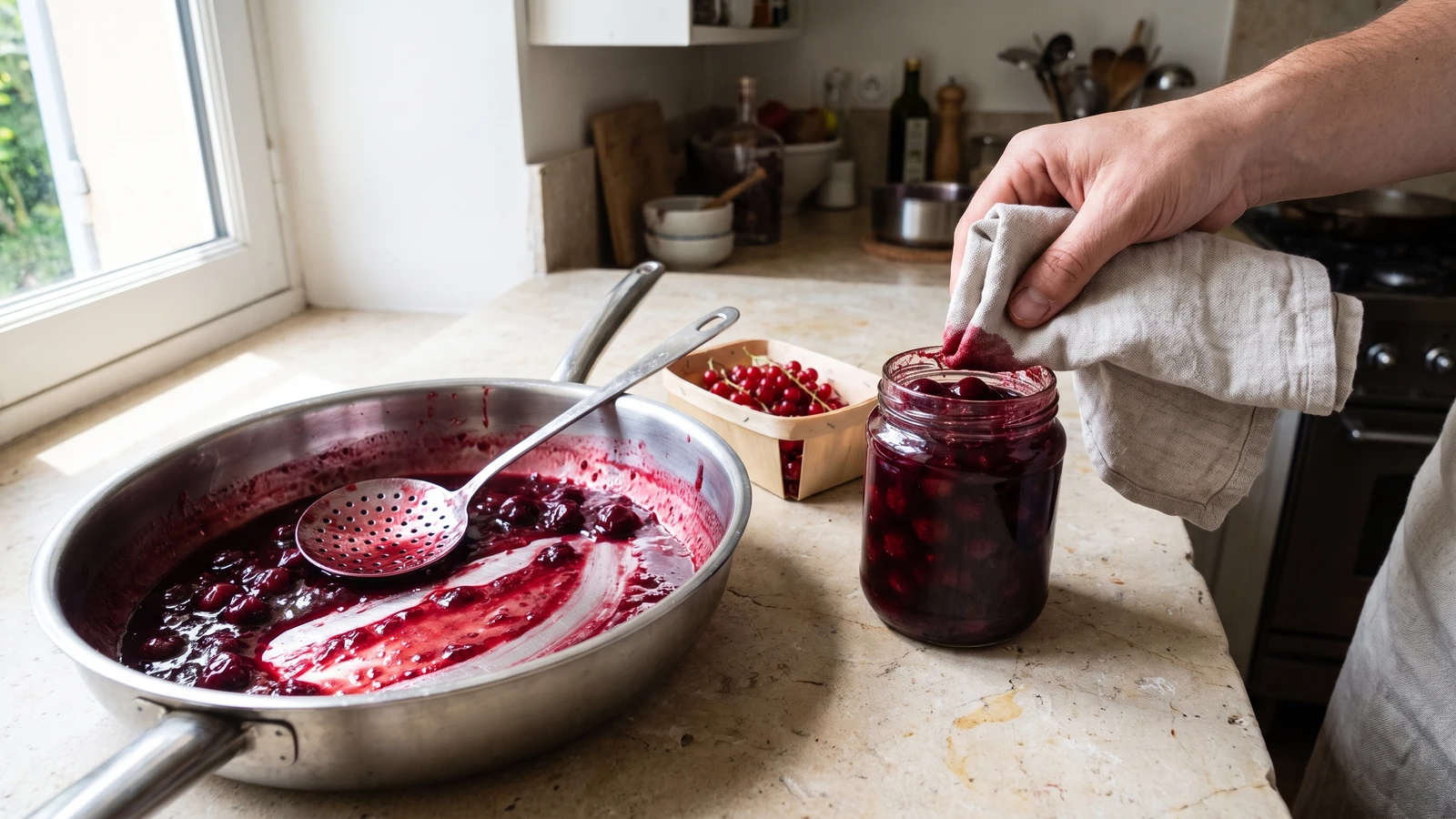
Confiture de cerises cooked over a fierce fire, with red-currant juice carrying the set and protecting the fruit's garnet colour. Skim early, stop at nappe, and the cherries stay bright and generous.
Confiture de cerises (cherry jam) teaches the governing rule of red-fruit preserving: cook fast enough to protect colour and perfume, then stop the instant the set arrives. Red-currant juice supplies the pectin cherries lack, so the fruit needn't stew itself brown before it thickens. The one true thing before you touch the pan is this: speed is useful only when every jar, skimmer, and spoon is ready.
The original formula assumed a broad preserving pan, a fierce range, and one cook free to skim without looking away. Its two-pound charge is already an honest home batch, so the book's ratios stay, while a wide, heavy 6-quart pan replaces the professional preserving pan. Plain granulated sugar replaces loaf sugar because the crystal form changes only the dissolving, not the preserve. The paper-and-glycerine closure from The Cooking, Potting, and Sealing of Jams (No. 2955) is brigade scaffolding that can go; clean fitted lids and refrigeration are the safe home equivalent used here. Fierce cooking and prompt skimming are the dish itself, and they stay.
You are after tender cherries suspended in a clear, garnet-red set, not fruit collapsed into brown paste. Skim the moment the cherries boil. If the froth sets into a skin before you catch it, lift it away in sheets rather than beating it back into the fruit. Ça se rattrape. That first skimming is the step that matters most.
Confiture de cerises has no single regional claimant; it belongs to orchard households and confituriers across France, with tart cherries especially associated with Montmorency north of Paris and cherry-growing country through Burgundy and the Rhône valley. Grand kitchens codified what household preserving pans already knew, that high-pectin red currants could give low-pectin cherries a clean set without prolonged cooking. The currant juice isn't meant to announce itself as a second flavour; its work is structure, preserving the cherries' colour and perfume.
Quantity
about 6 cups (2 lb / 910 g)
stoned and weighed after stoning
Quantity
3⅓ cups (1½ lb / 680 g)
Quantity
1⅛ cups (8 oz / 230 g)
use if the cherries are not notably sweet
Quantity
1 cup plus 3 tablespoons (285 ml / about 285 g)
Quantity
1 cup (240 ml / 240 g)
plus a little more only if needed for rescue
| Ingredient | Quantity |
|---|---|
| sweet cherriesstoned and weighed after stoning | about 6 cups (2 lb / 910 g) |
| plain white granulated sugar | 3⅓ cups (1½ lb / 680 g) |
| additional plain white granulated sugar (optional)use if the cherries are not notably sweet | 1⅛ cups (8 oz / 230 g) |
| unsweetened red-currant juice | 1 cup plus 3 tablespoons (285 ml / about 285 g) |
| waterplus a little more only if needed for rescue | 1 cup (240 ml / 240 g) |
Set out four or five clean 1-cup (250 ml) lidded jars, warmed and ready according to The Cooking, Potting, and Sealing of Jams (No. 2955). For this home adaptation, use fitted lids and keep the finished preserve refrigerated; this formula isn't being presented as a tested pantry-canning process. Place the skimmer, ladle, funnel, and a heatproof spoon beside the stove now. Once the fruit boils, you won't have a spare hand for cupboards.
Stone the cherries, then weigh out 2 pounds (910 g) of prepared fruit. Use 1½ pounds (680 g) sugar if the cherries are richly sweet. If they taste tart or merely mild, add the optional 8 ounces (230 g), bringing sugar and fruit to equal weights exactly as the source directs. Make this decision before cooking; changing the sugar near the finish makes the set difficult to judge.
Put the chosen quantity of sugar in the wide preserving pan and moisten it evenly with the water. Warm it gently, stirring only until every crystal has dissolved and the syrup is clear, then bring it to a brisk boil and cook for five minutes, skimming carefully throughout. Once it boils, stop stirring so crystals don't seed along the pan. If they do appear, take the pan off the heat, add 1 tablespoon (15 ml / 15 g) water, and warm gently until they dissolve. Ça se rattrape.
Add the cherries and red-currant juice carefully, tipping them away from you because the syrup is very hot. Stir gently until any tightened sugar loosens, then raise the heat and bring the fruit to the strongest steady boil your pan can hold without scorching or overflowing. The instant the cherries begin to boil, skim away every patch of pale froth. If the scum has already hardened into a skin, lift it out in sheets with a damp skimmer; don't beat it back into the jam, where it dulls the preserve and encourages fermentation.
Boil hard, stirring across the pan floor often enough to prevent catching, until the nappe stage, the coating stage, is reached, usually 8 to 15 minutes after the full boil returns. Lift the skimmer and watch the jam fall: at first it runs away quickly, but at nappe it gathers toward the centre and falls slowly at long intervals in broad, heavy drops. A thermometer commonly reads about 219°F to 221°F (104°C to 105°C) at sea level, but the falling drops govern. Remove the pan from the heat immediately. If you overshoot and the jam begins setting rubbery, stir in hot water 1 tablespoon (15 ml / 15 g) at a time until the nappe returns; if it cools too loose, return it to the pan and boil briefly to the same stage.
Let the jam stand off the heat for seven to eight minutes, no longer. Skim any last trace from the surface, then stir once gently so the cherries remain distributed rather than floating at the jar tops. Ladle the jam into the warm jars, leaving about ¼ inch (6 mm) at the rim. Wipe the rims scrupulously clean and fit the lids. Warm glass matters here; a cold jar meeting hot preserve may crack, and jam containing broken glass must be discarded.
Let the closed jars cool undisturbed, then refrigerate them within two hours. Leave the jam overnight before judging the set, as the currant pectin continues firming while it cools. Keep refrigerated for up to three weeks, or freeze for up to six months in freezer-safe jars with ½ inch (1.25 cm) headspace. Discard a jar entirely if you find mould, unexplained bubbling, leakage, or an alcoholic smell. Spoon the finished confiture onto buttered bread, brioche, or fromage blanc. À table!
1 serving (about 20g)
Culinary guides, cultural storytelling, and the editorial depth that makes cooking meaningful.
Discover Culinary ExplorerChef Juliette
Beef shin, lean beef, and fowl begin in cold water and rise slowly toward a tremble. Skim before the boil, and you learn the quiet discipline that gives every clear French broth its backbone.

Chef Juliette
Break the veal bones small, then give them eight hours at a bare tremble. This pale, gelatinous fond becomes the quiet foundation beneath velouté, blanquette, and every sauce that must stay light.

Chef Juliette
Sauce Orientale concentrates lobster-rich American Sauce with curry, then folds in cream away from the fire: a glossy, gently spiced derivative made for lobster, crayfish, and firm fish.

Chef Juliette
An old lesson in sauce families: Sauce Allemande takes mushroom liquor, then butter, lemon, and parsley, becoming a glossy Poulette for sheep's trotters, leeks, cauliflower, and anything needing gentle richness with a bright edge.