
Chef Juliette
Bavaroise
Bavaroise turns the ribbon stage into a drink: yolks and sugar, boiling tea and milk, and Kirsch whisked into a light crown of foam. Keep the whisk moving, and the café comes home.
A cooking platform built around craft, culture, and the stories behind what we eat.
Created by Chef Juliette
Based on No. 2940, Raspberry-flavoured, Red-currant Water, from Le Guide Culinaire (1907) by Auguste Escoffier
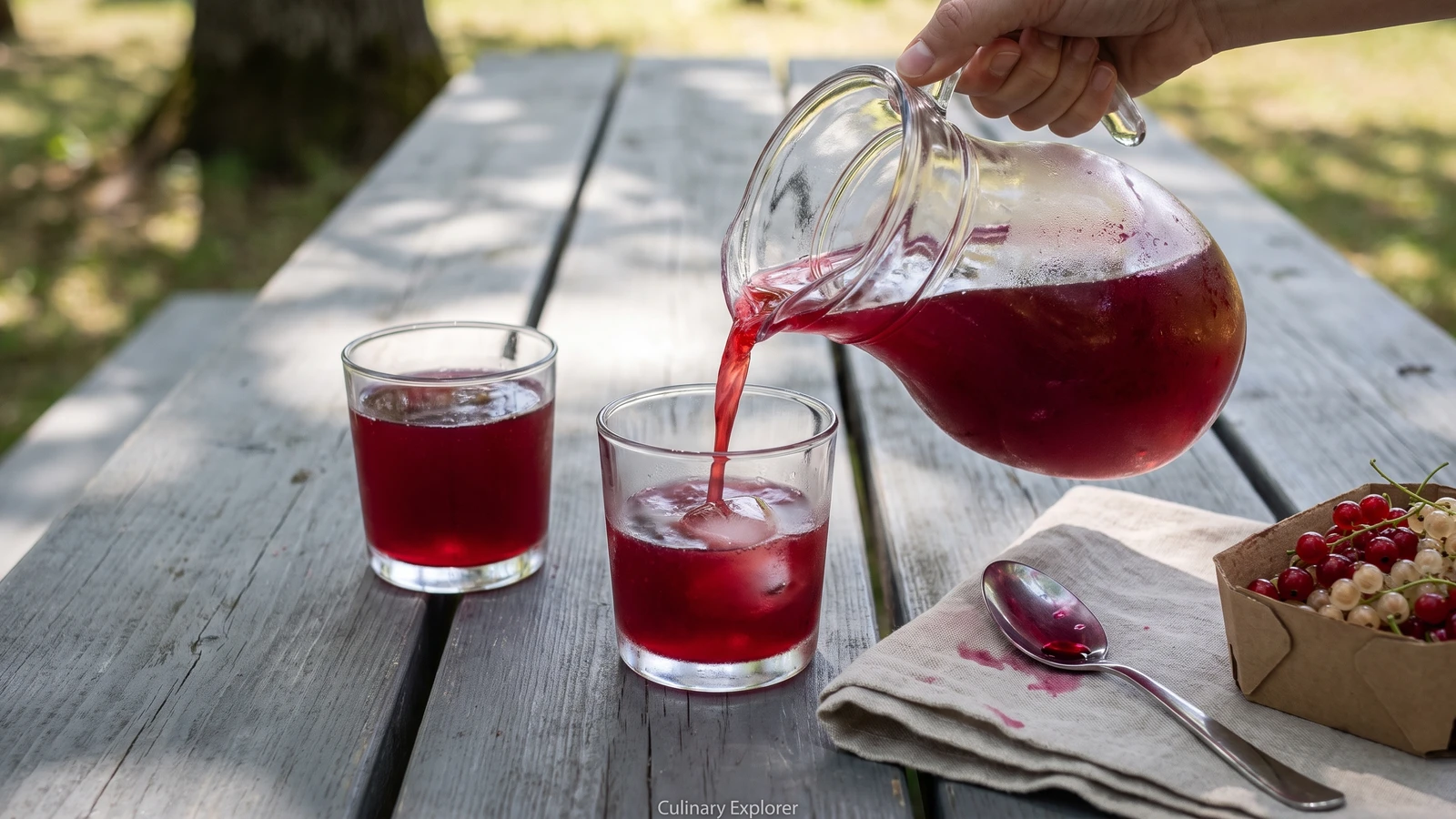
Eau de groseilles framboisée keeps red and white currants bright, lets ripe raspberry supply the perfume, and dissolves sugar without heat: a cold ruby refresher made with sieve, spoon, and patience.
Eau de groseilles framboisée (raspberry-flavoured red-currant water) teaches restraint. The one true thing to know before touching a pan is that no pan belongs here. Red and white currants provide the bright, tart body, ripe raspberries provide the perfume, and heat would cook that perfume straight out of the bowl.
The original preparation assumed a basin, a silver spoon, a washed piece cut from block ice, a reliably cool pantry, and a saccharometer waiting to judge the sugar degree. A fine-mesh sieve, a nonreactive bowl, a stainless-steel spoon, one large rinsed ice cube, and the refrigerator do the same work at home. Loaf sugar becomes caster sugar because it is still pure sugar but dissolves more willingly in cold liquid. Those details were the old kitchen's scaffolding. The raw sieving, the fixed proportions, and the cold twenty-minute rest are the dish itself, so they stay. The book's modest basinful already becomes one generous home pitcher, suitable for one cook and four to six glasses, with no further reduction needed.
Rub the fruit patiently enough to express its juice, but don't mill the seeds against the sieve until they turn bitter. That is the step that decides the drink. Keep the fruit raw from its first crush to the final glass.
Eaux de fruits belong to the French classical refreshment service, particularly the Parisian dining room and the bourgeois summer table, rather than to one provincial larder. They traveled easily from formal service, where a saccharometer fixed the sweetness, to garden and picnic tables requiring little more than ripe fruit, a sieve, sugar, water, and ice. Despite the English word “water,” this is not a faint infusion: the currants are expressed raw, while raspberry acts as a fragrant seasoning rather than the drink's main body.
Quantity
1½ cups (360 ml / 170 g)
stemmed, gently rinsed, and thoroughly dried
Quantity
1½ cups (360 ml / 170 g)
stemmed, gently rinsed, and thoroughly dried
Quantity
1 cup (240 ml / 115 g)
gently rinsed and thoroughly dried
Quantity
2⅓ cups (570 ml / 570 g)
Quantity
⅞ cup (210 ml / 170 g)
used as the cold-dissolving equivalent of loaf sugar
Quantity
1 large piece (about 85 g)
rinsed under cold water
Quantity
Reference only; 0 ml / 0 g added
use only its 9° saccharometer standard
| Ingredient | Quantity |
|---|---|
| fresh red currantsstemmed, gently rinsed, and thoroughly dried | 1½ cups (360 ml / 170 g) |
| fresh white currantsstemmed, gently rinsed, and thoroughly dried | 1½ cups (360 ml / 170 g) |
| very ripe fresh raspberriesgently rinsed and thoroughly dried | 1 cup (240 ml / 115 g) |
| cool filtered water | 2⅓ cups (570 ml / 570 g) |
| superfine caster sugarused as the cold-dissolving equivalent of loaf sugar | ⅞ cup (210 ml / 170 g) |
| clear icerinsed under cold water | 1 large piece (about 85 g) |
| Cherry Water (No. 2939)use only its 9° saccharometer standard | Reference only; 0 ml / 0 g added |
Set a fine-mesh sieve over a deep glass, ceramic, or stainless-steel bowl. Chill a 1-litre pitcher and the serving glasses. Keep every pan in the cupboard: this preparation depends on raw fruit perfume, and even gentle heat would flatten the raspberry and turn the currants toward cooked jam.
Put the red currants, white currants, and raspberries into the sieve in manageable handfuls. Rub them through with a flexible spatula or the back of a wooden spoon, pressing the soft flesh against the mesh and scraping the expressed fruit from the underside into the bowl. Continue until the sieve holds mostly skins and seeds, but stop before grinding the exposed seeds hard against the mesh. If a little seed grit passes through, ça se rattrape: rinse the sieve and pass the liquid through it once more without pressing.
Pour the filtered water into the raw currant liquid, add the caster sugar, and lower in the rinsed piece of ice. Stir steadily with a stainless-steel spoon until the sugar is dispersed. Stainless steel is the home equivalent of the original silver spoon, clean and nonreactive against the sharp fruit. If crystals remain after the resting time, keep the bowl cold and stir for another five to ten minutes. Do not reach for a hot syrup; the cold dissolution is the dish.
Keep the bowl refrigerated for 20 minutes, stirring from the bottom every five minutes as the ice softens the drink. The source reaches to Cherry Water (No. 2939) only for its degree, not for any added liquid: the traditional saccharometer target is the same 9°. If using a modern refractometer, a reading close to 16 °Brix is a practical equivalent; without either instrument, the fixed fruit, water, and sugar ratio carries the intended balance.
Give the eau de groseilles framboisée one final stir and pour it, with the remaining piece of ice, into the chilled pitcher. It should be jewel-red and lightly cloudy, sharp with currant at the first sip and fragrant with raspberry afterward. Serve at once in cold glasses. À table!
1 serving (about 220g)
Culinary guides, cultural storytelling, and the editorial depth that makes cooking meaningful.
Discover Culinary ExplorerChef Juliette
Bavaroise turns the ribbon stage into a drink: yolks and sugar, boiling tea and milk, and Kirsch whisked into a light crown of foam. Keep the whisk moving, and the café comes home.

Chef Juliette
Bischoff turns Champagne, tilleul, citrus, and brandy into pale-gold granité, coarse enough to sparkle under the spoon. The scraping makes the texture, and the timer becomes your smallest member of the brigade.

Chef Juliette
Café glacé is coffee taught by texture: dark, sweet, vanilla-softened, and churned only until it moves like loose snow. Stop before ice cream, pour into cold cups, and take it outside.

Chef Juliette
Zest brings perfume, juice brings acid, and three cool hours join them: a clear, lively French limonade finished with seltzer for the picnic table in the shade.