
Chef Juliette
Smelt (Éperlans)
Tiny éperlans, lightly floured and fried until their tails stand crisp, arrive in a generous heap on a napkin with fried parsley and grooved lemon, a weeknight lesson in heat and restraint.
A cooking platform built around craft, culture, and the stories behind what we eat.
Created by Chef Juliette
Based on No. 293, Pimento Butter, from Le Guide Culinaire (1907) by Auguste Escoffier
Equal weights of red capsicum and real butter become one silken, red-gold spread, provided you honor the final sieve, the step that gives Beurre de Piment its polish.
Beurre de Piment teaches a severe little lesson: texture can be flavor. Before you touch a pan, know the one true thing about it. The fine sieve is not polish added at the end; it is the dish, because removing every seed, shred of skin, and coarse fiber lets sweet capsicum and butter arrive as one satin mouthful.
This small formula never depended on a stockpot or a saucier on staff. It assumed something simpler: a commis to pound the capsicum by hand and a wide tamis through which to force the finished butter. When fresh capsicum was chosen, the range or salamander supplied the fierce heat; at home, a broiler does that work, while the preserved capsicum permitted by the original remains the honest choice for tonight. A mini processor replaces the pounding, and a fine-mesh sieve replaces the tamis. That labor was brigade scaffolding. The equal weights and final sieving must stay.
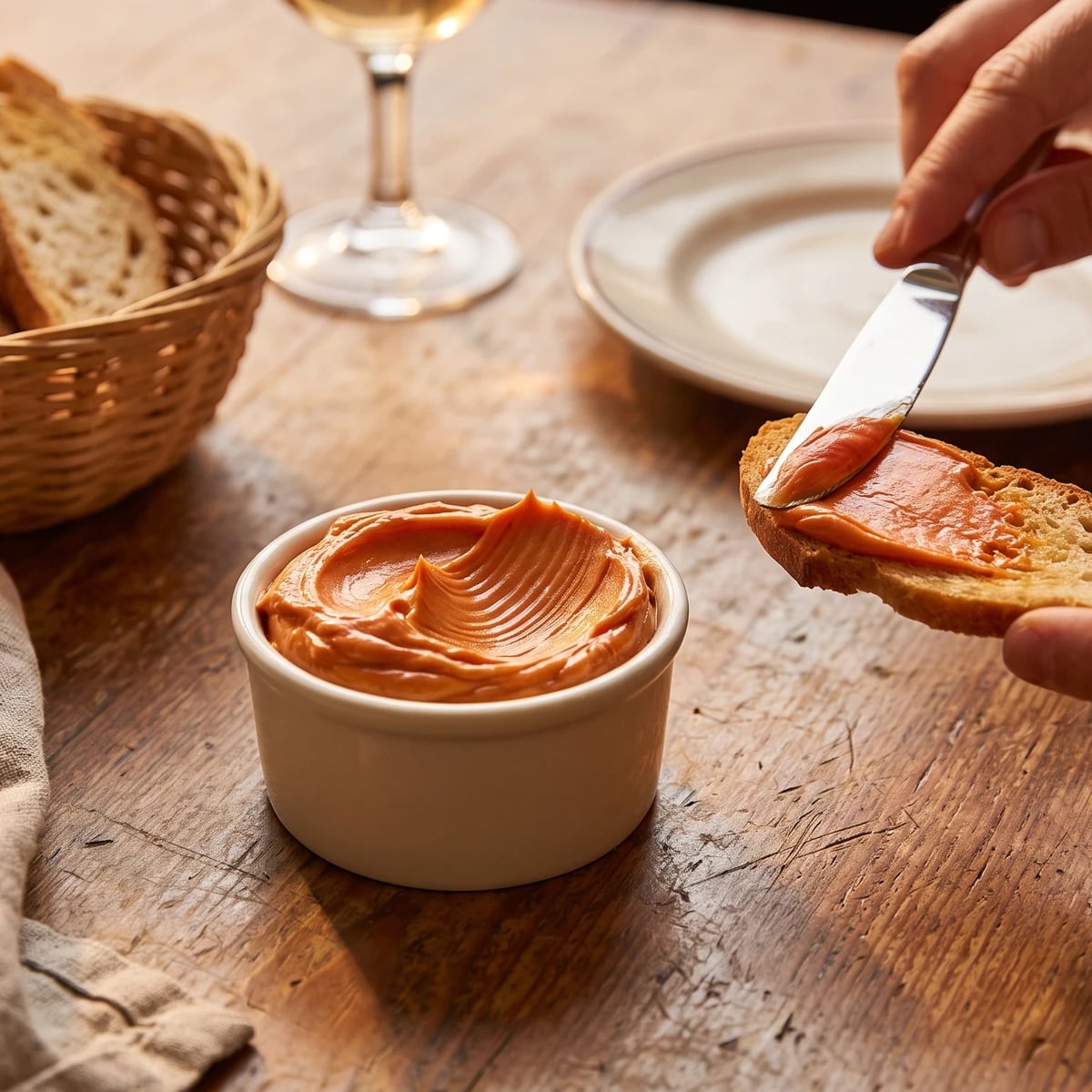
The original four ounces of capsicum and four ounces of butter already make a sensible home batch, so I have kept them exactly: one cook, one bowl, one evening. The finished butter should be red-gold, cool and softly spreadable, with no visible skin or seed. Do not skip the final sieving. Everything before it prepares the butter; that pass through fine mesh is the step that decides it.
The real home of Beurre de Piment is the French classical garde-manger and hors d'oeuvre table, not any single regional larder. It belongs to the family of beurres composés, compound butters made by pounding a concentrated garnish into butter and passing the mixture through a tamis for canapés and savory finishes. The source's word capsicum matters: this is a sweet, smooth red-pepper butter, not a chile-heavy spread sharpened with additional seasonings.
Quantity
¾ cup loosely packed (180 ml / 113 g)
drained, peeled, seeded, and thoroughly dried
Quantity
½ cup (120 ml / 113 g)
softened but still cool
| Ingredient | Quantity |
|---|---|
| preserved or freshly cooked red capsicumdrained, peeled, seeded, and thoroughly dried | ¾ cup loosely packed (180 ml / 113 g) |
| unsalted buttersoftened but still cool | ½ cup (120 ml / 113 g) |
Drain the capsicum well, remove every seed and loose scrap of skin, then press it firmly between clean kitchen towels. Weigh 113 g only after this preparation. Water is the likely trouble here: wet capsicum makes the butter weep, while a properly dried pepper gives a stable, concentrated spread.
Put the prepared capsicum in a mini food processor and pulse, scraping the bowl often, until it becomes the smoothest paste the machine can make. Keep the pulses short so friction does not heat the purée. A mortar and pestle performs the original pounding perfectly, but the processor removes labor rather than technique.
Cut the cool, softened butter into four pieces and add them one at a time, pulsing just until each disappears before adding the next. Stop when the mixture is uniform and opaque. If it turns shiny, loose, or oily, the butter has become too warm. Ça se rattrape: scrape it into a bowl, chill it for 10 minutes, then beat firmly with a spoon until it becomes matte and cohesive again.
Set a fine-mesh sieve over a chilled bowl. Working in small portions, rub the butter through with the back of a sturdy spoon or a flexible bowl scraper. Leave the coarse skin and seed fragments behind, then scrape every smooth ribbon from the underside of the sieve. If the butter stiffens and resists, let it stand for 3 minutes before continuing; do not melt it to hurry the work. The sieve is what turns two ingredients into Beurre de Piment.
Pack the sieved butter into a low ramekin, smoothing the surface with the back of a spoon. Cover directly against the surface and chill for 15 minutes, just until it holds soft ridges. Let it stand for about 10 minutes before serving so it spreads without tearing the toast. Bring it out with thin baguette toasts or crisp raw vegetables. À table!
1 serving (about 28g)
Culinary guides, cultural storytelling, and the editorial depth that makes cooking meaningful.
Discover Culinary Explorer
Chef Juliette
Tiny éperlans, lightly floured and fried until their tails stand crisp, arrive in a generous heap on a napkin with fried parsley and grooved lemon, a weeknight lesson in heat and restraint.

Chef Juliette
Brandade de Morue turns salt cod, warm olive oil, and milk into a pale, silky emulsion: keep everything warm and add the oil slowly, then crown the generous dome with butter-fried bread.

Chef Juliette
Salt cod worked warm with cream, one patient spoonful at a time, until the rough flakes become a glossy Nîmes paste, domed generously and ringed with butter-fried croutons for the table.

Chef Juliette
Wine-poached char packed in its earthenware crock beneath butter gold: a make-ahead first course that turns careful cooling, thorough boning, and one unbroken seal into quiet abundance.