
Chef Juliette
Various Almond Preparations
Five almond preparations, one discipline: remove the skins cleanly, dry every kernel through, then cut, toast, or cloak it in pale caramel without letting its fragrant oils escape.
A cooking platform built around craft, culture, and the stories behind what we eat.
Created by Chef Juliette
Based on No. 2915, Preparation for Iced Fruit Mousses, from Le Guide Culinaire (1907) by Auguste Escoffier
Mousses glacées aux fruits teach the no-churn grammar of frozen dessert: one part cold syrup, one part pure fruit, two parts very stiff Chantilly, folded lightly and frozen before the air can fall.
Préparation pour mousses glacées aux fruits (iced fruit mousse base) teaches proportion before flavor: one weight of cold syrup, one weight of fruit purée, and two weights of very stiff Chantilly, sweetened whipped cream. The one true thing is the cream. If it holds only a soft curl, the freezer will expose that weakness as coarse ice; whip it until the peak stands cleanly, then stop before it turns grainy.
The classical entry assumed a pastry station with 35° Baumé syrup already cold, purée already passed through a sieve, Chantilly made to order, and molds waiting for a brigade service. Here that becomes 150 g syrup, 150 g purée, and 300 g finished Chantilly, enough for six, made with a digital scale, one bowl, and an ordinary freezer. The hydrometer and the great batch are scaffolding, so they go; a syrup containing about 65% sugar by weight is their honest home equivalent. The ratio and the very stiff whip stay, because they are the dish. One cook, one stove, one evening.
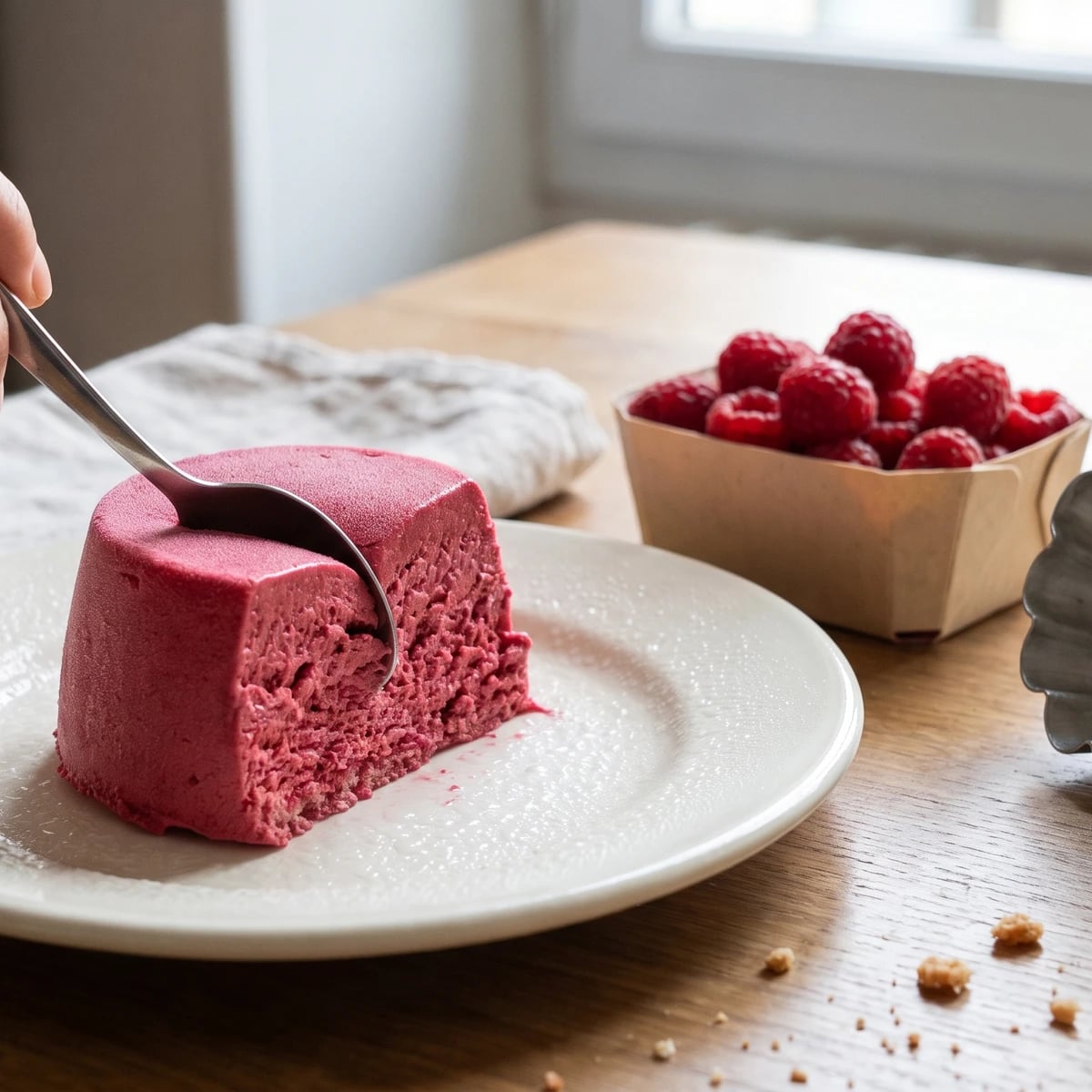
Frozen promptly, the mousse keeps the perfume and color of the fruit inside a texture lighter than ice cream and more generous than sorbet. Before you begin, clear a level place in the freezer and chill the syrup, purée, cream, bowl, and whisk thoroughly. Cold Chantilly whipped very stiff is the step that decides everything.
Mousses glacées aux fruits belong to classical French pâtisserie, particularly the Paris dessert table, where fruit purées became molded entremets glacés, or frozen desserts, through formulas a pastry brigade could apply to whatever fruit was ready. The 35° in this formula is degrees Baumé, a measure of cold syrup density rather than a cooking temperature, and it allowed the fruit to change without rewriting the method. Because the structure comes from concentrated syrup and Chantilly rather than custard, the preparation passes naturally from brigade freezer molds to a home freezer without requiring a churn.
Quantity
2/3 cup (155 ml / 130 g)
Quantity
1/4 cup plus 2 teaspoons (70 ml / 70 g)
Quantity
2/3 cup (150 ml / 150 g)
strained and very cold
Quantity
1 cup plus 2 tablespoons (270 ml / 270 g)
very cold
Quantity
1/4 cup (60 ml / 30 g)
sifted
Quantity
2 tablespoons (30 ml / 30 g)
very cold, for rescuing overwhipped Chantilly
| Ingredient | Quantity |
|---|---|
| granulated sugar | 2/3 cup (155 ml / 130 g) |
| water | 1/4 cup plus 2 teaspoons (70 ml / 70 g) |
| smooth unsweetened fruit puréestrained and very cold | 2/3 cup (150 ml / 150 g) |
| heavy cream with at least 35% fatvery cold | 1 cup plus 2 tablespoons (270 ml / 270 g) |
| confectioners' sugarsifted | 1/4 cup (60 ml / 30 g) |
| additional heavy cream (optional)very cold, for rescuing overwhipped Chantilly | 2 tablespoons (30 ml / 30 g) |
Set six 120 ml freezer-safe molds on a tray, then chill the mixing bowl and beaters. Put the granulated sugar and water in a small saucepan and warm them gently, stirring only until every crystal disappears. Remove the pan as soon as the syrup is clear; a prolonged boil would evaporate water and disturb its density. Transfer every drop to a bowl on the scale. The batch should weigh 200 g, so if evaporation has taken it below that, stir in cold water gram by gram until it returns to 200 g. Cool completely, then refrigerate for at least 30 minutes and weigh out exactly 150 g. This syrup is approximately 35° Baumé when cold, meaning about 65% sugar by weight.
Weigh 150 g of strained fruit purée into the 150 g of cold syrup and whisk until completely uniform. If you are working with raspberries, blackcurrants, strawberries, apricots, or peaches, pass the purée through a fine sieve before weighing; the ratio is based on usable purée, not seeds or skins. Refrigerate the mixture until thoroughly cold, about 4°C (40°F). A warm fruit base melts the cream's structure before the freezer can preserve it.
Whip the 270 g of cold heavy cream at medium speed until the whisk begins leaving clear tracks. Rain in the confectioners' sugar and continue until the Chantilly forms sharp, upright peaks and stays firmly in the bowl when it is tilted. Very stiff does not mean grainy. If the surface starts looking rough, stop immediately. Ça se rattrape: whisk in the optional cold cream one teaspoon at a time by hand until the Chantilly is smooth again, then weigh 300 g for the mousse. If the peak bends or slowly slumps, it is still too slack and will freeze icy; give it another few seconds before any fruit touches it.
Whisk about one quarter of the Chantilly into the fruit base to bring the two mixtures closer in density. Add the remaining Chantilly in two portions, cutting down through the center with a broad spatula, sweeping along the bowl, and lifting the mixture over itself while turning the bowl. Stop as soon as the color is even. A few faint pale threads are safer than another dozen strokes; overfolding drives out the air that gives a mousse glacée its fine, light texture.
Divide the mousse among the chilled molds without knocking the tray or tapping out the air. Level the tops lightly, cover them closely, and place the tray in the coldest part of the freezer at once. Freeze undisturbed for at least 6 hours, preferably overnight. No churning is needed. The syrup controls the freeze while the stiff Chantilly holds the air.
Move the mousses to the refrigerator for 15 minutes, or leave them at room temperature for about 5 minutes. For rigid molds, loosen the edge with a thin knife and wrap the outside briefly in a warm damp cloth before turning each mousse onto a chilled plate. If the surface softens before the center releases, return it to the freezer for 10 minutes and try again with less warmth. The spoon should meet slight resistance, then pass through a fine, airy frozen interior. Serve at once. À table!
1 serving (about 110g)
Culinary guides, cultural storytelling, and the editorial depth that makes cooking meaningful.
Discover Culinary Explorer
Chef Juliette
Five almond preparations, one discipline: remove the skins cleanly, dry every kernel through, then cut, toast, or cloak it in pale caramel without letting its fragrant oils escape.

Chef Juliette
A pastry pantry lesson in one tray: filberts warmed only until their red skins release, rubbed clean, cooled, and chopped into a fragrant mise-en-place for cakes, creams, pralines, and petits fours.

Chef Juliette
The smallest pâtisserie discipline decides whether a cake leaves its mould intact: clarified butter in every corner, followed by the lightest veil of dry flour or fécule.

Chef Juliette
Four whites, one spotless bowl, and a patient change of speed: whisk gently until loosened, then briskly to glossy stiffness, with powdered sugar waiting if the foam begins to granulate.