Culinary Explorer
A cooking platform built around craft, culture, and the stories behind what we eat.
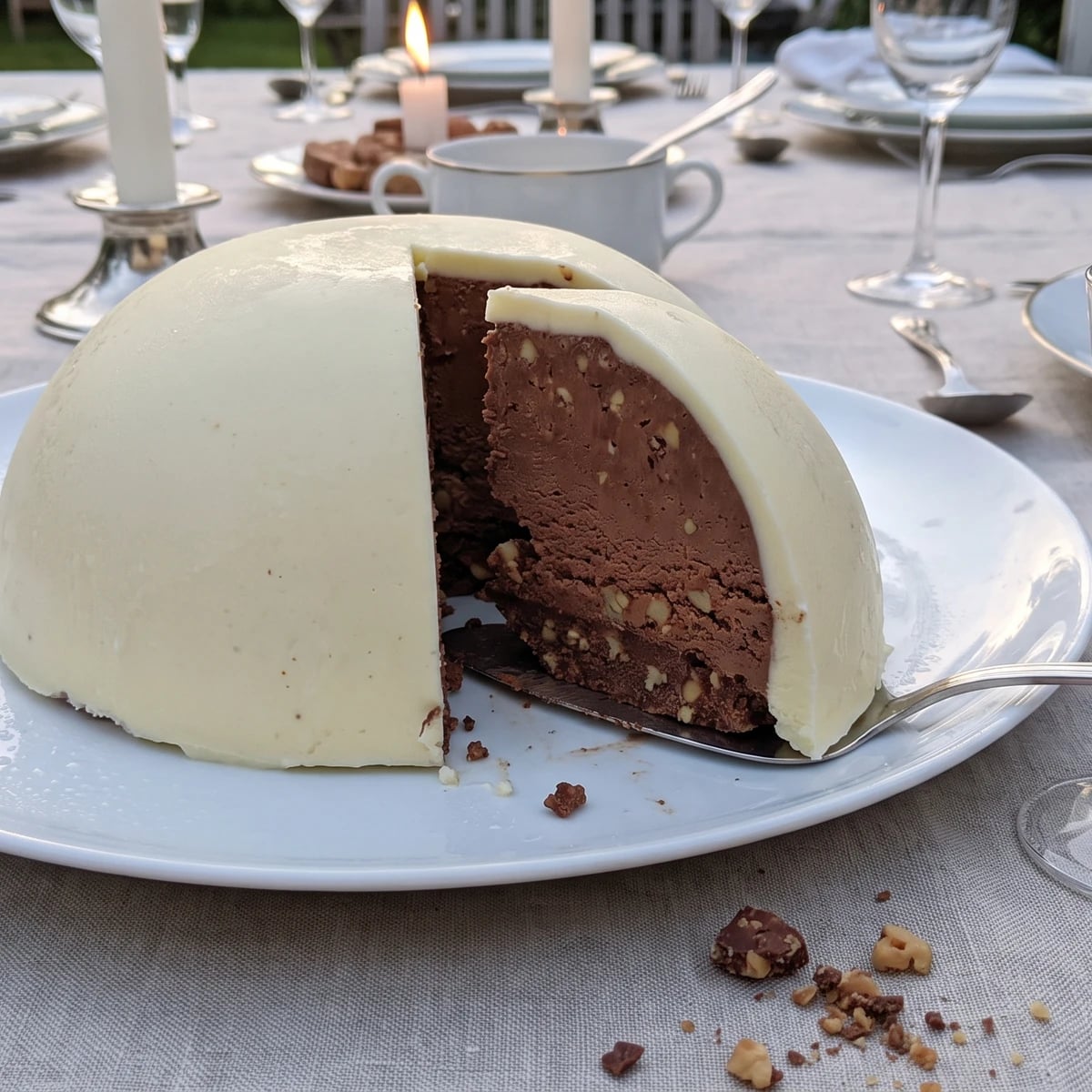
Bombe à la Royale
Created by Chef Juliette
Kirsch ice forms a fine, bright shell around chocolate-praline pâte à bombe, a frozen celebration of contrast where the lightest chemise protects, rather than smothers, the creamy centre.
Bombe à la Royale (a kirsch-ice bombe with chocolate-praline centre) teaches restraint. Kirsch and chocolate want each other, but the kirsch ice must remain a fine chemise, the thin frozen lining of the mould. Make it heavy and its sugar and alcohol smother the pralined centre; keep it slender and each spoonful moves from bright cherry spirit into cool, creamy chocolate.
The source assumed a pastry kitchen with prepared ices, bombe moulds packed in salt and ice, and enough hands to turn and coat each mould while another cook made the filling. A domestic freezer, a chilled metal bowl, and an offset spatula do the same work for a six-cup bombe. The repeated packing and repacking belonged to brigade service and can go; the thin chemise and properly aerated pâte à bombe are the dish and must stay. What changed is the scale and freezing apparatus, not the flavour or its order. One cook, one stove, one evening.
The one step that decides everything comes before the filling: coat the mould no thicker than 4 mm and inspect it against the light before it freezes solid. Bare patches can be covered and heavy ones scraped back. Ça se rattrape.
Ingredients
water
Quantity
1 cup (240 ml / 240 g)
for the kirsch ice
caster sugar
Quantity
⅓ cup (80 ml / 67 g)
for the kirsch ice
kirsch
Quantity
3 tablespoons (45 ml / 42 g)
| Ingredient | Quantity |
|---|---|
| waterfor the kirsch ice | 1 cup (240 ml / 240 g) |
| caster sugarfor the kirsch ice | ⅓ cup (80 ml / 67 g) |
| kirsch | 3 tablespoons (45 ml / 42 g) |
Where cooking meets culture.
Culinary guides, cultural storytelling, and the editorial depth that makes cooking meaningful.
Discover Culinary Explorer