
Chef Juliette
Various Almond Preparations
Five almond preparations, one discipline: remove the skins cleanly, dry every kernel through, then cut, toast, or cloak it in pale caramel without letting its fragrant oils escape.
A cooking platform built around craft, culture, and the stories behind what we eat.
Created by Chef Juliette
Based on No. 2889, Bombe Nesselrode, from Le Guide Culinaire (1907) by Auguste Escoffier
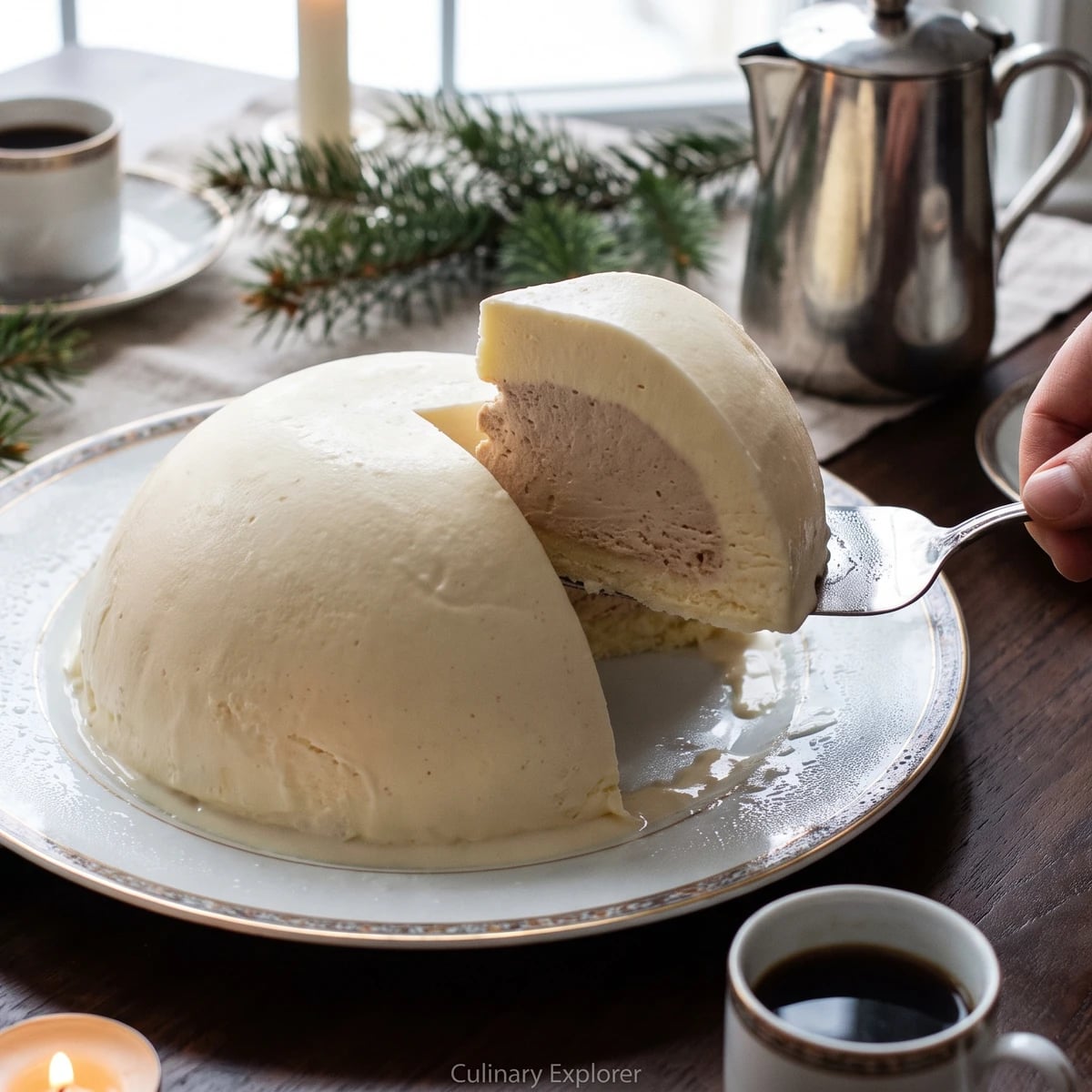
Vanilla ice cream forms a clean ivory shell around chestnut Chantilly, a holiday bombe whose grandeur depends on one humble discipline: sieve the purée twice, then freeze each layer completely.
Bombe Nesselrode (vanilla ice cream around chestnut Chantilly) teaches the discipline of texture: a frozen dessert this smooth exposes every rough edge. Its centre is crème Chantilly, lightly sweetened vanilla whipped cream, folded with chestnut purée. Sieve that purée twice. One scrap of skin that seems harmless in the tin feels like sand once the cream is cold.
The original assumed that a pastry section already had vanilla ice cream waiting, a proper metal bombe mould could be worked over salted broken ice, and another pair of hands was nearby when the filling had to move quickly. Here, dense vanilla ice cream is the finished component the source already asks for, a 1.5 L metal bowl and home freezer replace the ice tub, and the brigade quantity becomes eight generous slices. The equipment and scale changed because they had to. The architecture did not. One cook, one stove, one evening, though the stove gets this one off.
The old ice-tub choreography is scaffolding. Cut it freely. The even vanilla shell, airy chestnut Chantilly, and complete freeze are the dish itself, so defend them. Before you take out the whisk, pass the chestnut purée through the sieve for the second time. That is the step that decides whether this bombe feels magnificent.
Bombe Nesselrode belongs to the Parisian grand-kitchen repertoire of moulded ices, where a bombe means a layered frozen dessert set in a rounded metal mould rather than a baked cake. The name honors Count Nesselrode, a Russian statesman whose dining-room legacy became linked across Europe with chestnut frozen puddings; other formulas carry candied fruit or liqueur, but this entry is stricter, with vanilla ice cream outside and chestnut Chantilly within.
Quantity
1¼ quarts (1.2 L / 720 g)
softened only until spreadable
Quantity
1¼ cups (300 ml / 300 g)
at cool room temperature
Quantity
1¼ cups (300 ml / 300 g)
very cold and divided
Quantity
⅓ cup (80 ml / 40 g)
sifted
Quantity
1 teaspoon (5 ml / 5 g)
Quantity
1 technique reference (No. 916)
consulted only for the canonical meaning of clothing the mould; no savory component is used
| Ingredient | Quantity |
|---|---|
| dense vanilla ice creamsoftened only until spreadable | 1¼ quarts (1.2 L / 720 g) |
| unsweetened chestnut puréeat cool room temperature | 1¼ cups (300 ml / 300 g) |
| heavy creamvery cold and divided | 1¼ cups (300 ml / 300 g) |
| confectioners' sugarsifted | ⅓ cup (80 ml / 40 g) |
| pure vanilla extract | 1 teaspoon (5 ml / 5 g) |
| Another Method of Preparing Aspics de Filets de Solesconsulted only for the canonical meaning of clothing the mould; no savory component is used | 1 technique reference (No. 916) |
Set a 1.5 L rounded metal bombe mould or stainless-steel bowl in the freezer for 20 minutes. Chill the mixing bowl, whisk, serving platter, and a flexible spatula as well. Metal is the honest home equivalent of the old bombe mould because it freezes quickly and releases cleanly; glass holds the cold less responsively and risks cracking during unmoulding.
Press the chestnut purée through a fine-mesh sieve with a flexible scraper. Scrape the sieve clean, wash and dry it, then pass the purée through a second time. Do not rush this. A scrap of chestnut skin reads as grit once it is suspended in cold cream, and no amount of whipping will hide it. If the purée is too dry to pass, work in 1 tablespoon (15 ml / 15 g) of the measured cream after the first sieving, then continue. Ça se rattrape.
Set aside about 1 cup (240 ml / 145 g) of the vanilla ice cream for the base. Soften the remainder until a spatula moves through it with firm resistance, never until it runs. Spread half inside the frozen mould in an even coat, working from the bottom upward, then freeze for 20 minutes. Add the remaining lining ice cream, bringing the shell to about 1.5 cm thick, and freeze for 45 minutes. This is the dessert application of clothing the mould described in Another Method of Preparing Aspics de Filets de Soles (No. 916): the interior is evenly coated and set before the filling enters. If metal shows through anywhere, freeze the shell for 10 minutes and patch it with another spoonful of softened ice cream. Ça se rattrape.
Reserve 2 tablespoons (30 ml / 30 g) of the cream in the cold. Combine the remaining cream with the confectioners' sugar and vanilla in the chilled bowl. Whisk to soft-medium peaks, stopping when the cream holds a rounded fold but still looks smooth and supple. This is crème Chantilly, lightly sweetened vanilla whipped cream. If it begins to look grainy, stop immediately and fold in the reserved liquid cream a spoonful at a time until smooth. Do not keep beating and hope for mercy.
Stir one-third of the Chantilly firmly into the twice-sieved chestnut purée to lighten it, then fold in the remainder with broad turns of the spatula. The finished chestnut Chantilly should hold a soft mound without feeling dense. If it is too stiff, fold in any remaining reserved cream one teaspoon at a time; if it has grown slack, chill it for 15 minutes rather than beating it again.
Spoon the chestnut Chantilly into the frozen ice-cream shell, pressing it gently against the sides so no hollow pockets remain. Tap the mould twice on a folded towel, then level the filling about 1.5 cm below the rim. Soften the reserved vanilla ice cream and spread it over the filling to make a complete base, joining it firmly to the frozen shell around the edge. This seal matters. The choreography of rocking a mould over salted broken ice was brigade scaffolding and can go; the continuous vanilla shell is the dish and must stay.
Freeze the bombe uncovered for 30 minutes so the base firms without taking an imprint, then wrap the mould tightly. Freeze for at least 6 hours, preferably overnight, until solid through the centre. Do not shorten this rest. A firm exterior can conceal a soft filling, and a half-frozen bombe collapses precisely when the platter arrives.
Chill the serving platter for 20 minutes. Dip the outside of the mould into warm water for 5 seconds, dry it, invert it onto the platter, and lift. If it stays put, repeat for 3 seconds rather than forcing it. Return a softened bombe to the freezer for 15 minutes once released. Let it stand at room temperature for 8 to 10 minutes before cutting with a long knife dipped in hot water and wiped dry between slices. The vanilla shell should yield cleanly around the pale chestnut centre. À table!
1 serving (about 170g)
Culinary guides, cultural storytelling, and the editorial depth that makes cooking meaningful.
Discover Culinary Explorer
Chef Juliette
Five almond preparations, one discipline: remove the skins cleanly, dry every kernel through, then cut, toast, or cloak it in pale caramel without letting its fragrant oils escape.

Chef Juliette
A pastry pantry lesson in one tray: filberts warmed only until their red skins release, rubbed clean, cooled, and chopped into a fragrant mise-en-place for cakes, creams, pralines, and petits fours.

Chef Juliette
The smallest pâtisserie discipline decides whether a cake leaves its mould intact: clarified butter in every corner, followed by the lightest veil of dry flour or fécule.

Chef Juliette
Four whites, one spotless bowl, and a patient change of speed: whisk gently until loosened, then briskly to glossy stiffness, with powdered sugar waiting if the foam begins to granulate.