Culinary Explorer

A cooking platform built around craft, culture, and the stories behind what we eat.
Discover Culinary Explorer
Bombe Mignon

Bombe Mignon

Created by Chef Juliette

Based on No. 2878, Bombe Mignon, from Le Guide Culinaire (1907) by Auguste Escoffier

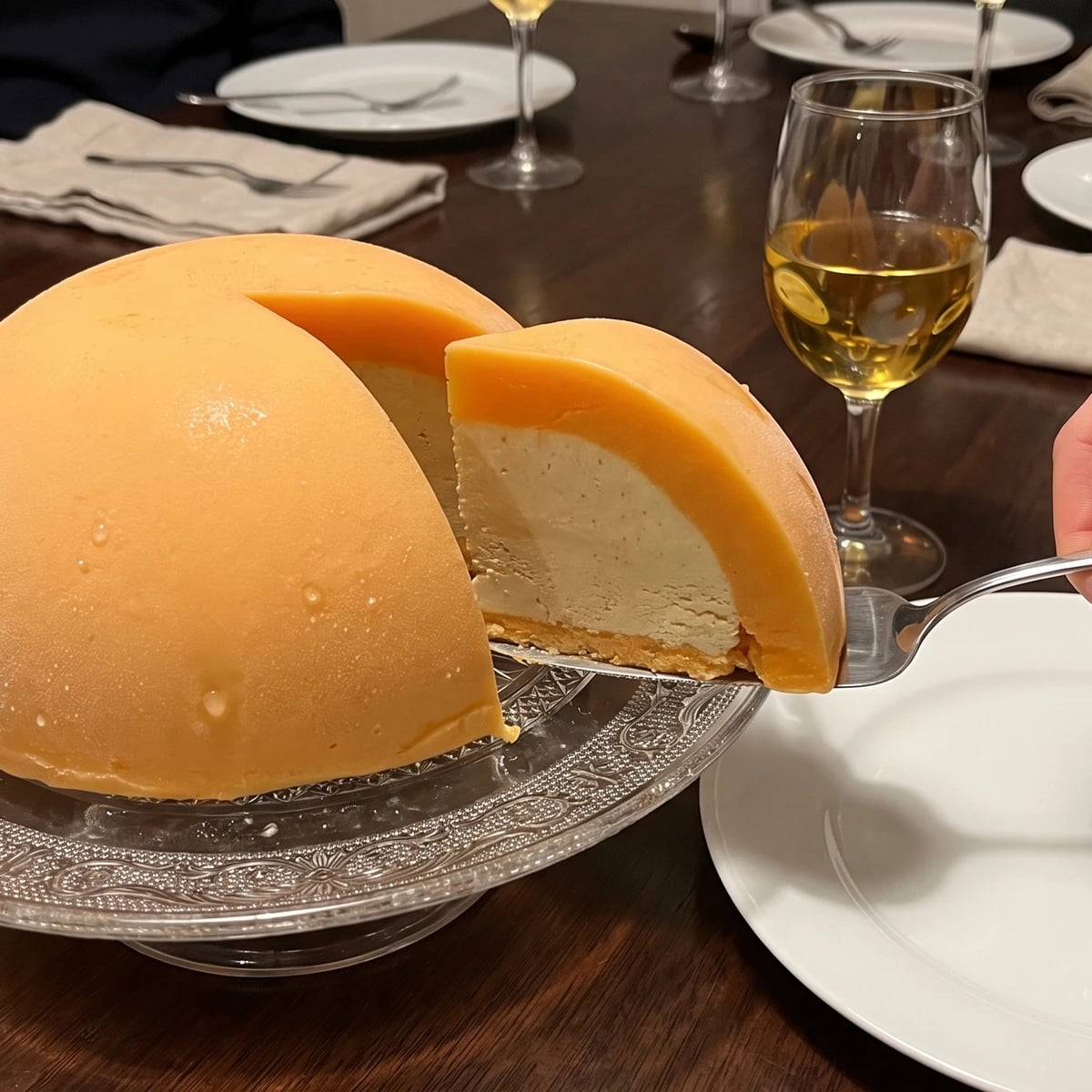
Bright apricot ice holds a pale, nut-rich pâte à bombe at its centre, sliced cold at the table to reveal the classical frozen dessert’s clean contrast of fruit, cream, and toasted hazelnut.

Desserts
French
Dinner Party
Make Ahead
Freezer Friendly
45 min
Active Time
15 min cook9 hr total
YieldOne 1-quart (1-liter) bombe, 6 servings

Bombe Mignon (an apricot ice dome filled with nut-enriched frozen cream) teaches the architecture of a bombe glacée: a bright, firm shell surrounding a softer, richer heart. The centre is pâte à bombe, egg yolks expanded with hot sugar syrup, lightened with real cream, and flavoured with hazelnuts. The one true thing to know before touching the pan is this: pound the nuts with some of the syrup, never dry. Dry pounding releases their oil and gives you a grey, heavy centre.

The original entry is a brigade command rather than a household recipe: clothe the mould with apricot ice, then fill it with nut Bombe-preparation. It assumed a glacier, the brigade’s frozen-dessert specialist, with prepared ices at hand, deep metal moulds packed in salted ice, and enough mixture for a dining room. Here the brigade quantity becomes one 1-quart mould, the salted-ice cabinet becomes an ordinary freezer, and an electric mixer carries the whisking. Those old service arrangements are scaffolding and can go. The apricot lining and syrup-cooked pâte à bombe are the dish, so both stay.

When cut, the bombe should show a clean apricot-orange ring around a pale hazelnut centre, one sharp and refreshing, the other round with yolk and cream. One cook, one stove, one evening; the freezer does the night shift. Before you begin, set the mould in the freezer and remember the nuts: syrup first, then pounding.

The bombe glacée belongs to Parisian pâtisserie and grand dining-room service, where glaciers layered contrasting ices in domed metal moulds packed with salt and ice. Its martial name comes from the mould’s rounded silhouette, while Bombe Mignon is distinguished by its apricot shell and nut Bombe-preparation. The pairing shows the classical method at work: one stable construction could carry many named combinations without losing its identity.

The technique, the tradition, and the story behind every dish.

Discover Culinary Explorer

Ingredients

unsweetened apricot purée

Quantity

2 cups (480 ml / 500 g)

thawed if frozen

granulated sugar, for the apricot ice

Quantity

1/2 cup (120 ml / 100 g)

water, for the apricot ice

Quantity

1/3 cup (80 ml / 80 g)

fresh lemon juice

Quantity

1 tablespoon (15 ml / 15 g)

skinned hazelnuts

Quantity

2/3 cup (160 ml / 85 g)

completely cooled

granulated sugar, for the pâte à bombe

Quantity

2/3 cup (160 ml / 135 g)

water, for the pâte à bombe

Quantity

1/3 cup (80 ml / 80 g)

large egg yolks

Quantity

4 (about 1/4 cup / 72 g)

cold heavy cream

Quantity

1 cup (240 ml / 240 g)

Another Method of Preparing Aspics de Filets de Soles

Quantity

1 procedural cross-reference, Another Method of Preparing Aspics de Filets de Soles (No. 916)

consulted only for clothing the mould; no part of the aspic enters the dessert

Equipment Needed

  • 1-quart (1-liter) metal bombe mould or round metal mixing bowl
  • Ice-cream maker, or shallow metal tray and food processor
  • Electric hand mixer or stand mixer
  • Small food processor or sturdy mortar and pestle
  • Sugar thermometer
  • Long slicing knife

Instructions

  1. 1

    Make the apricot ice

    Set a 1-quart (1-liter) metal bombe mould or round metal bowl in the freezer. Combine the sugar and water for the apricot ice in a small saucepan, warm just until the sugar dissolves, then cool completely. Blend the syrup with the apricot purée and lemon juice, chill until thoroughly cold, and churn until thick but still spreadable. If you have no ice-cream machine, freeze the mixture in a shallow metal tray and beat it smooth in a food processor every thirty minutes until evenly frozen; the texture will be slightly coarser, but the apricot will still clothe the mould properly.

  2. 2

    Clothe the mould

    The source points to Another Method of Preparing Aspics de Filets de Soles (No. 916) for the rocking action known as clothing the mould. Only the action crosses into this dessert, never the fish preparation. Press the semi-firm apricot ice over the bottom and sides of the frozen mould in an even layer about 1/2 inch (1.25 cm) thick, working quickly with the back of a cold spoon. Hold the mould toward the light and patch any thin places. If the ice slides toward the bottom, stop and freeze it for ten minutes before continuing. Ça se rattrape. Freeze the clothed mould for at least one hour, until the lining is hard enough to resist a fingertip.

    Keep the rim neat and the shell evenly thick. A very thick base gives a hard wedge of apricot ice, while a thin wall cracks during unmoulding.
  3. 3

    Pound the hazelnuts

    Combine the sugar and water for the pâte à bombe in a clean saucepan and warm gently until the syrup is perfectly clear. Remove three tablespoons (45 ml) of the warm syrup. Put the hazelnuts in a small processor or mortar, add two tablespoons of syrup, and pound to a smooth, dense paste. Keep the last spoonful of syrup nearby. Never pound these nuts dry: dry friction releases their oil, darkens the paste, and weighs down the finished centre. If the paste begins to look greasy, stop, chill it for ten minutes, then work in the reserved syrup a teaspoon at a time. Ça se rattrape.

  4. 4

    Whip the pâte à bombe

    Begin beating the yolks at medium speed. Return the remaining syrup to the heat and cook it without stirring to 244°F (118°C). If crystals form around the pan, add one tablespoon of water, cover for one minute, and let the condensation wash them down before cooking the syrup back to temperature. With the mixer running, pour the hot syrup into the yolks in a thin stream down the side of the bowl, never onto the moving beaters. Increase the speed and whip until the mixture triples in volume, falls in a thick ribbon, and the bowl feels barely warm. Beat in the hazelnut paste until no streaks remain.

  5. 5

    Fold in the cream

    Whip the cold cream to soft peaks that curl rather than stand stiffly. Stir one generous spoonful into the hazelnut pâte à bombe to loosen it, then fold in the remainder with broad strokes, turning the bowl as you work. Stop as soon as the mixture is uniform and buoyant. If you beat the cream until grainy, fold in a spoonful of unwhipped cream before combining it with the yolks; the extra liquid smooths the fat before it becomes butter.

  6. 6

    Fill and freeze

    Spoon the nut pâte à bombe into the hard apricot shell, pressing gently into the curve so no hollow pockets remain. Smooth the top level with the rim, cover the surface closely, and freeze for at least six hours, preferably overnight. The lining must be fully frozen before the filling enters; otherwise the two mixtures blur together and the clean apricot ring is lost.

  7. 7

    Unmould and serve

    Chill the serving platter. Wrap the mould for eight to ten seconds in a warm, well-wrung towel, invert it onto the platter, and lift straight upward. If it refuses to release, repeat for five seconds rather than forcing it. Should the surface soften, return the unmoulded bombe to the freezer for ten minutes. Let it stand for five minutes before slicing with a long knife dipped in hot water and wiped dry between cuts. The shell should cut cleanly while the centre yields softly. À table!

Chef Tips

  • The source gives its construction rather than household quantities. These amounts fill one 1-quart mould for six people; the change is scale alone, while the apricot shell, nut Bombe-preparation, and clothed-mould sequence remain intact.
  • Use unsweetened apricot purée with real acidity. Good frozen fruit is an honest choice when fresh apricots are woolly or out of season; thaw it, purée it smooth, and weigh the result before adding the syrup.
  • Skinned hazelnuts keep the centre smooth and clean-tasting. If yours retain their skins, warm them only enough to loosen those skins, rub them in a towel, and cool them completely before pounding.
  • For pregnant guests, young children, older guests, or anyone with reduced immunity, use pasteurized egg yolks. The hot syrup cooks the yolks considerably, but a home pâte à bombe is not a certified pasteurization process.
  • Serve with small glasses of Barsac or a bright apricot eau-de-vie, but not both. The bombe already carries enough sweetness and perfume to finish the meal.

Advance Preparation

  • The apricot mixture can be made and chilled two days ahead, then churned when you are ready to clothe the mould.
  • Assemble the entire bombe one to three days before the dinner. Keep it tightly covered so the apricot ice does not collect freezer odours or dry at the surface.
  • The bombe can be unmoulded onto its chilled platter up to thirty minutes before serving and returned to the freezer. Let it stand for five minutes at the table before cutting.

Frequently Asked Questions

Nutrition Information

1 serving (about 205g)

Calories
460 calories
Total Fat
27 g
Saturated Fat
11 g
Trans Fat
1 g
Unsaturated Fat
14 g
Cholesterol
175 mg
Sodium
20 mg
Total Carbohydrates
53 g
Dietary Fiber
3 g
Sugars
49 g
Protein
6 g

Note: Chef personas and recipes are created with AI assistance. Cook with care: follow safe food-handling practices, check doneness with a thermometer when needed, and adapt for allergies and your kitchen.

Where cooking meets culture.

Culinary guides, cultural storytelling, and the editorial depth that makes cooking meaningful.

Discover Culinary Explorer

More from Ices and Sherbets - Various Bombes

Browse the full collection