
Chef Juliette
Various Almond Preparations
Five almond preparations, one discipline: remove the skins cleanly, dry every kernel through, then cut, toast, or cloak it in pale caramel without letting its fragrant oils escape.
A cooking platform built around craft, culture, and the stories behind what we eat.
Created by Chef Juliette
Based on No. 2871, Bombe Margot, from Le Guide Culinaire (1907) by Auguste Escoffier
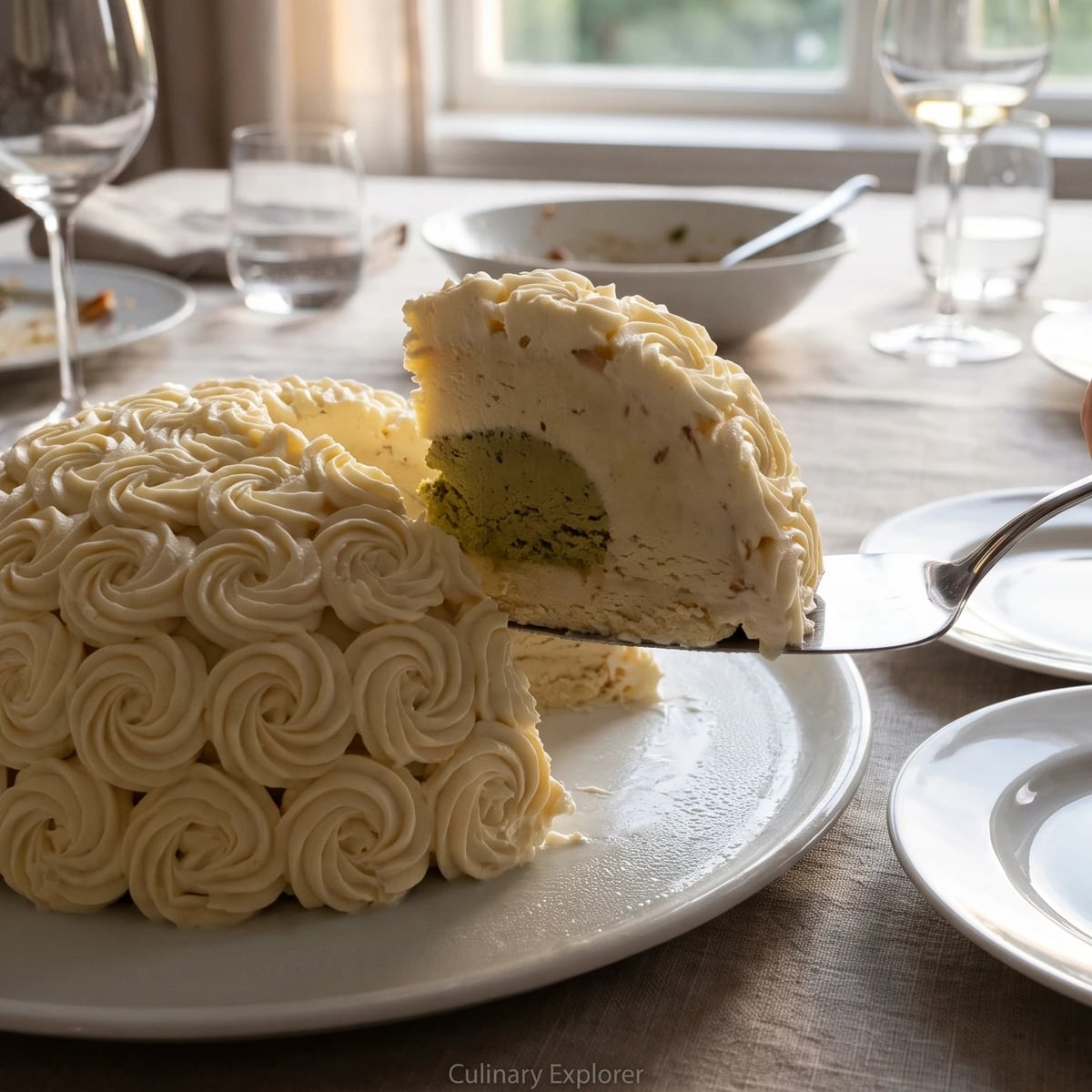
Almond ice forms the cold shell, pistachio pâte à bombe fills the heart, and piped vanilla finishes the dome. The lesson is temperature: freeze each layer hard, then decorate without dawdling.
Bombe Margot (an almond-lined pistachio frozen bombe) teaches one true thing before you touch a pan: cold is an ingredient. The almond ice must form a firm, even shell around an airy pistachio pâte à bombe, while the piped vanilla decoration must hold every ridge. Let one layer soften the next and the clean architecture disappears.
The original recipe assumed a glacier's station with several finished ices, metal moulds packed in ice and salt, and enough hands to unmould and pipe at once. Your honest equivalent is a cold home freezer, one small bombe mould, and one dense vanilla ice cream divided between two jobs. We blend part with almond praline paste for the lining and keep the rest for piping, while making the pistachio pâte à bombe because its light emulsion is the heart of the dish. The separate custard bases and repeated churning were brigade scaffolding; the almond shell, pistachio centre, and vanilla decoration are the dish, so all three stay.
Once turned out, the bombe begins softening from the surface inward. Work on a frozen platter, keep the piping bag cold, and return either one to the freezer the moment the vanilla loses its ridges. The decisive step comes earlier: chemiser, line the frozen mould, with one even coat of almond ice and freeze it completely before filling.
Bombe Margot belongs to the Parisian grande cuisine repertory of bombes glacées, elaborate frozen desserts assembled in domed metal moulds for formal tables. The word bombe describes that rounded mould, while Margot identifies this particular classical combination: almond ice outside, pistachio bombe preparation within, and vanilla ice cream added after unmoulding. No firmly documented Margot stands behind the name; the composition, rather than a biography, is what the canon preserves.
Quantity
3 cups (720 ml / 660 g)
divided and softened only as directed
Quantity
⅓ cup (80 ml / 90 g)
not marzipan
Quantity
⅛ teaspoon (0.6 ml / 1 g)
Quantity
4 (about 72 g)
Quantity
½ cup (120 ml / 100 g)
Quantity
¼ cup (60 ml / 60 g)
divided, using 3 tablespoons for the syrup and reserving up to 1 tablespoon for rescue
Quantity
⅓ cup (80 ml / 85 g)
Quantity
1 cup (240 ml / 240 g)
divided and very cold
Quantity
⅛ teaspoon (0.6 ml / 1 g)
Quantity
1 technique reference: Another Method of Preparing Aspics de Filets de Soles (No. 916), not an edible ingredient
consulted only for the mould-clothing principle
| Ingredient | Quantity |
|---|---|
| dense vanilla ice creamdivided and softened only as directed | 3 cups (720 ml / 660 g) |
| smooth white almond praline pastenot marzipan | ⅓ cup (80 ml / 90 g) |
| pure almond extract | ⅛ teaspoon (0.6 ml / 1 g) |
| large egg yolks | 4 (about 72 g) |
| granulated sugar | ½ cup (120 ml / 100 g) |
| waterdivided, using 3 tablespoons for the syrup and reserving up to 1 tablespoon for rescue | ¼ cup (60 ml / 60 g) |
| unsweetened smooth pistachio paste | ⅓ cup (80 ml / 85 g) |
| heavy cream, at least 35 percent fatdivided and very cold | 1 cup (240 ml / 240 g) |
| fine sea salt | ⅛ teaspoon (0.6 ml / 1 g) |
| Another Method of Preparing Aspics de Filets de Solesconsulted only for the mould-clothing principle | 1 technique reference: Another Method of Preparing Aspics de Filets de Soles (No. 916), not an edible ingredient |
Clear a flat shelf in a freezer holding at or below −18°C. Freeze the 1.2-liter bombe mould, serving platter, offset spatula, and piping tip for 30 minutes. Divide the vanilla ice cream while firm: set aside 1¾ cups (420 ml / 385 g) for the almond lining and keep the remaining 1¼ cups (300 ml / 275 g) frozen solid for decorating. The book's cross-reference, Another Method of Preparing Aspics de Filets de Soles (No. 916), supplies only the principle called clothing the mould; no fish preparation or aspic ingredient enters Bombe Margot.
Let the lining portion of vanilla ice cream stand just until a spoon can cut through it, usually 5 to 8 minutes. Beat a few spoonfuls into the almond praline paste until perfectly smooth, stir in the almond extract, then fold this mixture through the remaining lining ice cream. Spoon it into the frozen mould and chemiser, meaning line it, by pressing an even 1 to 1.5 cm coat over the bottom and sides with the frozen spatula. Hold the mould up to the light and patch every thin place, then freeze for at least 1 hour. If the lining slides or pulls away, it became too soft; freeze it for 10 minutes, press it back into place, and continue. Ça se rattrape.
Put the sugar and 3 tablespoons (45 ml / 45 g) water in a small heavy saucepan. Stir over gentle heat only until the sugar dissolves, then stop stirring and boil to 118°C. If crystals form into a white crust, remove the pan from the heat and carefully add some or all of the reserved tablespoon of water. Cover for 30 seconds over low heat so the condensation washes down the sides, then uncover and cook again to 118°C. Ça se rattrape; scraping crystals into the syrup does not.
While the syrup cooks, whisk the yolks in a heatproof bowl until pale and slightly thickened. With the mixer running at medium speed, pour the 118°C syrup in a thin stream down the inside of the bowl, safely clear of the moving beaters. Increase the speed and whisk for 7 to 10 minutes, until the pâte à bombe is very thick, holds a ribbon, and has cooled to room temperature. If the bowl still feels warm, set it over ice and keep whisking; warm pâte à bombe melts the cream, and no amount of hopeful folding will restore the lost air.
Mix the pistachio paste and salt with one-quarter of the pâte à bombe until smooth, then fold that loosened mixture through the rest. Reserve 2 tablespoons (30 ml / 30 g) of the cold cream and whip the remainder to soft peaks that bend at their tips. If the cream turns grainy, whisk in the reserved liquid cream by hand until it smooths. Fold one-third of the whipped cream into the pistachio mixture to lighten it, then fold in the remainder with broad strokes until no white streaks remain. Keep the air. It is the difference between a silken frozen centre and a green brick.
Check that the almond lining is completely hard. Spoon in the pistachio pâte à bombe, pressing it gently into the curve without gouging the shell, and level the exposed surface flush with the mould. Tap the mould once on a folded towel to settle any large air pocket, cover directly with parchment and then foil, and freeze for at least 6 hours, preferably overnight. This hard freeze is not waiting-room time; it is what lets the bombe leave its mould without the almond layer smearing.
Remove the parchment and place the frozen serving platter over the mould. Invert both together, then wrap the mould for 3 to 5 seconds in a towel wrung out in warm water. Lift the mould straight upward. If it resists, repeat with the warm towel for 2 seconds at a time rather than heating it longer. Should the almond surface soften or smear, smooth it with the frozen spatula and return the bombe to the freezer for 15 minutes. Never apologize at your own table. Fix it and carry on.
Fit a chilled piping bag with a 12 mm open-star tip. Let the reserved vanilla ice cream soften for 5 minutes, beat it briefly with a cold spoon until pipeable but still firm, and load only half the bag at a time. Pipe close rows of rosettes or fluted shells over the dome, returning the unused ice cream to the freezer. Work quickly once the bombe is out; the piped shell melts as you go. If the ridges begin slumping, put both bag and bombe back in the freezer for 5 to 10 minutes, then resume. Freeze the decorated bombe for 30 minutes, temper it for 5 minutes before cutting, and slice with a hot, thoroughly dried knife. À table!
1 serving (about 160g)
Culinary guides, cultural storytelling, and the editorial depth that makes cooking meaningful.
Discover Culinary Explorer
Chef Juliette
Five almond preparations, one discipline: remove the skins cleanly, dry every kernel through, then cut, toast, or cloak it in pale caramel without letting its fragrant oils escape.

Chef Juliette
A pastry pantry lesson in one tray: filberts warmed only until their red skins release, rubbed clean, cooled, and chopped into a fragrant mise-en-place for cakes, creams, pralines, and petits fours.

Chef Juliette
The smallest pâtisserie discipline decides whether a cake leaves its mould intact: clarified butter in every corner, followed by the lightest veil of dry flour or fécule.

Chef Juliette
Four whites, one spotless bowl, and a patient change of speed: whisk gently until loosened, then briskly to glossy stiffness, with powdered sugar waiting if the foam begins to granulate.