
Chef Juliette
Various Almond Preparations
Five almond preparations, one discipline: remove the skins cleanly, dry every kernel through, then cut, toast, or cloak it in pale caramel without letting its fragrant oils escape.
A cooking platform built around craft, culture, and the stories behind what we eat.
Created by Chef Juliette
Based on No. 2869, Bombe Maltaise, from Le Guide Culinaire (1907) by Auguste Escoffier
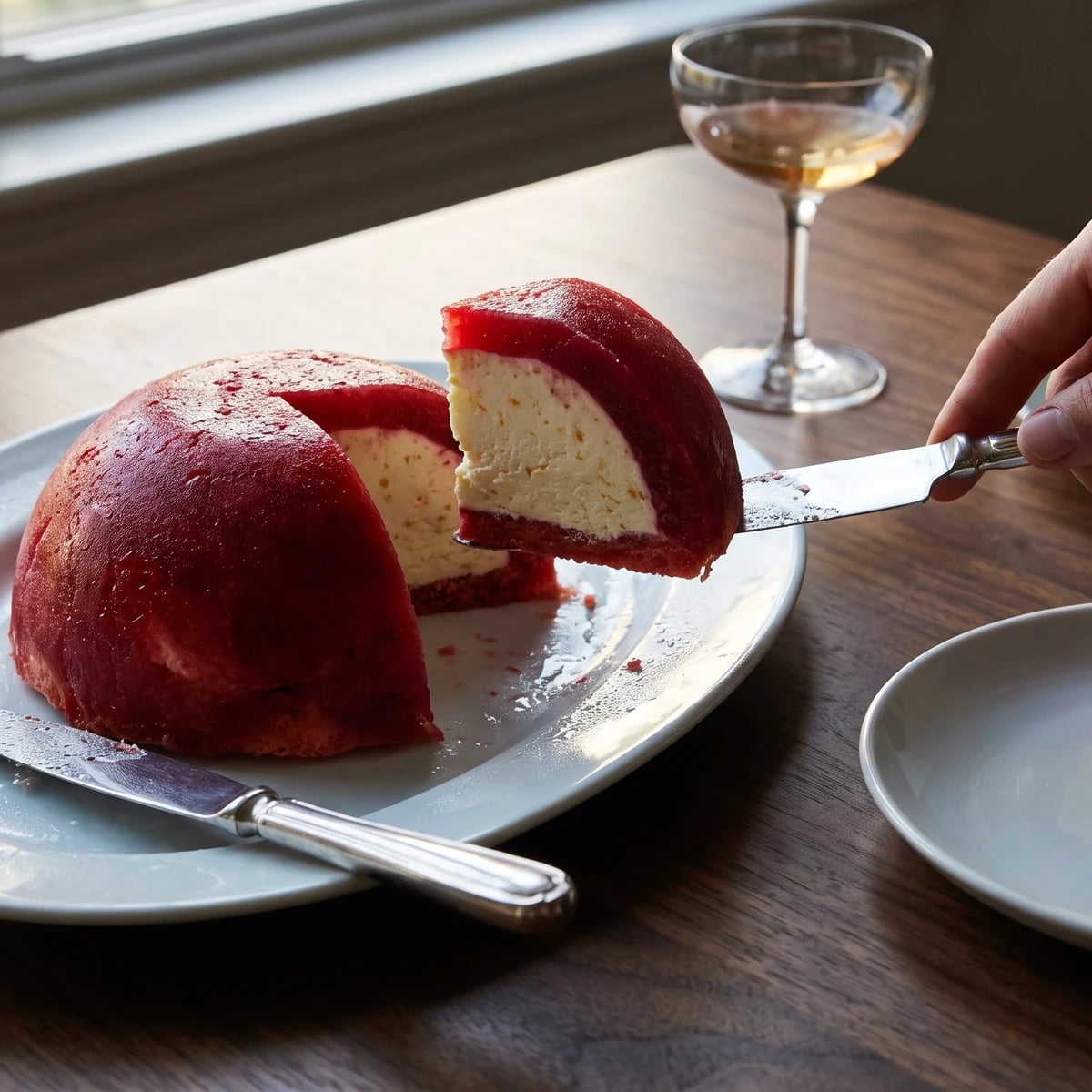
A crimson shell of blood-orange ice closes around softly whipped tangerine Chantilly, giving a clean citrus snap before the cream melts, fragrant and light, at the center.
Bombe Maltaise (blood-orange ice around tangerine Chantilly) teaches the grammar of the frozen mould: one flavor forms the shell, another fills it, and the cut slice must keep both clear. The one true thing to know before you touch a pan is this: the cream stops at soft peaks. Take it farther and it freezes waxy, with a chalky finish no amount of thawing can charm away.
The original instruction assumed a glacier, the cook assigned to ices, a bombe mould nested in salted ice, and both mixtures ready on command. At home, a 1.5-liter metal bowl, an ice-cream machine or shallow tray, and a cold freezer do the same honest work. I cut the brigade quantity to one eight-serving bombe and removed only the station's holding equipment; the blood-orange shell, the tangerine Chantilly, and the clothing of the mould are the dish and remain untouched. One cook, one stove, one evening.
When it is right, the first cut shows a dark crimson curve around pale, fragrant cream, the orange ice bright on the tongue before the Chantilly melts. Before you begin, clear a level freezer shelf and chill the mould thoroughly. An even frozen shell is the step that decides whether the first slice stands clean.
Bombe Maltaise belongs to the Parisian classical table of moulded frozen entremets, where a bombe meant a rounded metal mould lined with one frozen mixture and filled with another. Maltaise points not to a Maltese pudding but to the blood orange long associated in French kitchens with Malta, while the reference to Another Method of Preparing Aspics de Filets de Soles (No. 916) shows that aspics and frozen sweets shared the same mould-clothing grammar. Dependable home freezing carried the form from the pastry station to the dinner table without changing its essential contrast of bright ice and soft cream.
Quantity
¾ cup (180 ml / 150 g)
Quantity
½ cup (120 ml / 120 g)
Quantity
2 cups (480 ml / 480 g)
strained
Quantity
1½ tablespoons (22 ml / 22 g)
Quantity
⅛ teaspoon (0.6 ml / 0.7 g)
Quantity
1½ cups (360 ml / 360 g)
divided
Quantity
⅓ cup (80 ml / 40 g)
sifted
Quantity
Finely grated zest of 2 medium tangerines
Quantity
1 tablespoon (15 ml / 15 g)
strained
Quantity
1 reference: Another Method of Preparing Aspics de Filets de Soles (No. 916), none incorporated
| Ingredient | Quantity |
|---|---|
| granulated sugar | ¾ cup (180 ml / 150 g) |
| water | ½ cup (120 ml / 120 g) |
| freshly squeezed blood-orange juicestrained | 2 cups (480 ml / 480 g) |
| fresh lemon juice | 1½ tablespoons (22 ml / 22 g) |
| fine sea salt | ⅛ teaspoon (0.6 ml / 0.7 g) |
| cold heavy creamdivided | 1½ cups (360 ml / 360 g) |
| confectioners' sugarsifted | ⅓ cup (80 ml / 40 g) |
| tangerine zest | Finely grated zest of 2 medium tangerines |
| fresh tangerine juicestrained | 1 tablespoon (15 ml / 15 g) |
| technique reference for clothing the mould only | 1 reference: Another Method of Preparing Aspics de Filets de Soles (No. 916), none incorporated |
Clear a level freezer shelf. Put a 1.5-liter metal bombe mould or stainless-steel bowl in the freezer for at least 30 minutes, along with the serving platter. Chill a mixing bowl and whisk separately for the Chantilly. Metal catches the cold quickly and releases the finished bombe cleanly; a thick glass bowl insulates too well for this work.
Combine the sugar and water in a small saucepan. Warm gently, stirring only until the sugar dissolves and the syrup turns clear; it must not color. Cool for 10 minutes, then stir in the blood-orange juice, lemon juice, and salt. The lemon sharpens the orange without announcing itself. Chill the mixture thoroughly, about 45 minutes, because a warm base churns slowly and forms coarse crystals.
Churn the blood-orange mixture in an ice-cream machine until dense, smooth, and soft enough to spread, usually 20 to 30 minutes. Without a machine, pour it into a shallow metal pan, freeze it, and beat it firmly with a fork every 30 minutes until the crystals are fine and the mixture holds on a spoon. If it freezes solid before the mould is ready, ça se rattrape: move it to the refrigerator for 10 minutes, then beat it back to a thick slush.
Chemiser le moule, clothing the mould, is the operation that defines the bombe. Reach for the principle preserved in Another Method of Preparing Aspics de Filets de Soles (No. 916): reserve about 1 cup (240 ml) of the soft blood-orange ice, then press the remainder evenly against the bottom and sides of the frozen mould, making a layer about ⅓ inch (8 mm) thick. The cited preparation supplies the technical reference only; none of its savory contents enters this dessert. Freeze the shell for 20 minutes, inspect it against the light, and patch any thin or bare spots with more orange ice. The brigade's salted-ice tub can go. This clear, even shell cannot.
Set aside 2 tablespoons (30 ml / 30 g) of the cold cream. Rub the tangerine zest into the confectioners' sugar with your fingertips, releasing the fragrant oils, then add this sugar to the remaining cream in the chilled bowl. Whisk only until the cream forms soft peaks whose tips bend over. At the first grainy look, stop. Ça se rattrape: fold in the reserved liquid cream a teaspoon at a time until smooth. If the cream reached soft peaks properly, fold in the reserved cream at once to keep the filling supple, then fold in the tangerine juice one teaspoon at a time. Distinct butter grains mean the rescue window has closed; save that butter and begin the Chantilly again.
Spoon the tangerine Chantilly into the frozen orange shell, pressing it gently toward the sides so no hollow pockets remain. Stop about ⅓ inch (8 mm) below the rim and smooth the surface. Freeze for 20 minutes, just until the cream holds when touched. Stir the reserved blood-orange ice until spreadable, then cover the cream from edge to edge, sealing it completely inside the mould.
Cover the mould tightly and freeze it on the level shelf for at least 4 hours, or overnight. The center must be firm enough to support the orange shell when inverted, but the Chantilly should remain softer than the surrounding ice. This is why the cream stops at soft peaks and why no yolk custard belongs here.
Dip the mould up to its rim in warm, not hot, water for 5 to 8 seconds. Dry it, invert it onto the frozen platter, and lift steadily. If it refuses, dip it again for only 2 seconds; patience, not hotter water. Should the surface soften, return the unmoulded bombe to the freezer for 10 minutes. Let it stand for 5 minutes before cutting, then use a knife warmed in hot water and dried between every slice. À table!
1 serving (about 150g)
Culinary guides, cultural storytelling, and the editorial depth that makes cooking meaningful.
Discover Culinary Explorer
Chef Juliette
Five almond preparations, one discipline: remove the skins cleanly, dry every kernel through, then cut, toast, or cloak it in pale caramel without letting its fragrant oils escape.

Chef Juliette
A pastry pantry lesson in one tray: filberts warmed only until their red skins release, rubbed clean, cooled, and chopped into a fragrant mise-en-place for cakes, creams, pralines, and petits fours.

Chef Juliette
The smallest pâtisserie discipline decides whether a cake leaves its mould intact: clarified butter in every corner, followed by the lightest veil of dry flour or fécule.

Chef Juliette
Four whites, one spotless bowl, and a patient change of speed: whisk gently until loosened, then briskly to glossy stiffness, with powdered sugar waiting if the foam begins to granulate.