Culinary Explorer

A cooking platform built around craft, culture, and the stories behind what we eat.
Discover Culinary Explorer
Bombe Czarine

Bombe Czarine

Created by Chef Juliette

Based on No. 2847, Bombe Czarine, from Le Guide Culinaire (1907) by Auguste Escoffier

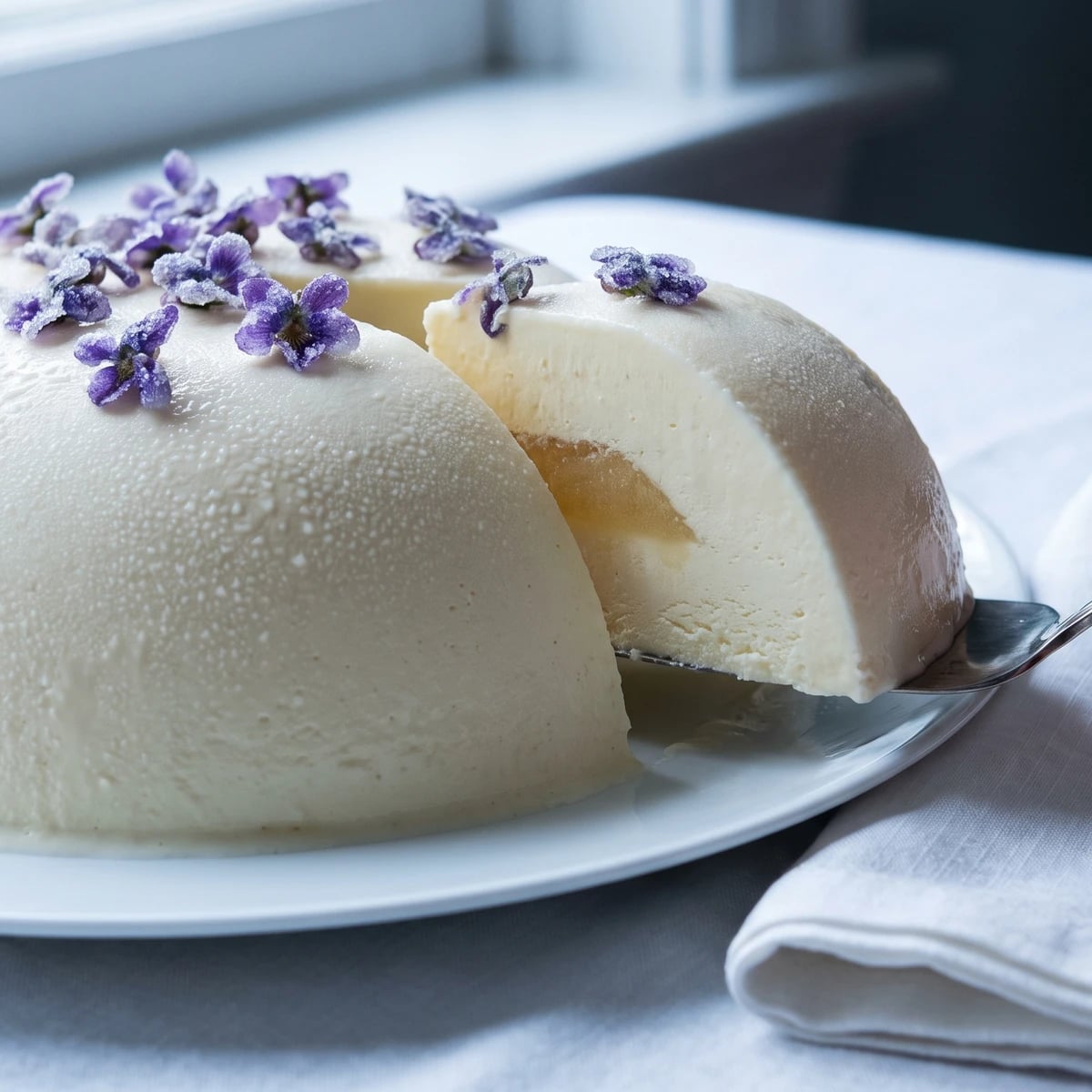
Vanilla ice holds a silken Kümmel pâte à bombe beneath crystallised violets, a formal frozen dessert made practical for one mould, one mixer, and a patient home freezer.

Desserts
French
Special Occasion
Celebration
Make Ahead
45 min
Active Time
10 min cook10 hr 30 min total
YieldOne 1.25 litre bombe (8 servings)

Bombe Czarine (a moulded vanilla ice with a Kümmel cream centre) teaches the discipline behind every bombe glacée: one layer must be truly set before the next arrives. The one true thing to know before you touch a pan is this: the vanilla shell must be frozen hard, not merely cold, or the filling will blur its clean white wall. Get that shell right and each slice shows two precise textures, firm vanilla outside and a softer, silken centre within.

The original formula assumes a pastry department can reach for prepared vanilla ice and bombe mixture, while a metal mould is rocked over broken ice by hands with no other supper to make. At home, good vanilla ice cream is the honest finished vanilla ice, a small pâte à bombe (egg yolks whipped with hot sugar syrup) is made in one bowl, and the freezer replaces the broken-ice station. I have scaled the brigade piece to a 1.25 litre mould for eight and kept what is the dish: clothing the mould evenly, cooling the yolk base completely, and freezing it solid. The repeated rocking was brigade scaffolding; firm freezer rests do the same work. One cook, one stove, one evening.

Kümmel carries caraway and can bully vanilla, so measure it with a teaspoon, not courage. Fold it into the cooled base, fill the hard shell, and leave the freezer to finish the work. If either component softens, stop and chill it until it behaves. Ça se rattrape. The crucial moment is the fill: hard shell, cool centre, quick hands.

Bombe Czarine belongs to the Parisian grand-kitchen repertory of bombes glacées, moulded desserts built with an outer ice and a richer bombe preparation within. Its name is a menu fantasy rather than evidence of a Russian regional sweet: Kümmel brings the caraway perfume of northern and eastern European tables, while crystallised violets supply the French confectioner's finish. The appeal to Another Method of Preparing Aspics de Filets de Soles (No. 916) is technical, not culinary; it shows that clothing a mould, laying down an even set lining before filling, was the same grammar in the cold savoury kitchen and the pastry room.

The technique, the tradition, and the story behind every dish.

Discover Culinary Explorer

Ingredients

good vanilla ice cream

Quantity

3 cups (710 ml / 540 g)

softened only until spreadable

pasteurised egg yolks

Quantity

5 large (about 90 g)

superfine sugar

Quantity

½ cup (120 ml / 100 g)

water

Quantity

¼ cup (60 ml / 60 g)

cold heavy cream

Quantity

¾ cup (180 ml / 180 g)

Kümmel liqueur

Quantity

2 teaspoons (10 ml / 9 g)

crystallised violets

Quantity

¼ cup (60 ml / 15 g)

for decorating

mould-clothing technique, no fish preparation enters the dessert

Quantity

1 application from Another Method of Preparing Aspics de Filets de Soles (No. 916)

Equipment Needed

  • 1.25 litre (5-cup) metal bombe mould or stainless-steel bowl
  • Small heavy saucepan
  • Digital sugar thermometer
  • Stand mixer or electric hand mixer
  • Small offset spatula
  • Chilled serving platter

Instructions

  1. 1

    Chill the mould

    Put a 1.25 litre metal bombe mould or stainless-steel bowl in the freezer for 30 minutes. Move the vanilla ice cream to the refrigerator for 10 to 15 minutes, just until a spoon can press through it. It must bend without flowing. If the edges begin to melt, return it to the freezer for 10 minutes; melted ice cream refreezes coarse, while merely softened ice cream keeps its fine texture.

  2. 2

    Clothe the mould

    Spoon the softened vanilla ice into the cold mould and press it over the bottom and sides with a chilled spoon or small offset spatula, building an even layer 1½ to 2 cm thick. This is clothing the mould, the operation demonstrated in Another Method of Preparing Aspics de Filets de Soles (No. 916); only the technique crosses into this dessert, never the fish preparation. Hold the mould against the light and fill any thin shadows, then freeze it for at least 1 hour, until the lining is hard enough that a fingertip leaves no mark.

    If the ice cream drags away from the metal, freeze the first rough layer for 10 minutes and patch it with a second pass. Ça se rattrape, and two thin passes are often neater than one heavy one.
  3. 3

    Cook the syrup

    Put the sugar and water in a small heavy saucepan. Warm gently, stirring only until the sugar dissolves, then bring it to a boil. Cover for 2 minutes so condensation washes stray crystals from the sides, uncover, and cook without stirring to 118°C (244°F). If the syrup crystallises, stop the heat, add 1 tablespoon (15 ml / 15 g) water, and dissolve it again gently before continuing. Don't scrape crystals from the pan wall into the clear syrup.

  4. 4

    Whip the pâte

    Begin beating the yolks at medium speed until they turn pale and slightly thick. With the mixer running, pour the hot syrup in a thin stream between the whisk and the side of the bowl. Keep beating at high speed until the pâte à bombe is voluminous, holds a broad ribbon, and the bowl feels no warmer than the room, about 8 minutes. If a few hard sugar threads form against the bowl, leave them there rather than scraping them into the base; the smooth centre is still sound.

  5. 5

    Cool and flavour

    Check that the pâte à bombe is below 26°C (78°F), then beat in the measured Kümmel. If the base remains warm, set the bowl briefly over ice water and whisk until cool, keeping every drop of water outside the bowl. Warm pâte à bombe melts whipped cream, and no amount of vigorous folding will repair that. Cold first, then cream.

  6. 6

    Fold the cream

    Reserve 1 tablespoon of the cream, then whip the rest to soft peaks that curl over when the whisk is lifted. If it turns grainy, whisk in the reserved liquid cream a teaspoon at a time until it smooths. Fold one-third into the Kümmel base to lighten it, then fold in the remainder with broad turns, stopping as soon as no white streaks remain. The finished preparation should be light but spoonable, not liquid.

  7. 7

    Fill and freeze

    Take the mould from the freezer and inspect the vanilla lining. If any patch has softened, freeze it again before proceeding. Spoon in the Kümmel bombe preparation, pressing gently into the curve so no hollow pockets remain, and level it flush with the rim. Cover the surface directly with baking parchment, then wrap the mould and freeze for at least 8 hours, preferably overnight, until solid through the centre.

  8. 8

    Turn out and finish

    Chill the serving platter. Remove the wrapping and dip only the outside of the mould into lukewarm water for 5 seconds, then dry it and invert it onto the platter. If the bombe doesn't release, wrap the mould for another 5 seconds in a warm damp towel; don't keep soaking it or the vanilla details will melt. Return a softened bombe to the freezer for 15 minutes, then crown it generously with the crystallised violets. Cut with a knife warmed in hot water and wiped dry between slices. À table!

Chef Tips

  • Use a clear, sweet Kümmel liqueur whose first perfume is caraway. Aquavit is drier and harsher, while loose caraway seeds would spoil the centre's silk. Two teaspoons are enough; more alcohol also prevents a clean freeze.
  • A metal bombe mould conducts cold quickly, but a 1.25 litre stainless-steel mixing bowl gives the same smooth dome. The old broken-ice station is unnecessary once the home freezer is used in firm, deliberate rests.
  • Choose dense vanilla ice cream made with cream and real vanilla. A highly aerated frozen dessert collapses while you spread it and gives the shell a weak, bubbly texture.
  • Crystallised violets soften in damp air. Keep them sealed and dry until the bombe is turned out, then add them at the last moment so their sugar remains crisp under the teeth.

Advance Preparation

  • Clothe the mould with vanilla ice up to a day before making the centre. Cover it well once hard so it doesn't collect freezer aromas.
  • The assembled bombe may be frozen for up to 3 days. Once solid, wrap the mould closely to protect the vanilla shell from frost.
  • Turn it out shortly before serving and return it to the freezer on its platter if necessary. Add the crystallised violets only at the table.

Frequently Asked Questions

Nutrition Information

1 serving (about 124g)

Calories
310 calories
Total Fat
19 g
Saturated Fat
11 g
Trans Fat
1 g
Unsaturated Fat
7 g
Cholesterol
180 mg
Sodium
70 mg
Total Carbohydrates
32 g
Dietary Fiber
0 g
Sugars
30 g
Protein
5 g

Note: Chef personas and recipes are created with AI assistance. Cook with care: follow safe food-handling practices, check doneness with a thermometer when needed, and adapt for allergies and your kitchen.

Where cooking meets culture.

Culinary guides, cultural storytelling, and the editorial depth that makes cooking meaningful.

Discover Culinary Explorer

More from Ices and Sherbets - Various Bombes

Browse the full collection