
Chef Juliette
Various Almond Preparations
Five almond preparations, one discipline: remove the skins cleanly, dry every kernel through, then cut, toast, or cloak it in pale caramel without letting its fragrant oils escape.
A cooking platform built around craft, culture, and the stories behind what we eat.
Created by Chef Juliette
Based on No. 2837, Bombe Batavia, from Le Guide Culinaire (1907) by Auguste Escoffier
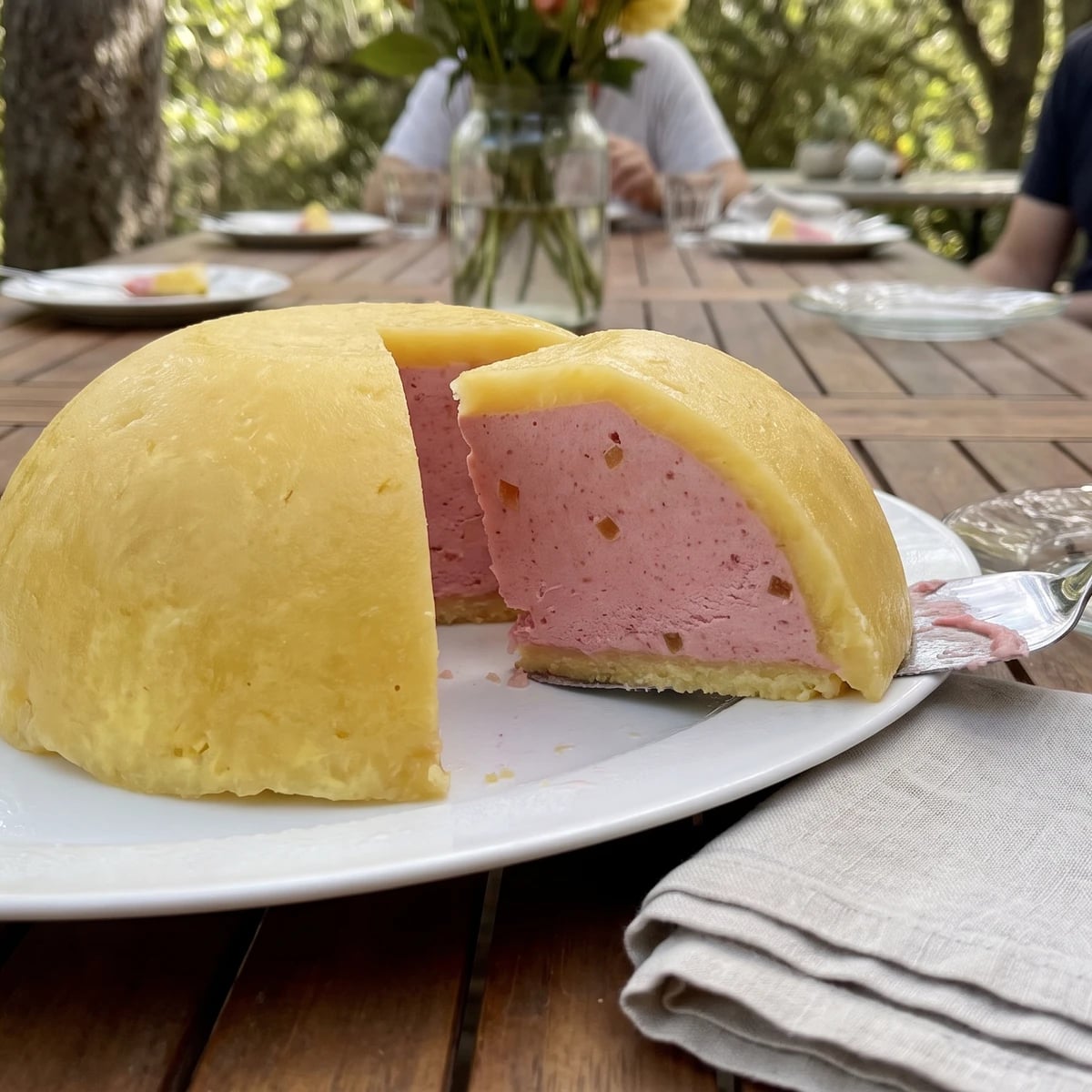
Golden pineapple ice around a rose-pink strawberry pâte à bombe, sharpened by tiny dice of candied ginger: a classical frozen centrepiece translated for one mould, one freezer, and one attentive home cook.
Bombe Batavia (a pineapple-lined strawberry frozen bombe) teaches the architecture of a bombe glacée, a moulded frozen dessert with a bright ice shell around a richer, softer heart. The one true thing to know before you heat the sugar is that frozen desserts are built by temperature, not force. The pineapple ice must be firm enough to hold its wall, and the strawberry filling must be cool and supple enough to settle inside without melting it.
The original entry assumed a glacier at the frozen-dessert station, a sorbetière packed with salted ice, several moulds held over broken ice, and enough hands to assemble brigade portions at speed. Your honest equivalents are a 1.5-liter metal bowl, a domestic freezer, and an ice cream maker or shallow freezing pan. The rocking of the mould on broken ice can go; that was service scaffolding. The even pineapple shell, the strawberry pâte à bombe, and the finely diced candied ginger are the dish itself, so all three stay. One cook, one stove, one evening, followed by a quiet night in the freezer.
Turned out, the Bombe Batavia is golden outside and rose-pink within, with pineapple freshness giving way to cream, strawberry, and a measured spark of ginger. Before you meet the hot syrup, freeze the pineapple lining until it is hard from rim to base. That shell is the step that decides the Bombe Batavia.
Bombe glacée belongs to the grand Parisian dessert table, where pâtissiers used deep moulds to arrange contrasting colours, flavours, and textures before service. Batavia was the European trading name for Jakarta, and the title points to the pineapple and preserved ginger that reached French kitchens through colonial trade, not to an Indonesian regional recipe. The reference to an aspic method is practical rather than savory: grand kitchens used the same chemisage, or clothing of a mould, whether the setting layer was jelly or fruit ice.
Quantity
1 batch, according to Another Method of Preparing Aspics de Filets de Soles (No. 916)
made from the pineapple, sugar, and water below
Quantity
2½ cups (600 ml / 400 g)
thoroughly drained
Quantity
½ cup (120 ml / 100 g)
Quantity
½ cup (120 ml / 120 g)
Quantity
2 cups (480 ml / 300 g)
enough to yield about 1 cup strained purée
Quantity
⅓ cup (80 ml / 70 g)
Quantity
2 tablespoons (30 ml / 30 g)
Quantity
3
Quantity
1 cup (240 ml / 240 g)
Quantity
¼ cup (60 ml / 40 g)
cut into 2 to 3 mm dice
| Ingredient | Quantity |
|---|---|
| pineapple ice for clothing the mouldmade from the pineapple, sugar, and water below | 1 batch, according to Another Method of Preparing Aspics de Filets de Soles (No. 916) |
| ripe pineapple flesh or unsweetened canned pineapple chunks in juicethoroughly drained | 2½ cups (600 ml / 400 g) |
| granulated sugar for the pineapple ice | ½ cup (120 ml / 100 g) |
| water for the pineapple ice | ½ cup (120 ml / 120 g) |
| hulled strawberriesenough to yield about 1 cup strained purée | 2 cups (480 ml / 300 g) |
| granulated sugar for the pâte à bombe | ⅓ cup (80 ml / 70 g) |
| water for the pâte à bombe | 2 tablespoons (30 ml / 30 g) |
| large egg yolks | 3 |
| cold heavy cream | 1 cup (240 ml / 240 g) |
| candied gingercut into 2 to 3 mm dice | ¼ cup (60 ml / 40 g) |
Combine the ½ cup sugar and ½ cup water in a small saucepan. Warm gently, stirring only until the sugar has dissolved, then remove it from the heat without reducing it. Cool for 10 minutes. Blend the syrup with the drained pineapple until completely smooth, then pass it through a fine sieve if the fruit is fibrous. Chill the mixture for at least 2 hours; a warm base freezes coarsely, while a properly cold one churns into a supple ice.
Churn the cold pineapple mixture in an ice cream maker until thick, smooth, and just firm enough to hold a ridge from the paddle. Without a machine, freeze it in a shallow metal pan and scrape it vigorously every 30 minutes until evenly slushy, then process it briefly until smooth. Chill the empty 1.5-liter metal mould in the freezer for at least 30 minutes while the ice churns.
Reserve ½ cup (120 ml / about 110 g) pineapple ice for sealing the bombe. The book points to Another Method of Preparing Aspics de Filets de Soles (No. 916) for chemiser, to clothe the mould with an even setting layer. Press half the remaining pineapple ice over the base and sides of the frozen mould, making an unbroken coat, then freeze it for 20 minutes. Add the rest wherever the shell looks thin, aiming for a wall 1 to 1¼ cm thick, and freeze until hard. If the ice slides toward the base, it is merely too soft: scrape it back into its bowl, chill it for 10 minutes, and begin again. Ça se rattrape. The brigade's rocking of a mould over broken ice was scaffolding; the continuous frozen shell is the dish and must stay.
Purée the strawberries and press them through a fine sieve, measuring 1 cup (240 ml / about 250 g). Keep the purée cold. Whip the heavy cream until it holds soft, rounded peaks, stopping before it becomes stiff or grainy, then refrigerate it. Cut the candied ginger into exact 2 to 3 mm dice. A large piece freezes hard and stops the spoon, so this small knife work matters.
Begin beating the yolks at medium speed in a heatproof bowl. Put the ⅓ cup sugar and 2 tablespoons water in a small clean saucepan, bring them to a boil, and cook without stirring to 118°C or 244°F. If crystals form around the pan, add 1 tablespoon water, cover for 30 seconds, and let the moisture wash them down before continuing. With the mixer running, pour the hot syrup in a thin stream down the inside of the bowl, clear of the beaters and your hands. Beat for 5 to 7 minutes, until the pâte à bombe, a cooked-yolk foam, is pale, thick enough to fall in ribbons, and no longer warm against the bowl.
Fold the cold strawberry purée into the pâte à bombe until the colour is even. Fold in one-third of the softly whipped cream to loosen the mixture, then the remainder with broad, gentle strokes. Fold in the finely diced ginger last. Spoon the filling into the hard pineapple shell, pressing lightly into the curve so no large pockets remain, and stop about 1 cm below the rim. If the shell begins to soften, return both mould and filling to the freezer for 10 minutes before continuing. Spread the reserved pineapple ice across the top to meet the frozen sides and seal the filling completely.
Cover the mould tightly and freeze it upright for at least 8 hours, preferably overnight. Do not hurry this freeze. The strawberry centre contains more cream and air than the pineapple shell, so it needs the full rest to become sliceable without turning hard and dull.
Chill the serving platter. Dip only the outside of the mould into warm water for 5 seconds, wipe it dry, cover it with the platter, and invert firmly. If the bombe does not release, repeat the dip for 2 or 3 seconds rather than forcing it with a knife. Should the surface soften too far, leave the inverted mould and platter in the freezer for 10 minutes, then lift the mould away. Rest the bombe for 5 minutes before cutting it with a knife dipped in hot water and wiped dry between slices. The pineapple shell should yield cleanly to the spoon, revealing the rose-pink strawberry centre and its tiny amber dice of ginger. À table!
1 serving (about 155g)
Culinary guides, cultural storytelling, and the editorial depth that makes cooking meaningful.
Discover Culinary Explorer
Chef Juliette
Five almond preparations, one discipline: remove the skins cleanly, dry every kernel through, then cut, toast, or cloak it in pale caramel without letting its fragrant oils escape.

Chef Juliette
A pastry pantry lesson in one tray: filberts warmed only until their red skins release, rubbed clean, cooled, and chopped into a fragrant mise-en-place for cakes, creams, pralines, and petits fours.

Chef Juliette
The smallest pâtisserie discipline decides whether a cake leaves its mould intact: clarified butter in every corner, followed by the lightest veil of dry flour or fécule.

Chef Juliette
Four whites, one spotless bowl, and a patient change of speed: whisk gently until loosened, then briskly to glossy stiffness, with powdered sugar waiting if the foam begins to granulate.