
Chef Juliette
Smelt (Éperlans)
Tiny éperlans, lightly floured and fried until their tails stand crisp, arrive in a generous heap on a napkin with fried parsley and grooved lemon, a weeknight lesson in heat and restraint.
A cooking platform built around craft, culture, and the stories behind what we eat.

Created by Chef Juliette
Based on No. 280, Butters and Creams, from Le Guide Culinaire (1907) by Auguste Escoffier
Beurres et crèmes d’hors-d’œuvre prove that cold-table finesse is mostly timing: smooth good dairy, cover it closely, hold it cool, then season only as you dish so every spoonful keeps a clean edge.
Beurres et crèmes d’hors-d’œuvre (cold-table butters and creams) teach one precise rule: prepare the dairy ahead if you wish, but season it only when you dish it. The source gives no flavour formula, and that absence is part of the instruction. No invented herbs, mustard, or fish paste belong here. These are neutral bases whose clean dairy character is finished at the last moment.
The original assumed a garde-manger tending bowls in a genuinely cool pantry. Your equivalent is a refrigerator, with parchment pressed against each surface so neither butter nor cream forms a skin or collects the smell of last night’s onions. The entry supplies no brigade ratio to reduce, so this practical home batch makes one cup of each, enough for eight guests. The cool pantry and clean paper were scaffolding; close covering, proper temperature, and late seasoning are the dish.
Done properly, the butter remains butter-gold, matte, and sharply ridged beneath the spoon, while the crème fraîche stays ivory, dense, and cool. Butter must be pliable, cream must be cold, and the salt must wait until the serving platter is in front of you. That last timing is the one step that matters most.
Beurres et crèmes d’hors-d’œuvre belong to the Parisian cold table, where the garde-manger kept small savoury preparations ready to open a formal meal. The practice travelled easily into bourgeois dining rooms because it required no grand apparatus, only good dairy, a truly cool place, and protection from air and kitchen odours. Its particular discipline concerns service rather than ornament: advance work stops at smoothing, covering, and chilling, while seasoning waits until the moment of dishing.
Quantity
1 cup (240 ml / 225 g)
cool but pliable
Quantity
1 cup (240 ml / 240 g)
thoroughly chilled
Quantity
½ teaspoon (2.5 ml / 3 g)
divided and added only at serving
Quantity
1 loaf (about 9 oz / 250 g)
thinly sliced
Quantity
1 bunch (about 8 oz / 225 g)
trimmed and washed
| Ingredient | Quantity |
|---|---|
| cultured unsalted buttercool but pliable | 1 cup (240 ml / 225 g) |
| full-fat crème fraîchethoroughly chilled | 1 cup (240 ml / 240 g) |
| fine sea saltdivided and added only at serving | ½ teaspoon (2.5 ml / 3 g) |
| small baguette (optional)thinly sliced | 1 loaf (about 9 oz / 250 g) |
| breakfast radishes (optional)trimmed and washed | 1 bunch (about 8 oz / 225 g) |
Let the butter stand just until it yields beneath a fingertip while remaining matte, usually about twenty minutes in a temperate kitchen. Keep the crème fraîche in the refrigerator. Butter that is too cold breaks into chips, while butter that is too warm turns shiny and greasy; if it begins to glisten, return it to the cold for ten minutes before continuing.
Reserve 2 tablespoons (30 ml / 28 g) of the butter and 2 tablespoons (30 ml / 30 g) of the crème fraîche in separate covered cups, then keep them cold for the final adjustment. Work the remaining butter briefly with a flexible spatula until smooth and cohesive, without whipping in air. In a second chilled bowl, fold the crème fraîche four or five times until evenly satiny. If the cream starts to look grainy, stop and fold in a spoonful of the reserved cold crème fraîche. Ça se rattrape.
Transfer the unseasoned butter and crème fraîche to separate bowls. Press a small piece of parchment directly against each surface, then cover the bowls and refrigerate for at least one hour or as long as two days. The old cool pantry and clean paper have become a refrigerator and food-safe parchment; the equipment changed because the home kitchen changed, but the protection from warmth, air, and odours remains.
About fifteen minutes before serving, remove the butter from the refrigerator but leave the crème fraîche cold. Uncover both and give each one gentle turn with its own clean spoon. Set out the bread and thoroughly dried radishes if using them, because the bases should be tasted with the food they will accompany, not alone from the bowl.
Sprinkle a small pinch of the salt over each base, fold once, and taste on a piece of baguette or radish. Continue by pinches until the butter tastes round and the crème fraîche tastes lively but still distinctly of cream. Keep at least half the salt back until after the first taste. If either becomes too salty, fold in its reserved unseasoned portion, taste again, and adjust gently. Late seasoning is not brigade scaffolding. It is the rule that defines this preparation.
Spoon the butter onto one end of a chilled oval platter in broad, clean ridges, then place the crème fraîche at the other end in a generous mound. Leave a little open space between them and arrange the bread and radishes nearby rather than decorating the dairy. Serve at once, returning any remainder to the refrigerator within two hours. Cooking well is not cooking fancy. À table!
1 serving (about 118g)
Culinary guides, cultural storytelling, and the editorial depth that makes cooking meaningful.
Discover Culinary ExplorerChef Juliette
Tiny éperlans, lightly floured and fried until their tails stand crisp, arrive in a generous heap on a napkin with fried parsley and grooved lemon, a weeknight lesson in heat and restraint.

Chef Juliette
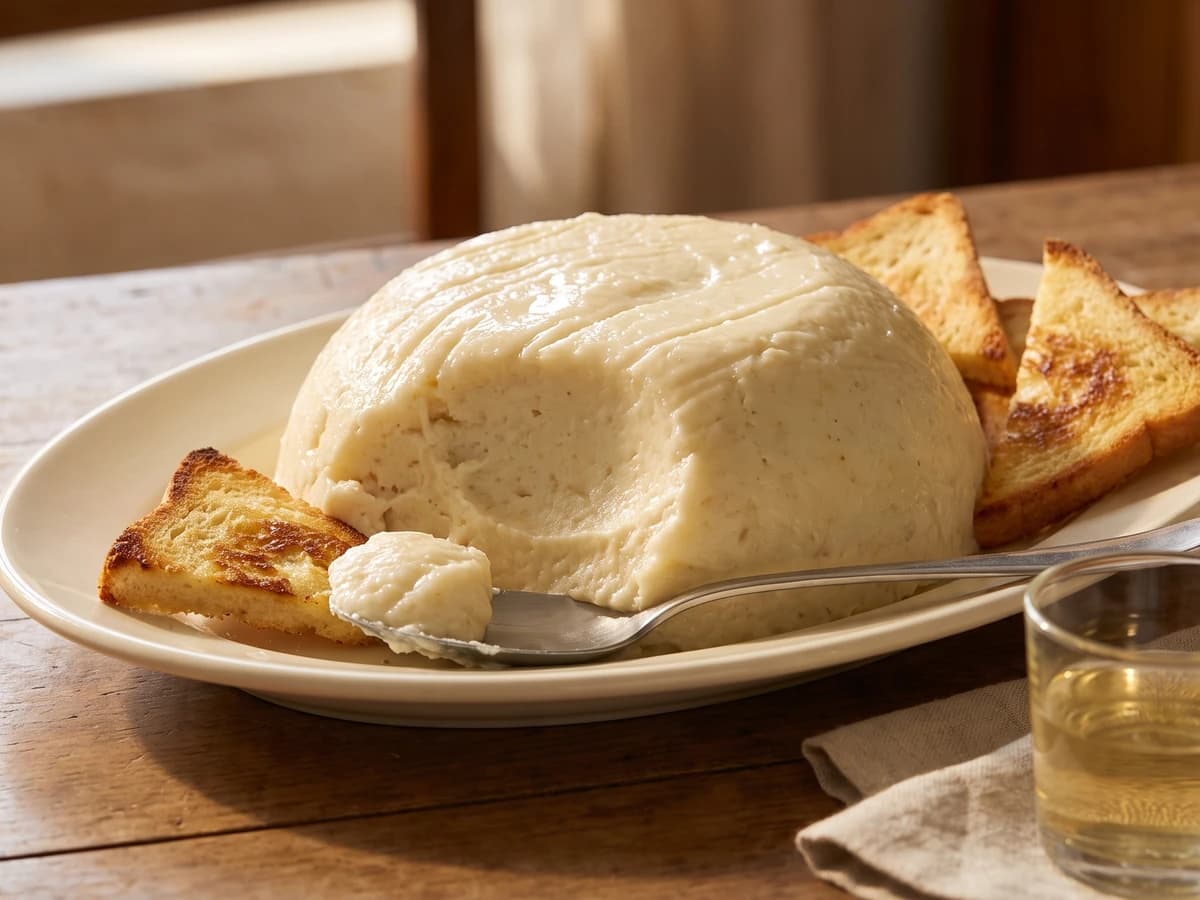
Brandade de Morue turns salt cod, warm olive oil, and milk into a pale, silky emulsion: keep everything warm and add the oil slowly, then crown the generous dome with butter-fried bread.
Chef Juliette
Salt cod worked warm with cream, one patient spoonful at a time, until the rough flakes become a glossy Nîmes paste, domed generously and ringed with butter-fried croutons for the table.

Chef Juliette
Wine-poached char packed in its earthenware crock beneath butter gold: a make-ahead first course that turns careful cooling, thorough boning, and one unbroken seal into quiet abundance.