Culinary Explorer

A cooking platform built around craft, culture, and the stories behind what we eat.
Discover Culinary Explorer
Fromage Glacé

Fromage Glacé

Created by Chef Juliette

Based on No. 2786, Fromage Glacé, from Le Guide Culinaire (1907) by Auguste Escoffier

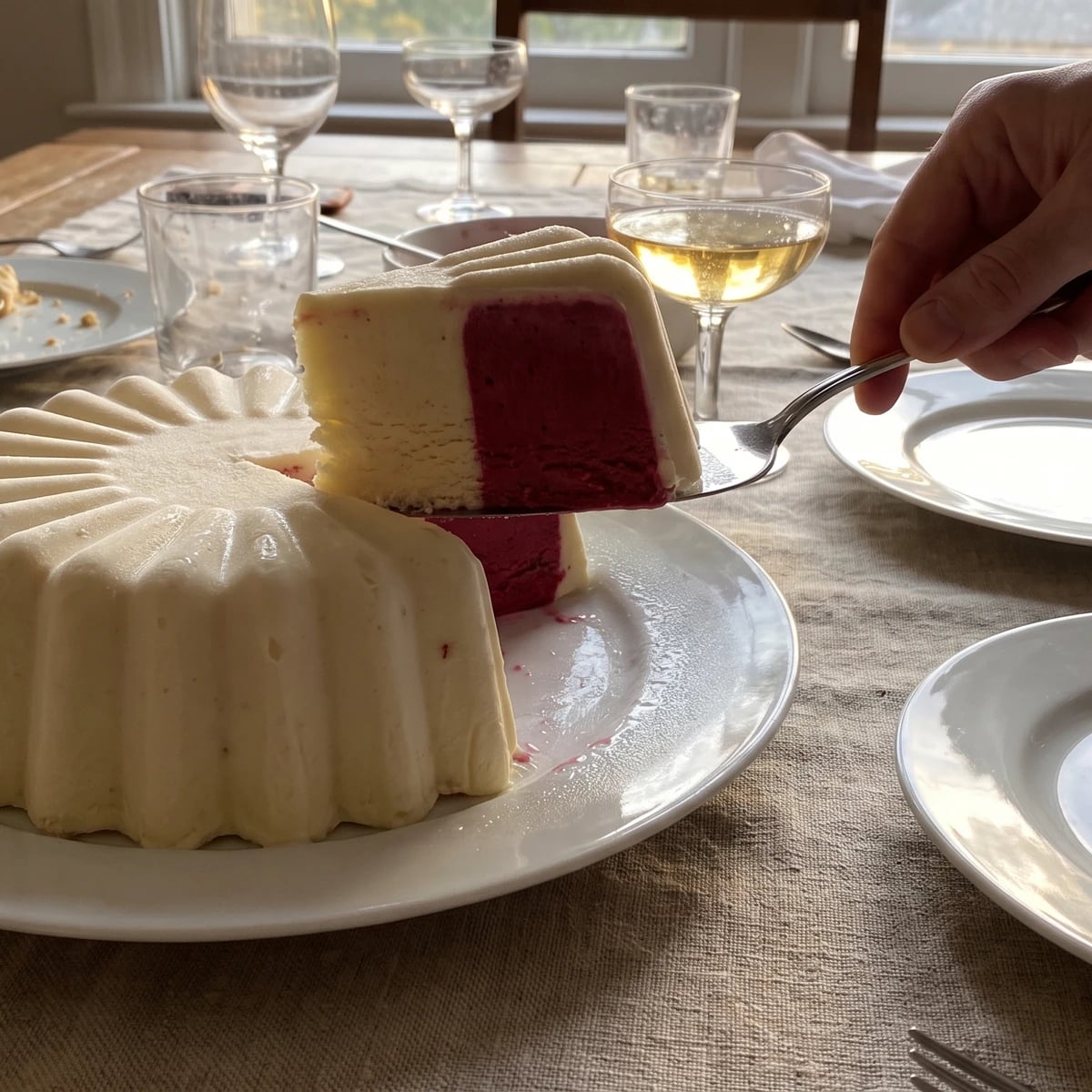
No cheese, only the confectioner's joke: vanilla crème glacée and vivid raspberry sorbet packed vertically in a fluted mould, frozen firm, and turned out with both colours running from crown to base.

Desserts
French
Dinner Party
Make Ahead
Celebration
45 min
Active Time
25 min cook12 hr total
YieldOne 1.5-litre (6-cup) mould, 8 to 10 servings

Fromage glacé (a fluted mould of two ices) teaches a cold truth: temperature is an ingredient. There is no cheese in it. The name belongs to the fluted mould, and the one true thing to know is that two ices packed side by side must have the same firmness or the clean vertical design will buckle.

The entry gives architecture rather than fixed flavours, so vanilla crème glacée and raspberry sorbet make a classical pair: ivory against garnet, rich against sharp. The classical confectioner's station assumed two finished ices ready together, a dedicated lidded fromage mould, and enough hands to pack it quickly. Your honest equivalents are one countertop churner, a 1.5-litre fluted metal pudding mould, and a strip of food-safe acetate. Two freezing tubs running at once were brigade scaffolding and can go; the fluting and vertical division are the dish, and they stay. One cook, one stove, one evening of work, then the freezer keeps watch.

Turned out, the ridged crown is pale vanilla on one side and brilliant raspberry on the other, with each flavour running from top to bottom. Before you fill the mould, make both ices equally firm and spreadable, able to bend under a spatula without flowing. That matching texture is the step that decides the dish.

Fromage glacé belongs to the Parisian confectioner's repertoire and the formal French dessert table, not to any regional cheese tradition. Its name follows the low, round, fluted mould, whose form echoed a small cheese and held contrasting ices packed vertically rather than layered. The deception was part of the pleasure: the title promised fromage, while the serving spoon found a frozen dessert.

The technique, the tradition, and the story behind every dish.

Discover Culinary Explorer

Ingredients

whole milk

Quantity

1 cup (240 ml / 247 g)

heavy cream

Quantity

1 cup (240 ml / 238 g)

granulated sugar for the vanilla crème glacée

Quantity

½ cup (120 ml / 100 g)

large egg yolks

Quantity

5

vanilla bean

Quantity

1

split lengthwise

fine sea salt

Quantity

⅛ teaspoon (0.6 ml / 0.75 g)

raspberries

Quantity

3 cups (720 ml / 375 g)

fresh or frozen and thawed

granulated sugar for the raspberry sorbet

Quantity

½ cup plus 2 tablespoons (150 ml / 125 g)

water

Quantity

½ cup (120 ml / 120 g)

fresh lemon juice

Quantity

1 tablespoon (15 ml / 15 g)

Equipment Needed

  • 1.5-litre (6-cup) solid fluted metal pudding or jelly mould
  • Countertop ice cream machine, preferably a compressor model or one with two frozen canisters
  • Stiff food-safe acetate strip or thin flexible cutting mat
  • Fine-mesh sieve
  • Instant-read thermometer
  • Small offset spatula

Instructions

  1. 1

    Cook the vanilla custard

    Scrape the vanilla seeds into a saucepan and add the pod, milk, and cream. Bring the dairy just below a simmer, then take it off the heat. Whisk the yolks with the vanilla sugar and salt until smooth, without beating in a great foam. Pour half the hot dairy over the yolks in a thin stream while whisking, return everything to the saucepan, and stir constantly over medium-low heat until the crème anglaise, a pourable custard, reaches 82°C (180°F) and coats the back of a spoon. Never let it boil. If a few fine curds appear at the edge, pull the pan from the heat, set it in ice water, blend briefly, and strain at once. Ça se rattrape. A custard that has scrambled into large curds must be remade now, because freezing will not hide it.

    Draw a finger through the custard on the spoon. When the path stays clean instead of running together, the crème anglaise is ready.
  2. 2

    Build the raspberry sorbet

    Combine the sorbet sugar and water in a small saucepan. Bring to a boil, stirring only until the sugar dissolves, then boil for one minute and cool for ten minutes. Purée the raspberries with the lemon juice and work the purée through a fine sieve to remove the seeds. Stir in the warm syrup. Do not cook the fruit itself; its tart fragrance and clear garnet colour are what keep the rich vanilla half in balance.

  3. 3

    Chill both bases

    Strain the vanilla custard into a clean bowl, pressing on the vanilla pod before discarding it. Set both bowls over ice water and stir until thoroughly cold, then cover the surfaces and refrigerate for at least four hours. Proper chilling gives the churn a head start and makes finer ice crystals; a warm base freezes slowly and turns coarse.

  4. 4

    Ready the fluted mould

    Cut a stiff strip of food-safe acetate to the internal height and diameter of the fluted mould. Fit it upright through the centre so it divides the mould into two equal vertical halves and touches the bottom as closely as possible. Freeze the mould and divider for thirty minutes. Metal is the honest equivalent of the dedicated fromage mould because it chills quickly and releases cleanly; a smooth loaf tin loses the fluting that gives the dish its name.

  5. 5

    Churn to matching textures

    Churn the vanilla custard until it holds the dense consistency of soft ice cream, then transfer it to a shallow covered container in the freezer while you churn the raspberry base. Bring both ices to the same packable texture before filling: each should hold a ridge from the spatula but remain supple enough to press into the flutes. If one pools, freeze it for ten minutes; if one has hardened into chunks, leave it in the refrigerator for five minutes and fold it firmly until smooth. Do not try to compensate by forcing a hard ice against a soft one, because the softer colour will run beneath the divider.

  6. 6

    Pack the vertical halves

    Nest the cold mould in a folded towel so it cannot turn. Add alternating spoonfuls of vanilla crème glacée and raspberry sorbet on opposite sides of the acetate, keeping the levels even and supporting the divider with one hand. Press each addition firmly into the fluted walls to remove air pockets. If colour slips beneath the divider, stop, chill both ices for ten minutes, scrape away the stray patch, and reset the acetate before continuing. Fill to within 1 cm (⅜ inch) of the rim, then draw the divider straight upward in one slow movement. Smooth the surface, which will become the base, and cover it directly with parchment.

  7. 7

    Freeze the form firm

    Freeze the filled mould on a level shelf for at least six hours, preferably overnight. Do not disturb it while the centre firms. The vertical seam needs a complete freeze before unmoulding, and an early attempt will pull the two halves apart even when the outside feels solid.

  8. 8

    Unmould and serve

    Chill the serving plate. Dip only the outside of the mould into warm water for five to eight seconds, dry it, cover it with the plate, and invert both together. If the fromage glacé does not release, wrap the mould in a warm damp towel for another five seconds rather than tugging. If an edge begins to soften, return the inverted mould and plate to the freezer for twenty minutes before trying again. Cut with a knife dipped in hot water and wiped dry, making the first slice across the central seam so both flavours show. Serve at once. À table!

Chef Tips

  • Use a solid fluted metal mould without a central tube. Silicone releases easily but softens the ridges, while a tube mould makes the vertical division needlessly awkward.
  • Frozen raspberries picked ripe are often better than tired fresh ones. Thaw them only until they can be puréed, and include every drop of their juice.
  • Do not reduce the sugar. In frozen work, sugar controls hardness as well as sweetness; cutting it makes the sorbet icy and prevents the two halves from softening at the same rate.
  • Serve the fromage glacé on cold plates with a demi-sec Champagne or a lightly sweet sparkling wine. It needs no berries, flowers, or decorative fuss. The fluted two-colour form is already the joke and the decoration.

Advance Preparation

  • Both bases can be cooked, covered, and refrigerated up to 24 hours before churning. The longer chill improves their texture.
  • The completed fromage glacé can be moulded up to three days before the dinner. Keep parchment against its exposed base and wrap the entire mould well so the vanilla does not collect freezer odours.
  • If your machine has only one freezer canister, churn the raspberry sorbet one day ahead and refreeze the cleaned canister. Churn the vanilla the following day, then temper the stored sorbet in the refrigerator until both mixtures have the same spreadable firmness.

Frequently Asked Questions

Nutrition Information

1 serving (about 145g)

Calories
260 calories
Total Fat
13 g
Saturated Fat
8 g
Trans Fat
0 g
Unsaturated Fat
5 g
Cholesterol
135 mg
Sodium
55 mg
Total Carbohydrates
33 g
Dietary Fiber
3 g
Sugars
29 g
Protein
4 g

Note: Chef personas and recipes are created with AI assistance. Cook with care: follow safe food-handling practices, check doneness with a thermometer when needed, and adapt for allergies and your kitchen.

Where cooking meets culture.

Culinary guides, cultural storytelling, and the editorial depth that makes cooking meaningful.

Discover Culinary Explorer

More from Ices and Sherbets

Browse the full collection