
Chef Juliette
Various Almond Preparations
Five almond preparations, one discipline: remove the skins cleanly, dry every kernel through, then cut, toast, or cloak it in pale caramel without letting its fragrant oils escape.
A cooking platform built around craft, culture, and the stories behind what we eat.
Created by Chef Juliette
Based on No. 2783, Glace Étoile du Berger, from Le Guide Culinaire (1907) by Auguste Escoffier
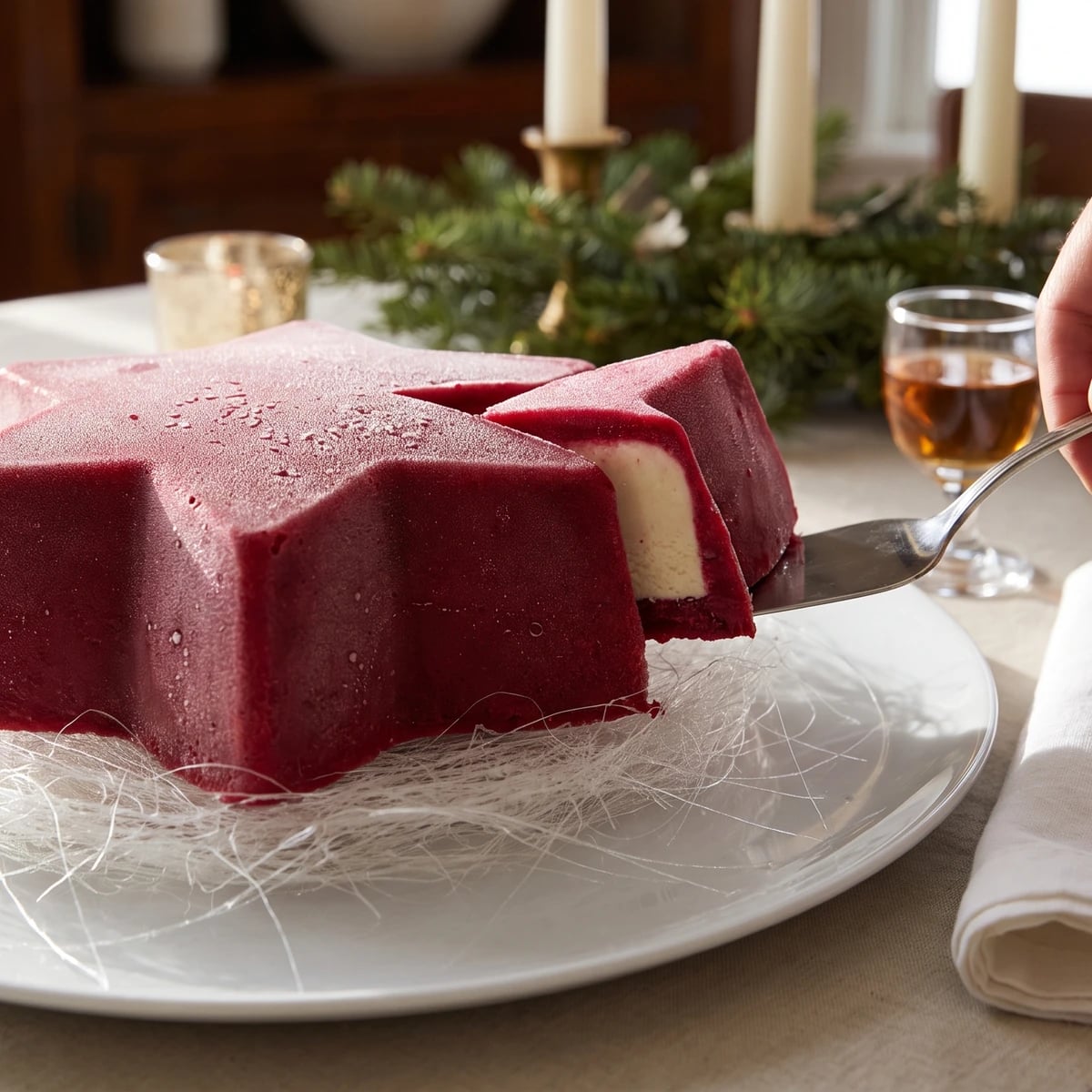
Raspberry ice forms a crimson star around pale Bénédictine mousse, set on a crisp disc of sucre filé whose fine rays flash between the points at the moment of serving.
Glace Étoile du Berger (Shepherd's Star ice) teaches architecture in the cold. A sharp crimson shell encloses a pale, herb-scented mousse, while sucre filé (spun sugar) supplies the crisp white disc and rays beneath it. The one true thing is simple: every layer must be properly frozen before the next one touches it, or the star loses its clean shape and its two distinct flavours.
The original assumed a pastry brigade with raspberry ice already churned, Mousses ready to flavour, decorative moulds buried in cold storage, and a sugar worker free to spin the final plinth at the last minute. Here it becomes one 1.5 litre star for eight, made with a domestic freezer, a mixer, and two ordinary forks. The brigade's separate stations were scaffolding and can go. The raspberry shell, Bénédictine mousse, star shape, and radiating sugar must stay, because together they are the dish. One cook, one stove, one evening.
The decisive technique is chemiser, to clothe the mould with an even layer of raspberry ice. Patch every thin place while the ice is still workable, then freeze the shell until completely firm before adding the mousse. That clean boundary decides the whole dessert.
Glace Étoile du Berger belongs to the grand Parisian entremets table, where moulded ices were carried in whole and sugar work supplied both plinth and spectacle. Its Bénédictine points precisely to Fécamp in Normandy, but this is not a Norman household sweet; the liqueur traveled into the national pastry canon while raspberry supplied the sharp red shell. The poetic shepherd's-star name describes the presentation, and the white spun sugar is structural, a disc and a set of rays, not a loose garnish.
Quantity
4 cups (500 g)
thawed
Quantity
2/3 cup (135 g)
for the raspberry ice
Quantity
1/2 cup (120 ml / 120 g)
for the raspberry ice
Quantity
1 tablespoon (15 ml / 15 g)
Quantity
4 large yolks (about 72 g)
Quantity
1/2 cup (100 g)
for the mousse
Quantity
3 tablespoons (45 ml / 45 g)
for the mousse
Quantity
1/4 cup (60 ml / 57 g)
Quantity
1 1/2 cups (360 ml / 355 g)
Quantity
1 1/4 cups (250 g)
for the sucre filé
Quantity
1/4 cup (60 ml / 60 g)
for the sucre filé
Quantity
1 tablespoon (15 ml / 20 g)
Quantity
1 teaspoon (5 ml / 4 g)
for the sugar-work surface and forks
Quantity
1 application of Another Method of Preparing Aspics de Filets de Soles (No. 916)
used only for clothing the mould; no aspic enters the dessert
| Ingredient | Quantity |
|---|---|
| frozen raspberriesthawed | 4 cups (500 g) |
| granulated sugarfor the raspberry ice | 2/3 cup (135 g) |
| waterfor the raspberry ice | 1/2 cup (120 ml / 120 g) |
| fresh lemon juice | 1 tablespoon (15 ml / 15 g) |
| pasteurized egg yolks | 4 large yolks (about 72 g) |
| granulated sugarfor the mousse | 1/2 cup (100 g) |
| waterfor the mousse | 3 tablespoons (45 ml / 45 g) |
| Bénédictine | 1/4 cup (60 ml / 57 g) |
| cold heavy cream | 1 1/2 cups (360 ml / 355 g) |
| granulated sugarfor the sucre filé | 1 1/4 cups (250 g) |
| waterfor the sucre filé | 1/4 cup (60 ml / 60 g) |
| liquid glucose or light corn syrup | 1 tablespoon (15 ml / 20 g) |
| neutral oilfor the sugar-work surface and forks | 1 teaspoon (5 ml / 4 g) |
| technique referenceused only for clothing the mould; no aspic enters the dessert | 1 application of Another Method of Preparing Aspics de Filets de Soles (No. 916) |
Bring the 135 g sugar and 120 ml water just to a boil, stirring only until the sugar dissolves. Cool the syrup, then blend it with the raspberries and lemon juice until completely smooth. Press the purée firmly through a fine sieve to remove the seeds, chill it until cold, and churn it to a dense, spreadable ice. Without an ice-cream machine, freeze it in a shallow tray until firm at the edges, process until smooth, and repeat once. If it freezes too hard to spread, leave it at room temperature for five minutes and beat it with a sturdy spoon. Ça se rattrape.
Chill a 1.5 litre star-shaped mould until very cold. A deep silicone star mould releases most easily; a metal star mould or a Madeleine-mould with a star on its bottom follows the source exactly. Set the mould level on a tray that fits your freezer, because a tilted mould gives you one thick wall and one fragile one.
Apply the clothing-the-mould principle from Another Method of Preparing Aspics de Filets de Soles (No. 916), using raspberry ice rather than jelly. Press a 5 mm layer of softened raspberry ice over the bottom and every point of the mould, then freeze it for twenty minutes. Add a second thin layer, bringing the shell to about 8 mm and patching any places where the mould shows through. Freeze until hard, at least forty-five minutes. Hold the mould toward a window before the second freezing; pale translucent patches need more ice, while heavy ridges should be scraped level.
Put the yolks in the mixer bowl and begin beating them at medium speed. Bring the 100 g sugar and 45 ml water to 118°C without stirring once it boils, then pour the syrup in a thin stream down the inside of the bowl while the whisk runs. Keep it away from the moving whisk or it will throw hard sugar threads around the bowl. Beat until the pâte à bombe is thick, pale, and cool enough that the bowl no longer feels warm. If crystals appear in the syrup pan, add a spoonful of water, cover for thirty seconds to wash down the sides, and dissolve them again before returning to temperature. Ça se rattrape.
Whisk the Bénédictine gradually into the cooled pâte à bombe. Reserve 2 tablespoons of the cream, then whip the remainder only to soft peaks; it should bend from the whisk, not stand like plaster. Fold one quarter of the cream into the yolk base to lighten it, then fold in the rest with broad turns until no white streaks remain. If the cream becomes slightly grainy, fold in the reserved liquid cream a teaspoon at a time to smooth it. If the yolk base is still warm, stop and cool it before folding, because warm pâte à bombe melts the cream and leaves a heavy mousse.
Spoon the Bénédictine mousse into the frozen raspberry shell, working from the deepest points toward the centre so no air pockets remain. Stop about 5 mm below the rim and smooth the surface level. Cover without touching the mousse and freeze until solid, at least six hours and preferably overnight. The alcohol keeps the centre tender, which is desirable, but extra Bénédictine would prevent a clean unmoulding.
Make the sucre filé shortly before serving. Mark a 25 cm circle on the underside of parchment or a silicone mat, then wipe the upper surface and two forks with the thinnest film of oil. Bring the 250 g sugar, 60 ml water, and glucose to 150°C without stirring, and remove the pan before the syrup takes amber colour. Let it stand until a fork dipped into it draws a fine continuous thread. Sweep two forks rapidly over the marked circle, building a thick web, then extend eight tapered bundles beyond its edge to form the rays. If the syrup falls in beads, it is too hot; wait briefly. If it thickens before the disc is complete, warm it over the lowest heat for a few seconds. Keep fingers well above the syrup and turn the pan handle inward, because cooked sugar clings and burns fiercely.
Transfer the sugar disc to a dry, room-temperature serving platter. Centre the frozen mould upside down over it, wrap the outside briefly with a warm dry towel, and lift the mould away. If the star holds fast, repeat for five seconds rather than pulling; too much warmth blurs the raspberry points. Turn the platter so the sugar rays appear between the points of the star. Cut with a knife warmed in hot water and wiped completely dry, then serve at once while the mousse is tender and the sucre filé remains crisp. À table!
1 serving (about 200g)
Culinary guides, cultural storytelling, and the editorial depth that makes cooking meaningful.
Discover Culinary Explorer
Chef Juliette
Five almond preparations, one discipline: remove the skins cleanly, dry every kernel through, then cut, toast, or cloak it in pale caramel without letting its fragrant oils escape.

Chef Juliette
A pastry pantry lesson in one tray: filberts warmed only until their red skins release, rubbed clean, cooled, and chopped into a fragrant mise-en-place for cakes, creams, pralines, and petits fours.

Chef Juliette
The smallest pâtisserie discipline decides whether a cake leaves its mould intact: clarified butter in every corner, followed by the lightest veil of dry flour or fécule.

Chef Juliette
Four whites, one spotless bowl, and a patient change of speed: whisk gently until loosened, then briskly to glossy stiffness, with powdered sugar waiting if the foam begins to granulate.