
Chef Juliette
Various Almond Preparations
Five almond preparations, one discipline: remove the skins cleanly, dry every kernel through, then cut, toast, or cloak it in pale caramel without letting its fragrant oils escape.
A cooking platform built around craft, culture, and the stories behind what we eat.
Created by Chef Juliette
Based on No. 2741, Suédoise of Fruit, from Le Guide Culinaire (1907) by Auguste Escoffier
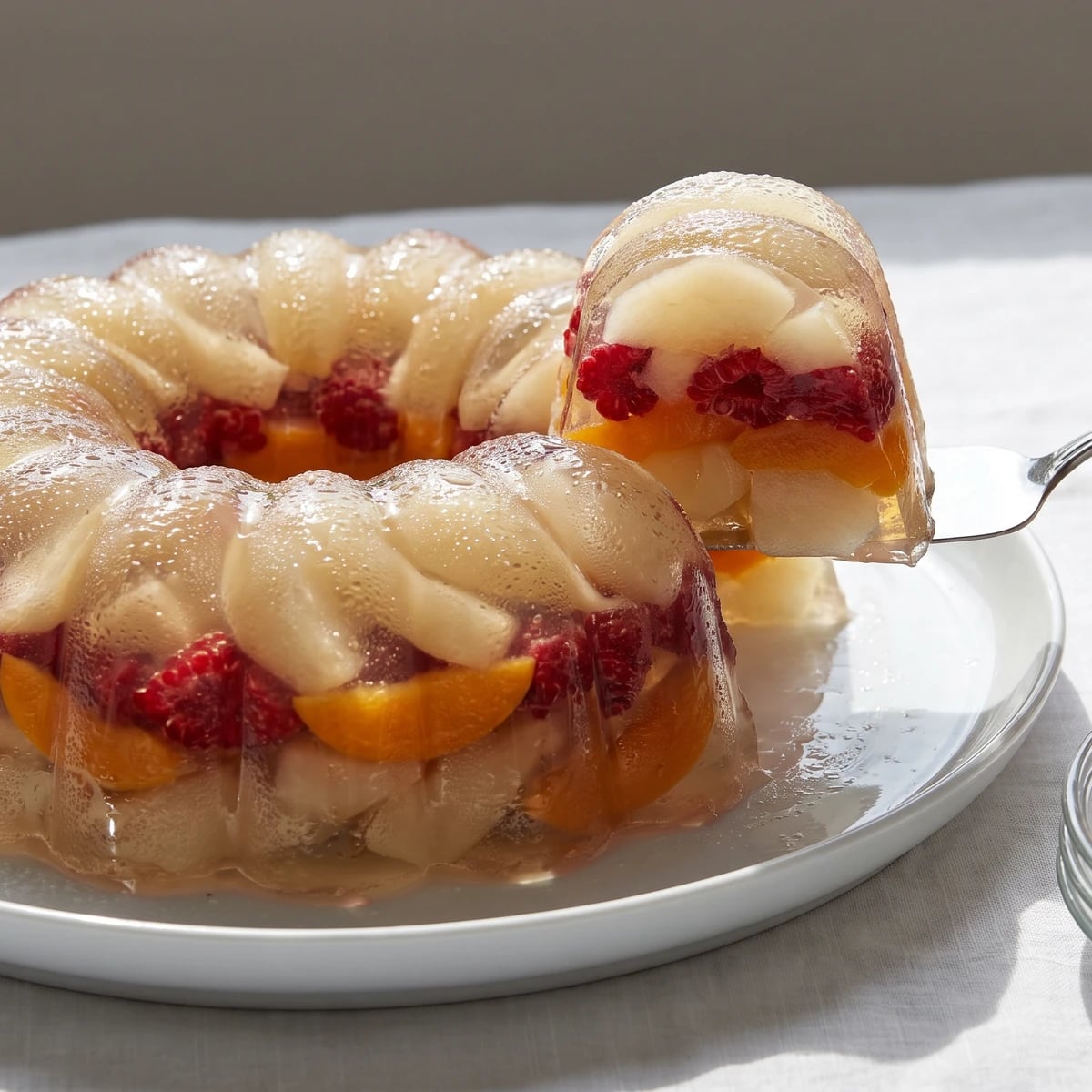
A jewel-clear Suédoise striped with pale pear, amber apricot, and crimson raspberry, unmoulded in one generous piece: a lesson in patience, clean layers, and letting cold do the precise work.
Suédoise de fruits (layered fruit jelly) teaches patience you can see. The one true thing to know before touching a pan is that every fruit and every spoonful of jelly must be cold, then each band must set firm before the next arrives. Rush it and the colours bleed into a muddle; wait, and the mould turns out jewel-clear, with pale pear, crimson raspberry, and amber apricot standing cleanly apart.
The original entry assumed a pastry section, a cold room, ranks of aspic moulds, and enough prepared fruit to build grand pieces for service. Your honest equivalent is one 1.5 litre metal ring mould on a level refrigerator shelf, filled with three sharply contrasting fruits. The grand quantity and parade of varieties were brigade scaffolding, so they go. The separate stewing, clear jelly, and repeated setting are the dish itself, so they stay. One cook, one stove, one evening, followed by a proper night in the cold.
A clear white-grape jelly supplies the brilliance without requiring a professional clarification, while canned apricots give the classical pantry's sensible answer when fresh ones are poor. If the jelly begins setting in its jug, stand the jug in warm water and stir gently until fluid again. Ça se rattrape. What matters most is simple: chill each layer until no liquid moves at its centre before adding the next.
Suédoise de fruits belongs to the Parisian grand-kitchen repertory of moulded jellies, where the same fluted aspic mould served savoury gelées and brilliant sweet desserts. Its geographical name is a French service designation, not proof of origin at a Swedish household table; the defining practice is the setting of separately stewed, strongly contrasted fruits in clear jelly. From formal dining rooms it passed naturally to bourgeois celebration tables, where its patient construction made it particularly useful as a dessert prepared well ahead.
Quantity
3 cups (720 ml / 720 g)
Quantity
7 tablespoons (105 ml / 105 g)
Quantity
¾ cup (180 ml / 150 g)
divided as directed
Quantity
3 tablespoons (45 ml / 45 g)
divided as directed
Quantity
2 tablespoons plus 2 teaspoons (40 ml / 24 g)
Quantity
2 medium (about 1¾ cups / 300 g prepared)
peeled, cored, and cut into 1 cm pieces
Quantity
1¼ cups (310 ml / 200 g)
thoroughly drained and cut into 1 cm pieces
Quantity
1¼ cups (310 ml / 150 g)
fresh, or frozen and thawed
| Ingredient | Quantity |
|---|---|
| white grape juice | 3 cups (720 ml / 720 g) |
| cold water | 7 tablespoons (105 ml / 105 g) |
| granulated sugardivided as directed | ¾ cup (180 ml / 150 g) |
| fresh lemon juicedivided as directed | 3 tablespoons (45 ml / 45 g) |
| unflavoured powdered gelatine | 2 tablespoons plus 2 teaspoons (40 ml / 24 g) |
| firm pearspeeled, cored, and cut into 1 cm pieces | 2 medium (about 1¾ cups / 300 g prepared) |
| canned apricot halves in juicethoroughly drained and cut into 1 cm pieces | 1¼ cups (310 ml / 200 g) |
| raspberriesfresh, or frozen and thawed | 1¼ cups (310 ml / 150 g) |
Fill the mould with measured water to confirm that it holds about 1.5 litres, then empty it, rinse it with cold water, and leave the faint wet film inside. Do not grease it, because fat clouds the finished jelly. Set the mould on a small rimmed tray so it can travel level between the counter and refrigerator. Sprinkle the gelatine evenly over the cold water and leave it undisturbed for 10 minutes, until every grain has swollen and the surface looks like a firm sponge.
Combine 1 cup (240 ml) of the grape juice, ¼ cup (60 ml / 50 g) of the sugar, and 1 tablespoon (15 ml / 15 g) of the lemon juice in a small saucepan. Bring it to a gentle simmer, add the pears, and poach for 5 to 8 minutes, turning once, until a knife enters with slight resistance. The pieces must be tender but still hold their corners. Lift them out with a slotted spoon, spread them on a plate, and leave them to cool completely. Strain and reserve every drop of the pale poaching syrup.
Put the raspberries in a wide small pan with 2 tablespoons (30 ml / 25 g) of the sugar and 1 tablespoon (15 ml) of the reserved pear syrup. Turn them gently over low heat for 1 to 2 minutes, just until glossy and beginning to surrender their juice. Do not mash them. Drain them in a sieve without pressing, spread them on a separate plate, and chill until completely cold. Pat the drained apricot pieces dry and chill those separately as well. Wet fruit streaks the clear jelly, so give this drying time its due.
Combine the remaining 2 cups (480 ml) grape juice, the reserved pear syrup, and the remaining 6 tablespoons (90 ml / 75 g) sugar. Warm gently until the sugar dissolves, then remove the pan from the heat. Add the swollen gelatine and stir slowly until perfectly clear, without whisking in bubbles. Stir in the remaining 2 tablespoons (30 ml / 30 g) lemon juice, then pass the jelly through a fine sieve into a pouring jug. Let it cool until it feels neither warm nor cold but remains fluid. If it sets in the jug, do not scrape lumps into the mould. Stand the jug in a bowl of warm water and stir until smooth again. Ça se rattrape.
Pour about ⅓ cup (80 ml) of the cooled jelly into the mould, turning it gently so the base is evenly covered. Refrigerate for 12 to 20 minutes, until the jelly is firm to a light touch and no liquid travels when the mould is tilted. This clear first layer becomes the polished crown after unmoulding, so keep it free of fruit and bubbles.
Arrange the cold pear pieces evenly over the clear jelly, keeping them a little away from the outer wall so the finished mould retains its glassy surface. Pour in enough cool jelly to cover the fruit by about 5 mm, directing the stream down the back of a spoon. Refrigerate for 25 to 35 minutes, until set firmly through the centre. If the pears float, the jelly is still too loose: lift them out, chill the poured jelly for another 5 minutes, then replace the fruit and continue.
Arrange the cold, well-drained raspberries over the pear layer and pour cool jelly around them, never directly onto them, until covered. Chill for another 25 to 35 minutes, until completely firm. This is the layer most likely to bleed. If a crimson trail appears, spoon away the loose stained jelly at once, remove and drain the offending berries, then chill the base for 10 minutes before continuing with fully cooled jelly.
Lay the dry apricot pieces over the firm raspberry layer and cover them with cool jelly. Chill until set, about 30 minutes, then pour in the remaining jelly to form a level base at least 1 cm deep. Depending on the exact displacement of the fruit, a spoonful of jelly may remain. Refrigerate the completed Suédoise for at least 6 hours, preferably overnight. Do not cover it until the surface is firm, or the covering will mark the base.
Chill the serving platter before you begin. Dip the mould to just below its rim in comfortably warm water for 5 seconds, dry the outside, place the platter over it, and invert both together in one confident movement. The Suédoise should release with a quiet pull. If it stays put, wrap the mould briefly in a warm damp towel and try again; repeated long dipping melts the fluting before the centre releases. Cut with a thin knife dipped in warm water and serve cold. À table!
1 serving (about 205g)
Culinary guides, cultural storytelling, and the editorial depth that makes cooking meaningful.
Discover Culinary Explorer
Chef Juliette
Five almond preparations, one discipline: remove the skins cleanly, dry every kernel through, then cut, toast, or cloak it in pale caramel without letting its fragrant oils escape.

Chef Juliette
A pastry pantry lesson in one tray: filberts warmed only until their red skins release, rubbed clean, cooled, and chopped into a fragrant mise-en-place for cakes, creams, pralines, and petits fours.

Chef Juliette
The smallest pâtisserie discipline decides whether a cake leaves its mould intact: clarified butter in every corner, followed by the lightest veil of dry flour or fécule.

Chef Juliette
Four whites, one spotless bowl, and a patient change of speed: whisk gently until loosened, then briskly to glossy stiffness, with powdered sugar waiting if the foam begins to granulate.