
Chef Juliette
Various Almond Preparations
Five almond preparations, one discipline: remove the skins cleanly, dry every kernel through, then cut, toast, or cloak it in pale caramel without letting its fragrant oils escape.
A cooking platform built around craft, culture, and the stories behind what we eat.
Created by Chef Juliette
Based on No. 2739, Rice à l’Impératrice, from Le Guide Culinaire (1907) by Auguste Escoffier
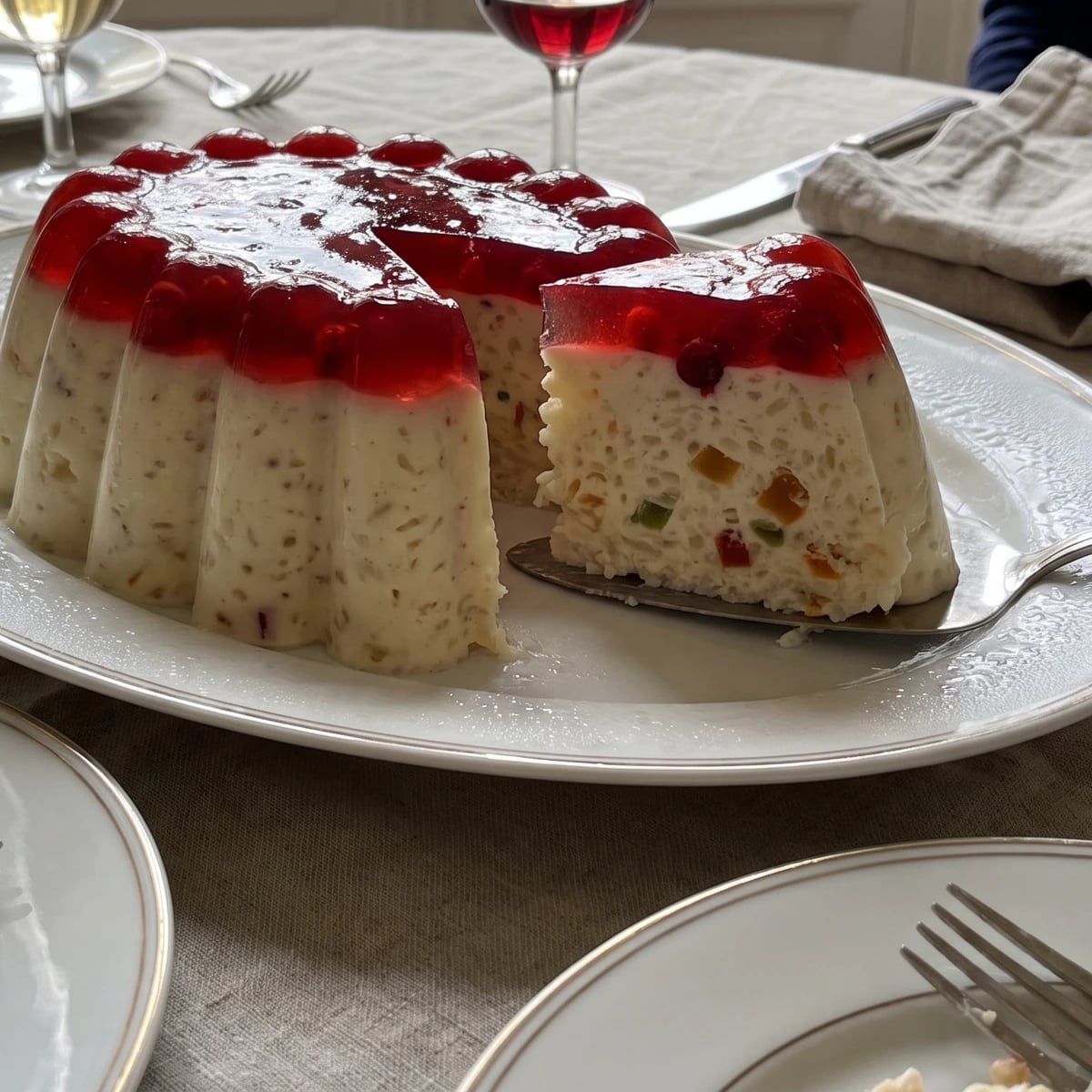
Vanilla rice, candied fruit, apricot, and kirsch Bavarois settle beneath a ruby currant-jelly crown, a grand molded entremets made practical for one cook and glorious after a night in the cold.
Riz à l’Impératrice (Empress-style vanilla rice Bavarois) teaches the cold-dessert rule that matters across the canon: temperature is an ingredient. The rice must become completely tender and fragrant, then lose every trace of warmth before it meets the whipped cream. Rush that meeting and the cream splits and loses its body; wait, and the entremets cuts into pale, airy slices jeweled with candied fruit beneath a ruby currant crown.
The original formula assumed an entremets station, a basin of Kirsch Bavarois already prepared, a metal mould packed in ice, and half a pound of raw rice destined for a banquet. Here the formula is halved to four ounces of rice, and its own alternate measure becomes one cup of thick crème anglaise and one cup of cream, stabilized with the little gelatin a molded Bavarois requires. A refrigerator replaces the packed ice, while a chilled platter replaces the serving napkin. That cloth service was brigade scaffolding, not the dish. One cook, one stove, one evening.
The candied-fruit salpicon (a fine, even dice), apricot jam, kirsch, and red-currant jelly remain in their prescribed balance. Those are the dish and they stay. Before the cream comes near the rice, put a thermometer into it: below 27°C / 80°F is the threshold that decides everything.
Riz à l’Impératrice belongs to the Parisian grand-kitchen tradition of molded entremets, where vanilla rice was lightened with Bavarois and dressed from the confectioner’s cupboard with preserves, candied fruit, and kirsch. Its imperial name tempts cooks to attach it to a particular empress, but the canon is firmer about the formula than the dedication: candied-fruit salpicon, apricot, kirsch, and red-currant jelly define the dish. It traveled naturally from banquet service to the bourgeois celebration table because it could be prepared ahead, unmolded cold, and carried whole to the guests.
Quantity
1/2 cup plus 1 tablespoon (135 ml / 113 g)
Quantity
2 cups (480 ml / 495 g)
Quantity
7 tablespoons (105 ml / 85 g)
Quantity
1
split lengthwise and scraped
Quantity
1/8 teaspoon (0.6 ml / 0.75 g)
Quantity
1/3 cup (80 ml / 57 g)
cut into even 5 mm dice
Quantity
2 tablespoons (30 ml / 40 g)
Quantity
1/3 cup (80 ml / 100 g)
Quantity
2 teaspoons (10 ml / 6 g)
Quantity
2 tablespoons (30 ml / 30 g)
Quantity
3/4 cup (180 ml / 185 g)
Quantity
3
Quantity
3 tablespoons (45 ml / 38 g)
Quantity
2 tablespoons (30 ml / 28 g)
Quantity
1 cup (240 ml / 240 g)
very cold
| Ingredient | Quantity |
|---|---|
| short-grain white rice | 1/2 cup plus 1 tablespoon (135 ml / 113 g) |
| whole milk for the rice | 2 cups (480 ml / 495 g) |
| granulated sugar for the rice | 7 tablespoons (105 ml / 85 g) |
| vanilla beansplit lengthwise and scraped | 1 |
| fine sea salt | 1/8 teaspoon (0.6 ml / 0.75 g) |
| mixed candied-fruit salpiconcut into even 5 mm dice | 1/3 cup (80 ml / 57 g) |
| smooth apricot jam | 2 tablespoons (30 ml / 40 g) |
| red-currant jelly | 1/3 cup (80 ml / 100 g) |
| unflavored powdered gelatin | 2 teaspoons (10 ml / 6 g) |
| cold water | 2 tablespoons (30 ml / 30 g) |
| whole milk for the crème anglaise | 3/4 cup (180 ml / 185 g) |
| large egg yolks | 3 |
| granulated sugar for the crème anglaise | 3 tablespoons (45 ml / 38 g) |
| Kirsch | 2 tablespoons (30 ml / 28 g) |
| heavy creamvery cold | 1 cup (240 ml / 240 g) |
Rinse a 1.5 L Bavarois or charlotte mould with cold water and leave its inside damp; do not grease it. Chill the empty mould for 10 minutes. Warm the red-currant jelly over low heat just until fluid, never boiling, then pour it into the base and tilt the mould until the jelly settles into an even layer about 3 mm thick. Refrigerate for 20 minutes, until completely firm.
Bring a saucepan of water to a boil, add the rice, and blanch it for 2 minutes. Drain thoroughly. Put the rice into a clean heavy saucepan with the 2 cups of milk, 7 tablespoons of sugar, the vanilla seeds and pod, and the salt. Bring it just to a simmer, cover partially, and cook over the lowest heat for 30 to 35 minutes, stirring gently every few minutes, until every grain is swollen and tender and nearly all the milk has been absorbed. The rice should be thick and creamy, not dry. If the milk begins to scorch, do not scrape the bottom. Transfer the unburned rice immediately to a clean pan and finish it over gentler heat; the bitter layer stays behind.
Remove the vanilla pod and spread the rice in a wide bowl or shallow tray. Let it cool, turning it gently now and then. When it reaches about 35°C / 95°F, still pliable but no longer hot, fold in the apricot jam followed by the candied-fruit salpicon. Continue cooling until the rice is no warmer than 27°C / 80°F. Do not cover it while warm, or trapped heat will linger precisely where you do not want it.
Sprinkle the gelatin evenly over the cold water in a small bowl and leave it untouched for 5 to 10 minutes. It should absorb all the water and swell into a soft sponge. Proper blooming prevents hard gelatin beads from appearing in the finished Bavarois.
For the crème anglaise (pouring custard), heat the 3/4 cup of milk until small bubbles gather at the edge. Whisk the yolks with the remaining 3 tablespoons of sugar until smooth, then pour in the hot milk gradually while whisking. Return everything to the saucepan and cook over low heat, stirring constantly, until it reaches 82°C / 180°F and coats the back of a spoon. Take it off the heat at once. If a few tiny curds appear, whisk in 1 tablespoon of the measured cold cream and pass the custard through a fine sieve immediately. Small curds can be rescued; firm scrambled pieces mean the custard went too far and must be remade.
Stir the bloomed gelatin into the hot crème anglaise until fully dissolved, then strain the mixture into a clean bowl. Set the bowl over ice water and stir until the custard cools to about 27°C / 80°F and begins to gain the body of light cream. Stir in the Kirsch. Whip the remaining cold cream to soft peaks that bend at their tips, then fold one-third into the custard to lighten it and fold in the rest. If the gelatin sets into soft lumps before the cream goes in, rest the bowl briefly over lukewarm water and stir just until smooth, then cool it again.
Check the rice again. It must be at or below 27°C / 80°F, with no pocket of warmth hiding in the center. Fold one-third of the Kirsch Bavarois into the rice to loosen it, then add the remainder in two broad, gentle folds. Do not beat. Warm rice melts the whipped cream and turns the mixture loose and glossy. If that happens, ça se rattrape: set the bowl over ice and fold slowly until the gelatin begins to restore some body, then mould it at once. It will be slightly denser, but it will hold.
Make certain the red-currant jelly layer is fully set, then spoon the rice mixture gently over it. Press only enough to remove large air pockets, keeping the Bavarois light, and smooth the surface. Cover and refrigerate for at least 6 hours, preferably overnight. The refrigerator is the honest home equivalent of surrounding the mould with ice, and it asks nothing more of you.
Chill the serving platter. Wrap the sides of the mould with a towel dipped in warm water for 5 to 8 seconds, loosen the top edge gently with a fingertip, then invert onto the platter. If the entremets resists, repeat the warm towel for another 3 seconds rather than shaking it. Slice with a thin knife dipped in hot water and wiped dry between cuts. Serve it cold on the platter, not on the old service napkin, with its red-currant crown left completely visible. À table!
1 serving (about 170g)
Culinary guides, cultural storytelling, and the editorial depth that makes cooking meaningful.
Discover Culinary Explorer
Chef Juliette
Five almond preparations, one discipline: remove the skins cleanly, dry every kernel through, then cut, toast, or cloak it in pale caramel without letting its fragrant oils escape.

Chef Juliette
A pastry pantry lesson in one tray: filberts warmed only until their red skins release, rubbed clean, cooled, and chopped into a fragrant mise-en-place for cakes, creams, pralines, and petits fours.

Chef Juliette
The smallest pâtisserie discipline decides whether a cake leaves its mould intact: clarified butter in every corner, followed by the lightest veil of dry flour or fécule.

Chef Juliette
Four whites, one spotless bowl, and a patient change of speed: whisk gently until loosened, then briskly to glossy stiffness, with powdered sugar waiting if the foam begins to granulate.