
Chef Juliette
Mayonnaise de Volaille
Cold roast chicken, ciseled lettuce, and a shining coat of homemade mayonnaise, arranged with capers, olives, anchovies, eggs, and lettuce hearts, then tossed at the table as the canon intends.
A cooking platform built around craft, culture, and the stories behind what we eat.
Created by Chef Juliette
Based on No. 2730, Melon en Surprise, from Le Guide Culinaire (1907) by Auguste Escoffier
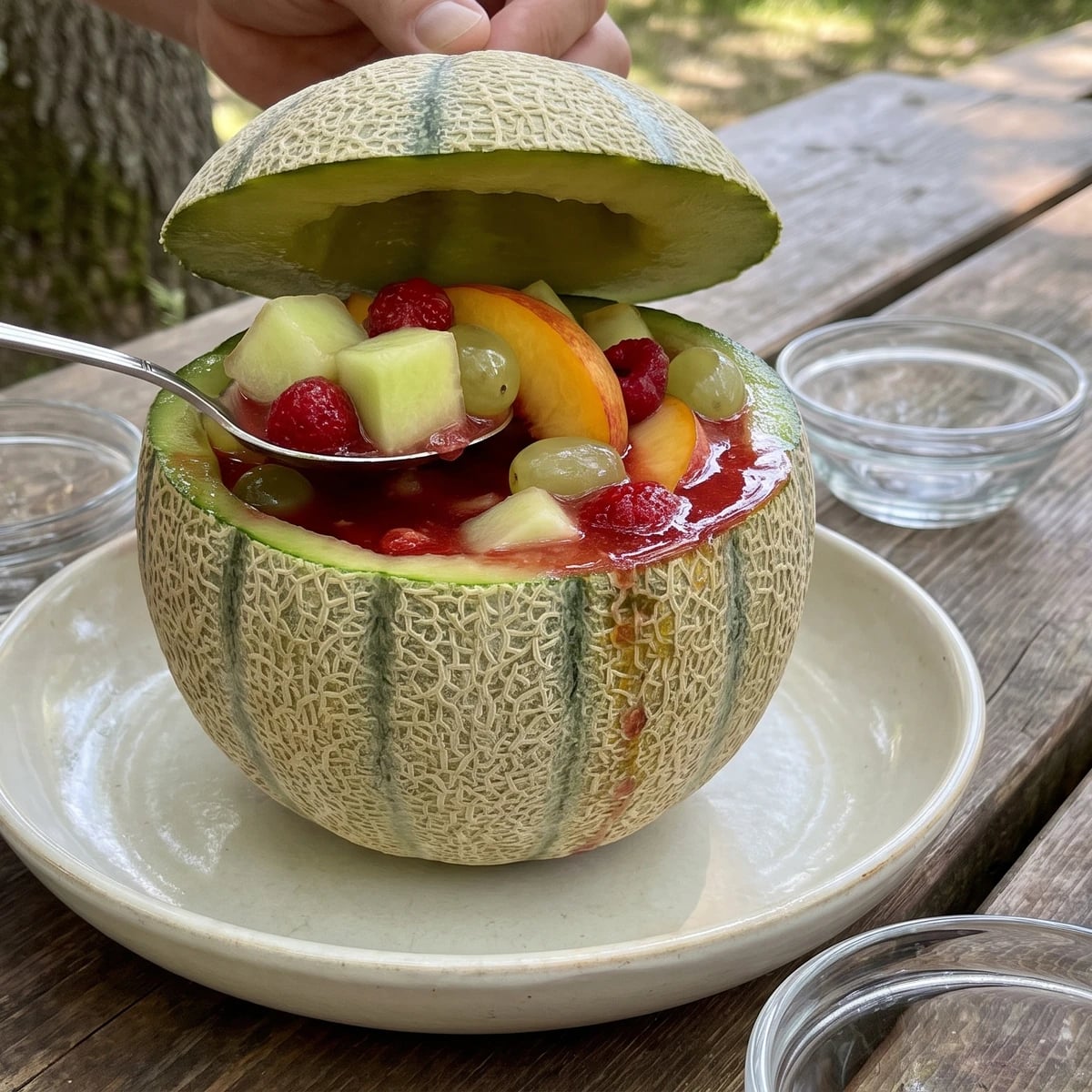
Lift the lid on a chilled melon and find a jewel-bright macédoine inside, its diced pulp and fresh fruit lightly bound with wild strawberry purée and kirsch after two necessary hours in the cold.
Melon en Surprise (melon filled with fruit macédoine) teaches the discipline of a cold fruit dish: ripe fruit must be cut evenly, dried carefully, and bound just enough to glisten. A macédoine is a neatly cut mixture of fruits, and the one true thing to know before you touch even a knife is that excess juice is the enemy. The strawberry purée should cling to the fruit, not collect beneath it.
The original entry assumed a garde-manger, the cold-pantry cook, with wild strawberry purée ready, a cold room, and enough hands to cut fruit for service. It needed no saucier, simmering stockpot, or salamander. At home, a small blender and fine-mesh sieve give the same seedless purée as a hand-worked tamis (drum sieve), one medium melon makes four servings instead of a service basin, and an ordinary refrigerator does the cold room's work. Only the scale and equipment have changed.
The brigade's bowls of prepared fruit are scaffolding and can go. The macédoine, diced melon pulp, sweetened kirsch-scented wild strawberry purée, and two-hour rest are the dish, so each stays. Dry the cut fruit before binding it; that quiet step decides whether the surprise under the lid is jewel-bright or watery.
Melon en Surprise belongs to the French classical entremets table rather than to one province; hollowed fruit let the grand kitchen make a fresh market melon both ingredient and covered serving dish. From formal dining rooms it passed naturally to bourgeois summer lunches and garden tables, since the spectacle depends on knife work and cold rather than specialized cooking equipment. The surprise is literal: the fitted lid conceals a macédoine, while wild strawberry and kirsch bind the fruits into one preparation instead of a loose salad.
Quantity
1 medium (about 3 lb / 1.4 kg)
Quantity
1 medium (about 3/4 cup / 120 g diced)
cut into small even dice
Quantity
1/2 cup (120 ml / 80 g)
halved or quartered
Quantity
1/2 cup (120 ml / 60 g)
Quantity
1 cup (240 ml / 150 g)
hulled
Quantity
2 tablespoons (30 ml / 25 g)
Quantity
2 tablespoons (30 ml / 29 g)
| Ingredient | Quantity |
|---|---|
| ripe but firm Charentais melon or cantaloupe | 1 medium (about 3 lb / 1.4 kg) |
| ripe but firm yellow peachcut into small even dice | 1 medium (about 3/4 cup / 120 g diced) |
| seedless green grapeshalved or quartered | 1/2 cup (120 ml / 80 g) |
| fresh raspberries | 1/2 cup (120 ml / 60 g) |
| fraises des bois (wild strawberries), or small intensely fragrant strawberrieshulled | 1 cup (240 ml / 150 g) |
| superfine sugar | 2 tablespoons (30 ml / 25 g) |
| kirsch | 2 tablespoons (30 ml / 29 g) |
Scrub the melon under cool running water and dry it well, since the knife can carry anything on the rind into the flesh. Set the melon in a shallow bowl to steady it, then cut a round lid around the stem, angling the blade slightly inward so the lid cannot fall through. Lift it away, scoop out the seeds and loose fibres, and keep the lid intact.
Score the melon flesh into roughly 1/2-inch (1.25 cm) cubes without cutting through the rind, then lift out the pulp with a sturdy spoon. Leave a wall about 1/2 inch (1.25 cm) thick so the shell holds its shape. Trim the withdrawn pulp into even dice and spread it over a towel-lined tray to drain while the shell chills. If the rind is nicked, don't discard it; nestle it firmly in the serving bowl and keep the filling properly bound rather than wet.
Dice the peach to match the melon. Halve small grapes and quarter large ones, then spread both beside the melon pulp. Keep the raspberries whole and separate. Let the cut fruit drain for 10 minutes, then blot it gently. Even cutting makes every spoonful coherent; drying keeps the strawberry purée from being diluted.
Combine the wild strawberries, sugar, and kirsch in a small blender and leave them for 5 minutes so the sugar begins to dissolve. Blend briefly to a vivid red purée, then press it through a fine-mesh sieve, carrying the soft pulp through while leaving the seeds behind. It should fall from the spoon in a soft ribbon and smell distinctly of kirsch.
Fold the drained melon, peach, and grapes together in a cold bowl. Add the strawberry purée gradually, using only enough to coat every piece and bind the macédoine without leaving a puddle, then fold in the raspberries with two or three gentle turns. If the fruit begins to swim, lift it into a sieve for 5 minutes, return it to the bowl, and coat it again with a spoonful of the thicker drained purée. Ça se rattrape.
Spoon the macédoine into the hollowed melon without pressing down, stopping when it reaches the rim. If a spoonful remains, chill it beside the melon rather than crushing the fruit to force it inside. Replace the lid, set the melon upright in its shallow bowl, cover, and refrigerate for the full 2 hours. That rest is not waiting-room time: the melon takes the kirsch, the purée settles around the fruit, and the preparation becomes one dish.
Carry the closed melon to the table while it is thoroughly chilled. Lift the lid in front of everyone and serve from the bottom upward so each bowl receives diced melon, macédoine, and the wild strawberry purée. Keep it cold until the moment of serving. À table!
1 serving (about 315g)
Culinary guides, cultural storytelling, and the editorial depth that makes cooking meaningful.
Discover Culinary Explorer
Chef Juliette
Cold roast chicken, ciseled lettuce, and a shining coat of homemade mayonnaise, arranged with capers, olives, anchovies, eggs, and lettuce hearts, then tossed at the table as the canon intends.

Chef Juliette
Cold roast or poached chicken with fine ribbons of lettuce, dressed at the final moment with oil and vinegar: a composed salad whose freshness depends entirely on timing.

Chef Juliette
Five leaves, one living rule: laitue, romaine, chicorée, mâche, or pissenlit must be washed, dried, and dressed only as they go to the table, while every leaf still carries its light vinaigrette.

Chef Juliette
Salade de Betteraves proves that baking, not boiling, is the whole argument: concentrated garnet sweetness, tender baked onion, sharp mustard, and herbs cut into a weeknight salad worth making ahead.