
Chef Juliette
Various Almond Preparations
Five almond preparations, one discipline: remove the skins cleanly, dry every kernel through, then cut, toast, or cloak it in pale caramel without letting its fragrant oils escape.
A cooking platform built around craft, culture, and the stories behind what we eat.
Created by Chef Juliette
Based on No. 2695, Pêches à l’Aurore, from Le Guide Culinaire (1907) by Auguste Escoffier
Pêches à l’Aurore balances temperature as carefully as flavor: kirsch-scented peaches, berry-bright frozen mousse, and warm Curaçao sabayon meeting in one generous spoonful at the table.
Pêches à l’Aurore (peaches at dawn) teaches the marriage of temperatures. Cold strawberry mousse supports cool, Kirsch-scented fruit, then Curaçao sabayon (a warm yolk foam) flows over everything in a golden ribbon. The one true thing to know is simple: the sabayon waits for the table, never the table for the sabayon.
The original entry assumed its iced mousse with strawberries was waiting at the pastry station, one cook could poach the fruit while another whisked the sauce, and a silver timbale stood cold for service. Your honest equivalents are a freezer, an electric whisk, and a shallow stainless-steel serving bowl. The brigade's parallel labor and ceremonial silver were scaffolding, so they can go; the Kirsch poach, the frozen mousse, and the last-minute Curaçao sabayon are the dish itself, and all three stay. One cook, one stove, one evening.
Make the mousse and peaches early enough to become thoroughly cold, then bring your guests to the table before you begin the sauce. The step that decides Pêches à l’Aurore is the sabayon: whisk it over barely simmering water and pour the moment it holds a ribbon.
Pêches à l’Aurore belongs to the Parisian grand-kitchen repertoire of named entremets, where poached fruit, frozen mousses, and a last-minute sabayon were assembled for formal service. The title is a color instruction rather than a regional claim: strawberry rose, pale peach, and orange-gold Curaçao suggest the colors of dawn. The silver timbale signaled dining-room ceremony, but it never made the dish; the canon lies in the contrast between cold mousse and freshly whisked sauce.
Quantity
4 (about 1 lb 2 oz / 500 g total)
Quantity
2 cups (475 ml / 475 g)
Quantity
1 cup (240 ml / 200 g)
Quantity
2 tablespoons (30 ml / 28 g)
Quantity
1⅔ cups (400 ml / 250 g)
hulled
Quantity
¼ cup (60 ml / 50 g)
Quantity
2 (about 60 g total)
Quantity
½ cup (120 ml / 100 g)
Quantity
3 tablespoons (45 ml / 45 g)
Quantity
¾ cup (180 ml / 175 g)
Quantity
4 (about 75 g total)
Quantity
¼ cup (60 ml / 50 g)
Quantity
2 tablespoons (30 ml / 30 g)
Quantity
2 tablespoons (30 ml / 29 g)
| Ingredient | Quantity |
|---|---|
| small firm-ripe freestone peaches | 4 (about 1 lb 2 oz / 500 g total) |
| water, for the peach syrup | 2 cups (475 ml / 475 g) |
| granulated sugar, for the peach syrup | 1 cup (240 ml / 200 g) |
| Kirsch | 2 tablespoons (30 ml / 28 g) |
| strawberrieshulled | 1⅔ cups (400 ml / 250 g) |
| granulated sugar, for the strawberry purée | ¼ cup (60 ml / 50 g) |
| large egg whites | 2 (about 60 g total) |
| granulated sugar, for the Italian meringue | ½ cup (120 ml / 100 g) |
| water, for the Italian meringue | 3 tablespoons (45 ml / 45 g) |
| cold heavy cream | ¾ cup (180 ml / 175 g) |
| large egg yolks | 4 (about 75 g total) |
| granulated sugar, for the sabayon | ¼ cup (60 ml / 50 g) |
| cooled peach poaching syrup, reserved for the sabayon | 2 tablespoons (30 ml / 30 g) |
| orange Curaçao liqueur | 2 tablespoons (30 ml / 29 g) |
Blend the strawberries with the ¼ cup (60 ml / 50 g) sugar until completely liquid, then press the purée through a fine sieve to remove the seeds. Chill it while you make the meringue. Straining is a small piece of discipline that matters here: frozen preparations magnify every seed and coarse fiber.
Put the ½ cup (120 ml / 100 g) sugar and 3 tablespoons (45 ml / 45 g) water in a small saucepan. Warm gently until the sugar dissolves, then boil without stirring. When the syrup reaches 230°F (110°C), begin beating the egg whites to soft peaks. At 244°F (118°C), stream the syrup slowly down the inside of the mixing bowl while beating, keeping it away from the moving beaters. Continue until the meringue is glossy, firm, and no longer warm. If the syrup crystallizes before reaching temperature, take it off the heat, add 1 tablespoon of water, and dissolve the crystals gently before continuing.
Reserve 1 tablespoon of the cold cream, then whip the remainder only to soft peaks. Fold one-third of the strawberry purée into the meringue to loosen it, fold in the rest, then fold in the cream with broad strokes until no white streaks remain. If the cream has gone grainy from overbeating, fold in the reserved liquid cream before combining it with the mousse. Spread the iced mousse with strawberries in a 1½-quart (1.4-liter) shallow stainless-steel serving bowl, making an even layer about 1 inch (2.5 cm) deep. Freeze until firm but still spoonable, at least 4 hours.
Bring the 2 cups (475 ml / 475 g) water and 1 cup (240 ml / 200 g) sugar to a simmer, stirring only until the sugar dissolves. Halve the peaches along their seams, remove the stones, and peel them thinly with a paring knife. Add half the Kirsch to the syrup, lower in the peaches, and poach at the barest tremble for 5 to 10 minutes, turning once, until a knife enters with slight resistance and the halves still hold their shape. Lift out any peach that softens early. Take the pan from the heat, add the remaining Kirsch, and cool the fruit in its syrup before chilling it for at least 2 hours.
Reserve 2 tablespoons (30 ml / 30 g) of the cold poaching syrup for the sabayon. Drain the peach halves for 10 minutes and blot their cut faces lightly, since excess syrup would make the mousse slide. Arrange all eight halves cut-side down on the frozen strawberry mousse, nestled closely but not pressed into it. Return the bowl to the freezer for 10 minutes while you prepare the bain-marie.
Bring 1 inch (2.5 cm) of water to a bare simmer in a saucepan. In a heatproof bowl, whisk the yolks, ¼ cup (60 ml / 50 g) sugar, reserved poaching syrup, and Curaçao until smooth. Set the bowl over the saucepan without allowing its base to touch the water, then whisk constantly for 6 to 8 minutes. The sabayon is ready when it has tripled in volume, reached 160°F (71°C), and falls from the whisk in a thick ribbon that remains visible for several seconds. If cooked yolk appears around the edge, lift the bowl off the heat immediately and whisk in 1 tablespoon of cold poaching syrup, then strain into a clean bowl and continue over gentler water if necessary. Ça se rattrape.
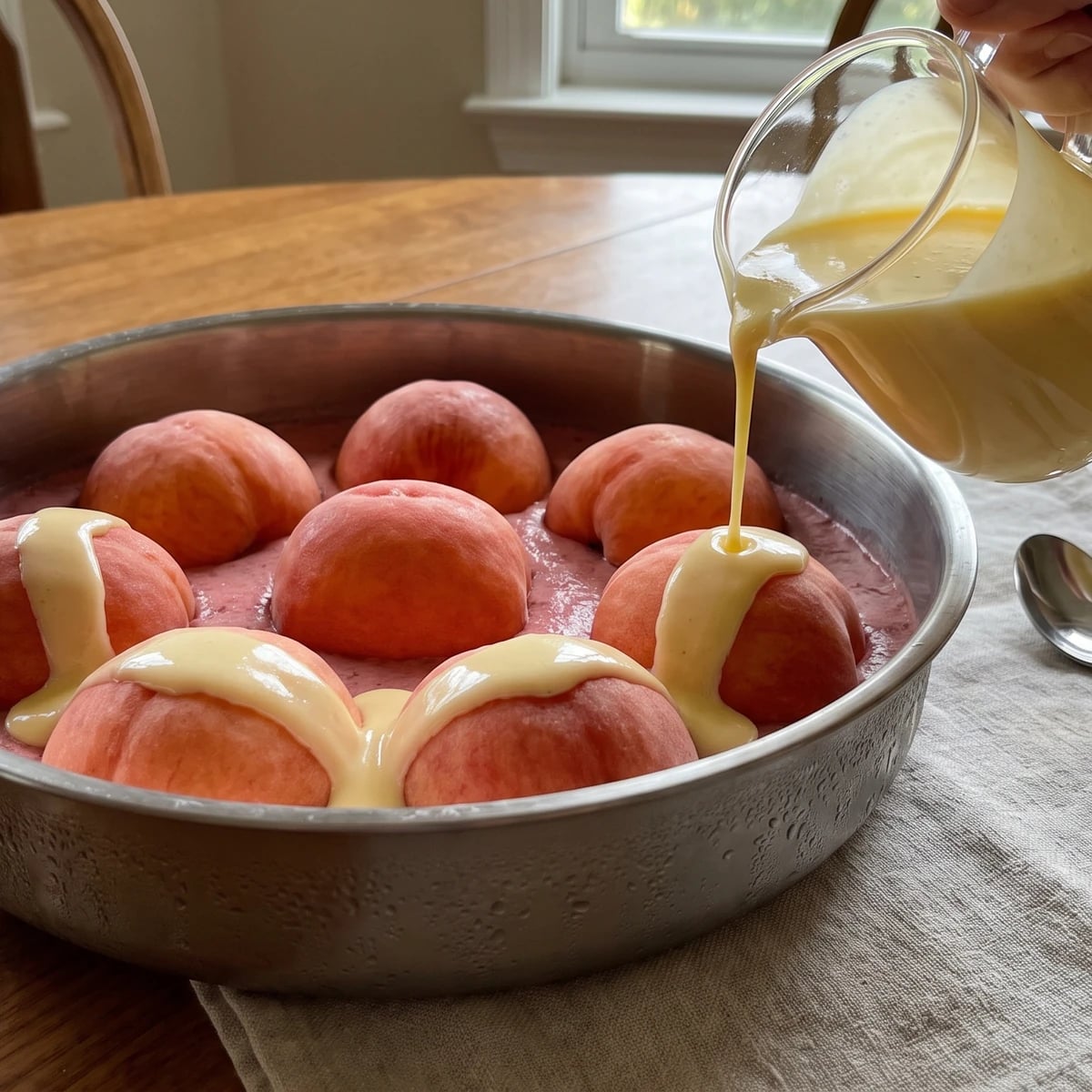
Bring the chilled serving bowl directly to the table and pour the sabayon from the center outward, coating the peaches and allowing a little to settle over the exposed mousse. Serve immediately, while the sauce is still light and the mousse remains firmly cold beneath it. The contrast is the dish, so this is no moment to park it on a sideboard. À table!
1 serving (about 340g)
Culinary guides, cultural storytelling, and the editorial depth that makes cooking meaningful.
Discover Culinary Explorer
Chef Juliette
Five almond preparations, one discipline: remove the skins cleanly, dry every kernel through, then cut, toast, or cloak it in pale caramel without letting its fragrant oils escape.

Chef Juliette
A pastry pantry lesson in one tray: filberts warmed only until their red skins release, rubbed clean, cooled, and chopped into a fragrant mise-en-place for cakes, creams, pralines, and petits fours.

Chef Juliette
The smallest pâtisserie discipline decides whether a cake leaves its mould intact: clarified butter in every corner, followed by the lightest veil of dry flour or fécule.

Chef Juliette
Four whites, one spotless bowl, and a patient change of speed: whisk gently until loosened, then briskly to glossy stiffness, with powdered sugar waiting if the foam begins to granulate.