
Chef Juliette
Various Almond Preparations
Five almond preparations, one discipline: remove the skins cleanly, dry every kernel through, then cut, toast, or cloak it in pale caramel without letting its fragrant oils escape.
A cooking platform built around craft, culture, and the stories behind what we eat.
Created by Chef Juliette
Based on No. 2693, Oranges Soufflées en Surprise, from Le Guide Culinaire (1907) by Auguste Escoffier
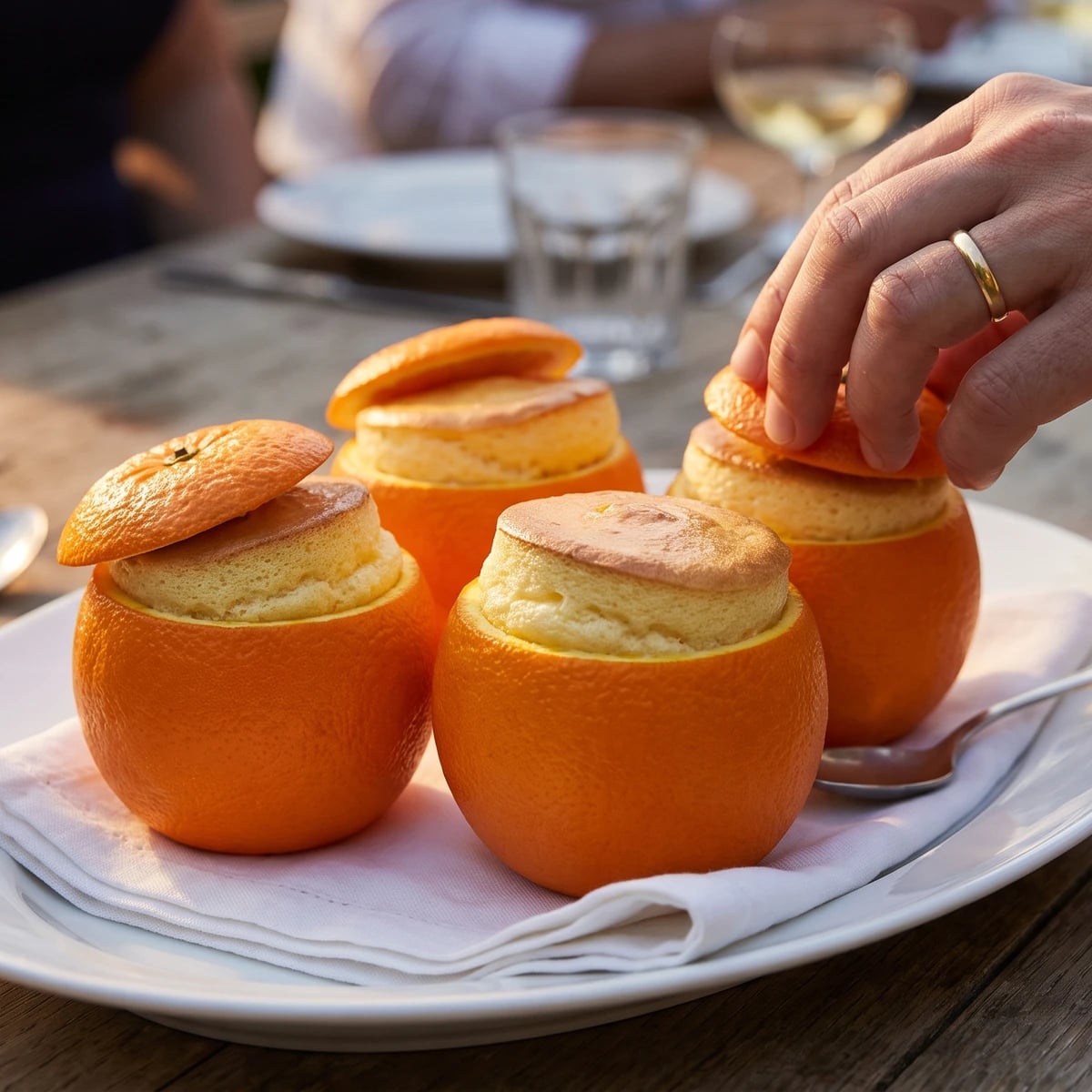
Four bright orange rinds hide tender, citrus-perfumed soufflés under their own caps, a dinner-party lesson in glossy whites, a light folding hand, and the good sense to seat everyone before baking.
Oranges soufflées en surprise (orange soufflés baked in their own rinds) teach the strictest, most useful law of every hot soufflé: service is part of the cooking. The shells may be prepared, the orange base cooled, and the table laid, but once the whites meet that base, dessert belongs first to the oven and then to the guests. A soufflé waits for nobody.
The original entry assumed a pastry station with an orange soufflé preparation ready, enough hands to empty the fruit neatly, and someone to carry each serving from oven to dining room in seconds. It needs neither a saucier nor stock never off the fire, and a salamander would scorch the rinds before the centres rose. The honest home equivalent is a four-serving, starch-thickened orange base, each shell held upright in a ramekin, a fully heated oven, and a napkin-lined platter waiting beside it. The brigade's extra hands were scaffolding; the hollow rind, orange base, last-minute whites, immediate baking, and replaced cap are the dish and must stay. One cook, one stove, one evening.
The one true thing to know before touching a pan is this: air is your only lift. Cool the base until it is supple rather than warm, whip the whites until glossy rather than dry, and fold only until the white streaks disappear. That fold decides whether the soufflés rise proudly or sit heavy in their beautiful orange coats.
Oranges soufflées en surprise belong to the Parisian grand-kitchen repertoire of sweet entremets, where a familiar fruit returned to the dining room as both vessel and perfume. The surprise is not a hidden second filling: the emptied rind, capped after baking, conceals a hot orange soufflé and makes the fruit appear almost whole again. From pastry stations to bourgeois celebration tables, its drama has always depended less on ornament than on immediate service.
Quantity
4 large (about 2 lb / 900 g total)
Quantity
1 tablespoon (15 ml / 14 g)
softened and divided
Quantity
1/2 cup (120 ml / 100 g)
divided
Quantity
1/2 cup plus 1 tablespoon (135 ml / 140 g)
taken from the oranges and divided
Quantity
1 tablespoon plus 1 teaspoon (20 ml / 12 g)
Quantity
2 large (about 2 tablespoons / 36 g)
Quantity
1/8 teaspoon (0.6 ml / 0.75 g)
Quantity
4 large (about 1/2 cup / 120 g)
at room temperature
Quantity
1 large (about 2 tablespoons / 30 g)
only for rescuing overwhipped whites
| Ingredient | Quantity |
|---|---|
| large thick-skinned navel oranges | 4 large (about 2 lb / 900 g total) |
| unsalted buttersoftened and divided | 1 tablespoon (15 ml / 14 g) |
| superfine sugardivided | 1/2 cup (120 ml / 100 g) |
| strained fresh orange juicetaken from the oranges and divided | 1/2 cup plus 1 tablespoon (135 ml / 140 g) |
| cornstarch | 1 tablespoon plus 1 teaspoon (20 ml / 12 g) |
| large egg yolks | 2 large (about 2 tablespoons / 36 g) |
| fine salt | 1/8 teaspoon (0.6 ml / 0.75 g) |
| large egg whitesat room temperature | 4 large (about 1/2 cup / 120 g) |
| extra large egg white (optional)only for rescuing overwhipped whites | 1 large (about 2 tablespoons / 30 g) |
Cut a lid about 1/2 inch (1.25 cm) deep from the top of each orange and keep every lid with its own fruit. Use a grapefruit spoon or small spoon to loosen and remove the flesh without cutting through the white pith, then squeeze and strain the pulp. Measure 1/2 cup (120 ml / 125 g) juice for the base and reserve the remaining 1 tablespoon (15 ml / 15 g). If an orange wobbles, shave the thinnest possible slice from its bottom without exposing the flesh. If you nick a shell, ça se rattrape: press a clean scrap of orange membrane over the hole from inside and seal its edges with a little softened butter.
Brush the interiors and cut rims with about 1 teaspoon (5 ml / 4 g) of the softened butter. Spoon in about 1 tablespoon (15 ml / 12 g) of the sugar, turning each shell until the inside is lightly coated, then tap away the excess. Stand the oranges snugly in four ovenproof ramekins so they cannot roll or lean. Keep the matching lids nearby and chill the prepared shells while you make the base.
Whisk the yolks with 1/4 cup (60 ml / 50 g) of the sugar, the cornstarch, and salt in a small saucepan until smooth. Gradually whisk in the measured 1/2 cup (120 ml / 125 g) orange juice. Cook over medium-low heat, whisking into every corner, until the mixture becomes a thick, glossy cream and the first slow bubbles break at the surface. Continue whisking for 30 seconds to cook the starch, then remove it from the heat and beat in the remaining butter. If the base forms lumps, lift it off the heat at once, whisk in the reserved juice a teaspoon at a time, and pass it through a fine sieve. Ça se rattrape.
Scrape the base into a shallow bowl and press parchment directly against its surface. Let it cool for 15 to 20 minutes, until no warmth remains but the mixture is still pliable. A warm base softens the whites; an ice-cold, rigid base makes you overfold them. If it tightens while standing, whisk in enough of the reserved orange juice to restore a smooth cream that falls reluctantly from the whisk.
Set a rack in the lower-middle of the oven and heat it thoroughly to 400°F (200°C, or 180°C fan). Place a folded clean linen napkin on a heatproof serving platter and clear a direct path from oven to table. Seat the guests before you whip the whites. This bit of dining-room discipline replaces the extra hands the original kitchen took for granted.
In a perfectly clean, grease-free bowl, whip the four egg whites at medium speed until they form soft peaks. Add the remaining sugar gradually, then continue beating only until the whites are glossy and hold firm peaks whose tips bend slightly. Stop there. If they become dry, grainy, or clumped, don't throw them out. Ça se rattrape: add the optional fresh egg white and whisk gently by hand just until the mass becomes cohesive and glossy again.
Whisk one-quarter of the whites into the cooled orange base to lighten it. Add the remaining whites in two batches, cutting down through the centre with a broad spatula, sweeping across the bottom, and lifting the mixture over itself while turning the bowl. Stop as soon as no broad white streaks remain. Divide the preparation among the orange shells, filling them level with the cut rims, then smooth the tops and wipe the rims clean. Put them in the oven immediately. The mixture cannot wait on the counter while you find the dessert spoons.
Bake for 14 to 17 minutes without opening the oven during the first 12. The soufflés are ready when they stand about 1 inch (2.5 cm) above the rinds, their tops are lightly golden, and the centres quiver gently rather than slosh when the tray is nudged. If the centres still move like liquid, give them 2 minutes more. A slightly tilted soufflé needs no correction; touching it now does more harm than a little charming asymmetry.
Lift each hot orange from its ramekin, supporting it from beneath with a spoon, and arrange it on the napkin-lined platter. Set its own lid lightly over the risen soufflé without pressing down. Carry the platter straight to the table and serve at once. If a dome settles during the journey, the texture remains tender and fragrant beneath its cap. Never apologize at your own table. À table!
1 serving (about 95g)
Culinary guides, cultural storytelling, and the editorial depth that makes cooking meaningful.
Discover Culinary Explorer
Chef Juliette
Five almond preparations, one discipline: remove the skins cleanly, dry every kernel through, then cut, toast, or cloak it in pale caramel without letting its fragrant oils escape.

Chef Juliette
A pastry pantry lesson in one tray: filberts warmed only until their red skins release, rubbed clean, cooled, and chopped into a fragrant mise-en-place for cakes, creams, pralines, and petits fours.

Chef Juliette
The smallest pâtisserie discipline decides whether a cake leaves its mould intact: clarified butter in every corner, followed by the lightest veil of dry flour or fécule.

Chef Juliette
Four whites, one spotless bowl, and a patient change of speed: whisk gently until loosened, then briskly to glossy stiffness, with powdered sugar waiting if the foam begins to granulate.