
Chef Juliette
Various Almond Preparations
Five almond preparations, one discipline: remove the skins cleanly, dry every kernel through, then cut, toast, or cloak it in pale caramel without letting its fragrant oils escape.
A cooking platform built around craft, culture, and the stories behind what we eat.
Created by Chef Juliette
Based on No. 2688, Mandarines à la Crème, from Le Guide Culinaire (1907) by Auguste Escoffier
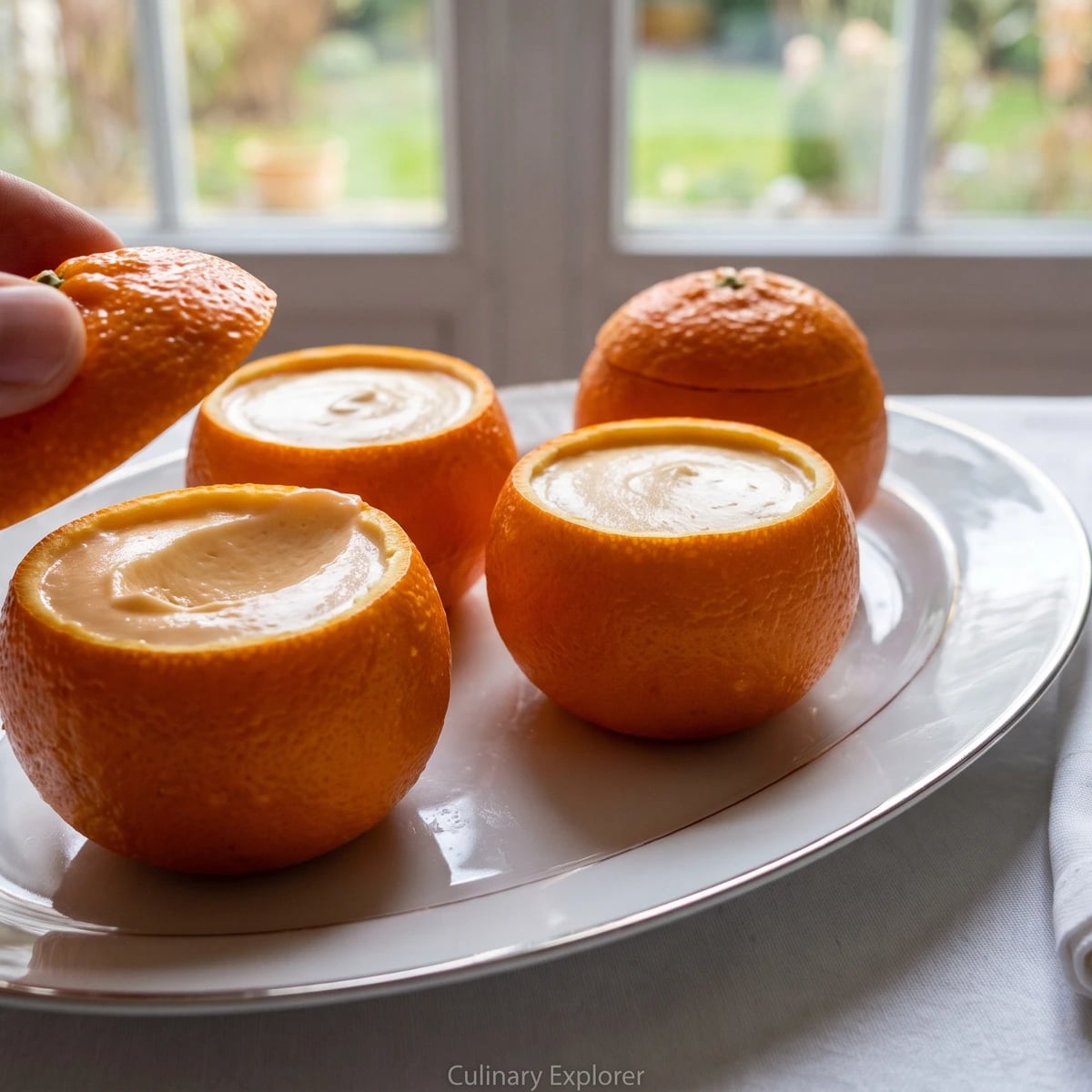
Tangerine shells become their own little moulds, holding a citrus-bright Bavarois softened with fresh cream at the ribbon stage, then chilled until the spoon meets a tender, trembling set.
Mandarines à la Crème (tangerine shells filled with cream-softened Bavarois) teaches the cold dessert's hardest lesson: temperature is an ingredient. The filling should taste intensely of tangerine, yet meet the spoon like a tender custard, neither rubbery from too much gelatin nor loose enough to escape its bright orange shell.
The original recipe assumed a pastry section with thick tangerine Bavarois already waiting, brigade quantities to measure by bulk, and deep ice for holding the filled fruit until service. Your honest equivalents are a small crème anglaise, an ordinary measuring jug, and the refrigerator. The brigade batch and bed of ice are scaffolding, so they go. The intact peels, the thick Bavarois, and the final liquid cream measured at exactly one-third of its volume are the dish, so they stay. One cook, one stove, one evening.
Before you touch the pan, know the step that decides everything: cool the citrus custard to the ribbon stage before any cream enters. Warm custard melts whipped cream; over-set custard leaves little gelatin knots. Catch it between those two, thick enough to trail briefly from the spatula, and the rest is gentle folding.
Mandarines à la Crème belongs to the Parisian entremets table, where pastry kitchens treated winter citrus as both flavour and serving vessel. It moved readily into bourgeois dining rooms because the peel supplied its own mould, while an ice chest or bed of ice gave the Bavarois the cold it needed to set. The defining detail is not merely cream with fruit: each shell holds a true Bavarois, then fresh liquid cream equal to one-third of its bulk softens the set without erasing it.
Quantity
8 medium, yielding 3/4 cup (180 ml / 180 g) strained juice
chilled; one finely zested before hollowing
Quantity
2 tablespoons (30 ml / 30 g)
Quantity
2 teaspoons (10 ml / 6 g)
Quantity
1/2 cup (120 ml / 124 g)
Quantity
1/3 cup (80 ml / 67 g)
Quantity
3
Quantity
1 small pinch
Quantity
1/2 cup (120 ml / 120 g)
for whipping into the Bavarois
Quantity
about 2/3 cup (160 ml / 160 g)
kept liquid; use exactly one-third the measured volume of finished Bavarois
| Ingredient | Quantity |
|---|---|
| unwaxed tangerines or mandarinschilled; one finely zested before hollowing | 8 medium, yielding 3/4 cup (180 ml / 180 g) strained juice |
| cold water | 2 tablespoons (30 ml / 30 g) |
| powdered gelatin | 2 teaspoons (10 ml / 6 g) |
| whole milk | 1/2 cup (120 ml / 124 g) |
| granulated sugar | 1/3 cup (80 ml / 67 g) |
| large egg yolks | 3 |
| fine sea salt | 1 small pinch |
| cold heavy creamfor whipping into the Bavarois | 1/2 cup (120 ml / 120 g) |
| cold heavy creamkept liquid; use exactly one-third the measured volume of finished Bavarois | about 2/3 cup (160 ml / 160 g) |
Finely zest one tangerine, taking only the orange surface. Cut a neat cap from the stem end of every fruit, about one-fifth of the way down, and keep the caps. Working over a bowl, slide a small spoon between the flesh and peel, then lift out the segments without piercing the base. Trim away loose central pith, but don't scrape the shells thin. Set them upright in a muffin tin and chill. Press and strain the removed fruit, measuring 3/4 cup (180 ml / 180 g) juice.
Pour the strained juice into a small saucepan and simmer gently until reduced from 3/4 cup to 1/2 cup (120 ml / 120 g), about 8 to 12 minutes. This reduction is the flavour foundation: it gives the Bavarois clear tangerine character without flooding it with water. Transfer it to a jug and let it cool.
Put the cold water in a small bowl and sprinkle the gelatin evenly over the surface. Leave it untouched for 5 to 10 minutes, until every grain has swollen and the mixture resembles a soft sponge. Don't pour water over a mound of gelatin; the dry centre will remain lumpy.
Warm the milk and tangerine zest until small bubbles gather at the edge, then remove it from the heat and cover for 5 minutes. Whisk the yolks, sugar, and salt until smooth. Pour in the warm milk gradually while whisking, return everything to the saucepan, and cook over gentle heat with a spatula until the crème anglaise, the stirred custard, reaches 79 to 82°C and coats the back of the spatula. Never let it boil. If a few egg flecks appear, pull it off the heat immediately, whisk hard, and strain it over a cold bowl. Ça se rattrape. Heavy curds and a cooked-egg smell mean the custard went too far and must be remade.
Remove the custard from the heat and stir in the bloomed gelatin until completely dissolved, then strain it into a clean bowl. Let it cool to about 45°C before whisking in the reduced tangerine juice. Set the bowl over ice water and stir steadily until the mixture reaches 24 to 26°C and falls from the spatula in a ribbon that remains visible for a moment. If it starts setting firmly around the edge, lift it from the ice and stand the bowl briefly over barely warm water, whisking until smooth. Ça se rattrape. If it remains thin, return it to the ice and keep stirring; don't ask the cream to thicken a warm base.
Whip the first 1/2 cup (120 ml / 120 g) cream to soft folds, not stiff peaks. Stir one-third of it into the ribboned custard to lighten the base, then fold in the remainder. This is the somewhat thick tangerine Bavarois called for by the original recipe. Transfer it to a measuring jug and note its volume without packing it down. Measure cold liquid cream equal to exactly one-third of that volume, about 2/3 cup (160 ml / 160 g) for 2 cups (480 ml) Bavarois, then fold it through in two additions. The measurement governs, not the estimate. If the mixture becomes very loose because the room is warm, chill it for 5 minutes and stir once before filling.
Spoon the Bavarois into the cold tangerine shells, stopping just below each rim. Keep the shells upright in the muffin tin, cover without touching the filling, and refrigerate for at least 4 hours, until softly set. Chill the peel caps separately. The original bed of ice held a dining room's worth of fruit; the refrigerator gives eight shells the same steady cold with less commotion. Don't freeze them, because freezing turns the custard grainy and damages the peels.
Transfer the mandarines to a chilled platter and rest each cap slightly askew so the pale apricot filling remains visible. Serve directly from the cold. The spoon should pass through a tender set, then meet a filling that tastes first of concentrated tangerine and only afterward of cream. À table!
1 serving (about 85g)
Culinary guides, cultural storytelling, and the editorial depth that makes cooking meaningful.
Discover Culinary Explorer
Chef Juliette
Five almond preparations, one discipline: remove the skins cleanly, dry every kernel through, then cut, toast, or cloak it in pale caramel without letting its fragrant oils escape.

Chef Juliette
A pastry pantry lesson in one tray: filberts warmed only until their red skins release, rubbed clean, cooled, and chopped into a fragrant mise-en-place for cakes, creams, pralines, and petits fours.

Chef Juliette
The smallest pâtisserie discipline decides whether a cake leaves its mould intact: clarified butter in every corner, followed by the lightest veil of dry flour or fécule.

Chef Juliette
Four whites, one spotless bowl, and a patient change of speed: whisk gently until loosened, then briskly to glossy stiffness, with powdered sugar waiting if the foam begins to granulate.