
Chef Juliette
Various Almond Preparations
Five almond preparations, one discipline: remove the skins cleanly, dry every kernel through, then cut, toast, or cloak it in pale caramel without letting its fragrant oils escape.
A cooking platform built around craft, culture, and the stories behind what we eat.
Created by Chef Juliette
Based on No. 2670, Ananas à la Ninon, from Le Guide Culinaire (1907) by Auguste Escoffier
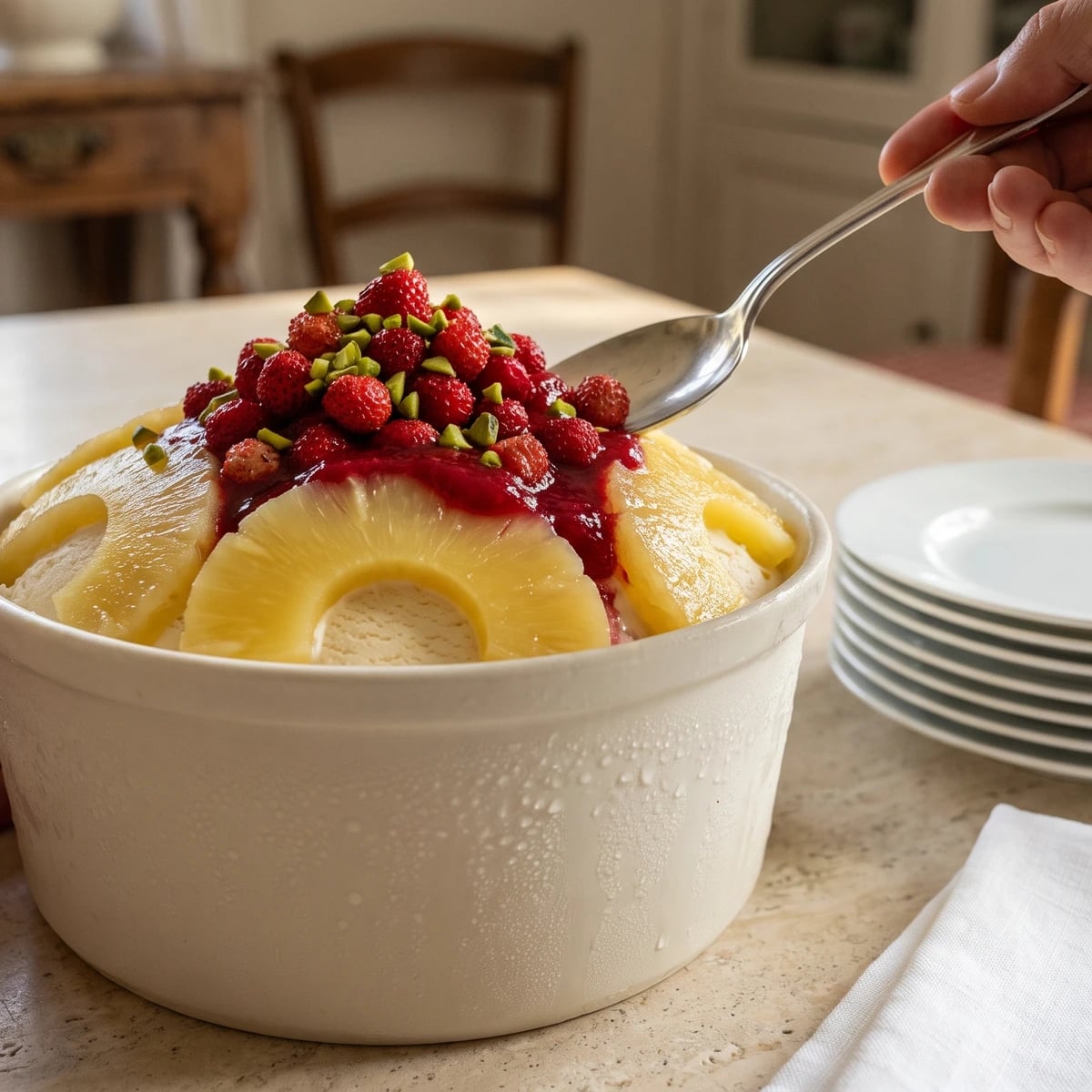
A cold Parisian showpiece made practical: vanilla ice swept into an oblique lining, two rows of pineapple, and a heart of wild strawberries under bright raspberry purée and pistachios.
Ananas à la Ninon (pineapple with vanilla ice cream, wild strawberries, and raspberry purée) teaches the first law of cold assembly: cold is structure. Before you touch the soufflé timbale, chill it thoroughly and dry every piece of fruit. The vanilla lining must support the pineapple, not melt beneath it.
The source assumed a pâtissier, house-made vanilla ice held at precisely the right softness, a chilled metal timbale, and enough hands to prepare fruit while another cook laid the frozen lining. At home, a straight-sided 1½-quart soufflé dish, a frozen sheet pan, and excellent purchased vanilla ice cream perform the same honest work. I have scaled the composition to six servings and removed the brigade scaffolding of churning and extra hands. The oblique lining, projecting pineapple rows, strawberry pyramid, raspberry purée, and pistachios remain, because they are the dish. One cook, one stove, one evening, with the stove enjoying the night off.
When it is right, pale vanilla ice rises toward the rim beneath overlapping gold pineapple, while tiny red strawberries stand in the center under a sharp crimson purée. Work quickly, but don't panic. The step that decides Ananas à la Ninon is shaping the oblique vanilla lining and freezing it firm before the fruit touches it.
Ananas à la Ninon belongs to the Parisian grand-kitchen repertory of cold entremets, where molded ices and precisely cut fruit closed formal meals. Its name invokes Ninon de l'Enclos, the Parisian salonnière whose name entered the canon in the honorific fashion used for elegant preparations; this is a named composition, not a regional pineapple custom. What traveled to private tables was its architecture: vanilla ice as a sloping support, pineapple set in projecting rows, and soft berries held at the center under purée.
Quantity
2½ cups (600 ml / 420 g)
softened only until spreadable
Quantity
3 cups (720 ml / 450 g)
cut into ⅛-inch (3 mm) flexible half-rings and blotted dry
Quantity
2 cups (480 ml / 300 g)
chilled
Quantity
2½ cups (600 ml / 300 g)
thawed if frozen, puréed and strained to yield about 1 cup (240 ml / 240 g)
Quantity
2 tablespoons (30 ml / 18 g)
finely chopped
| Ingredient | Quantity |
|---|---|
| vanilla ice cream made with real creamsoftened only until spreadable | 2½ cups (600 ml / 420 g) |
| fresh pineapplecut into ⅛-inch (3 mm) flexible half-rings and blotted dry | 3 cups (720 ml / 450 g) |
| fresh wild or alpine strawberries (fraises des bois)chilled | 2 cups (480 ml / 300 g) |
| fresh or frozen raspberriesthawed if frozen, puréed and strained to yield about 1 cup (240 ml / 240 g) | 2½ cups (600 ml / 300 g) |
| shelled unsalted pistachiosfinely chopped | 2 tablespoons (30 ml / 18 g) |
Place a straight-sided 1½-quart soufflé timbale, a rimmed sheet pan, and a small offset spatula in the freezer for 30 minutes. Chill the serving plates if space permits. Keep the vanilla ice cream frozen for now; it should soften under your control, not while the other ingredients wait.
Purée the raspberries until completely smooth, then press them through a fine sieve to remove every seed. Chill the purée in a shallow covered container. Do not sweeten it; the vanilla ice cream and pineapple carry the sweetness, while the raspberry must remain bright. If thawed berries have released a pool of clear liquid, drain that liquid before puréeing so the finished purée coats the strawberries instead of running through them.
Slice the peeled pineapple crosswise into very thin rounds, remove the hard cores, and cut the rounds into half-rings. They should bend without cracking. Blot each slice thoroughly between clean towels, then chill them in a single layer. Examine the fraises des bois, removing hulls only where necessary, and keep the berries whole and cold. Dry fruit matters here: surface juice makes the frozen lining slick.
Let the vanilla ice cream stand just until a spatula can move through it, about 5 to 8 minutes. Set the frozen timbale on the frozen sheet pan, then spread the ice cream into a continuous oblique bed, thick against the inner rim and sloping down toward the center of the bottom. Turn the timbale as you work so the incline remains even. This slope is the principle inside the method: it supports the pineapple rows while leaving the center ready for the berries. If the ice cream tears, wait 2 minutes; if it shines, slides, or puddles, stop. Ça se rattrape: return the timbale, tray, and ice cream to the freezer for 8 minutes, then patch and continue. Freeze the completed lining for 20 minutes, until firm to a light touch.
Arrange the pineapple half-rings over the frozen incline in two or three overlapping concentric rows, beginning near the lower center and working upward. Shingle each piece slightly over the last, and set the uppermost row so its curved edges project ½ to ¾ inch (1 to 2 cm) beyond the timbale rim, exactly as the composition requires. Press only enough to secure the fruit. If the lining begins to soften while you work, return the whole dish to the freezer for 5 to 8 minutes before continuing.
Build the chilled fraises des bois into a generous pyramid at the center of the timbale. Spoon the cold raspberry purée over the berries until they are coated in crimson but still hold their shape, then scatter the chopped pistachios evenly over the purée. Carry Ananas à la Ninon straight to the table and serve onto chilled plates. The finished fruit should remain tender, never frozen hard. À table!
1 serving (about 240g)
Culinary guides, cultural storytelling, and the editorial depth that makes cooking meaningful.
Discover Culinary Explorer
Chef Juliette
Five almond preparations, one discipline: remove the skins cleanly, dry every kernel through, then cut, toast, or cloak it in pale caramel without letting its fragrant oils escape.

Chef Juliette
A pastry pantry lesson in one tray: filberts warmed only until their red skins release, rubbed clean, cooled, and chopped into a fragrant mise-en-place for cakes, creams, pralines, and petits fours.

Chef Juliette
The smallest pâtisserie discipline decides whether a cake leaves its mould intact: clarified butter in every corner, followed by the lightest veil of dry flour or fécule.

Chef Juliette
Four whites, one spotless bowl, and a patient change of speed: whisk gently until loosened, then briskly to glossy stiffness, with powdered sugar waiting if the foam begins to granulate.