Culinary Explorer
A cooking platform built around craft, culture, and the stories behind what we eat.
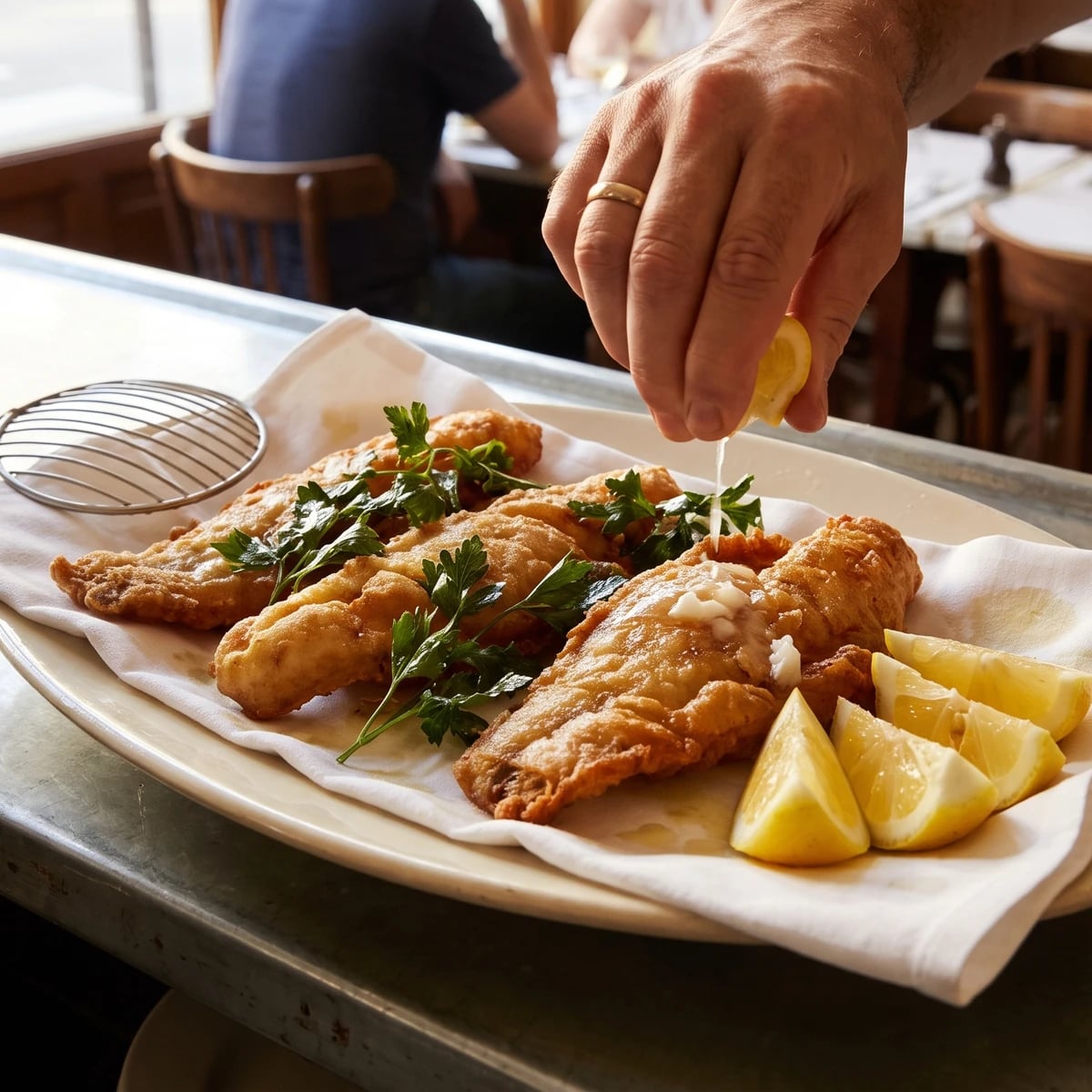
Frying Medium For Fish
Created by Chef Juliette
Bain de friture teaches the rule governing fried fish: match the oil's heat to the fish's size, and milk plus flour forms a crisp, protective coat.
Bain de friture pour poisson (frying medium for fish) teaches one true thing: the oil's temperature must suit the fish's thickness, so the coating browns at the same moment the flesh finishes cooking. Too cool and the flour drinks oil. Too hot and the coat darkens while the centre remains raw. For these fillets, 180°C is the meeting point.
The original method assumed a large working fryer, repeated batches, and frying fat filtered and used until its strength was exhausted. A home kitchen has neither that turnover nor a brigade watching the vat, so fresh refined oil, a heavy pot, and a clip-on thermometer are the honest equivalents. Pushing dark oil to exhaustion was useful economy at scale; at home it becomes bitter and smoky. That scaffolding can go. The salted-milk steep, the light flouring, and the temperature control are the dish and must stay. One cook, one stove, one evening.
When it lands on the platter, the crust should be thin and crisp rather than armoured, with moist flakes beneath and only the faintest sheen of oil. Flour immediately before frying and wait for the oil to recover between batches. That pause decides the whole result.
Ingredients
skinless firm white-fish fillets, such as cod, haddock, or pollock
Quantity
4 fillets, 1½ pounds total (680 g)
cut evenly, about ¾ inch (2 cm) thick
cold whole milk
Quantity
1½ cups (360 ml / 370 g)
fine sea salt
Quantity
2 teaspoons (10 ml / 12 g)
divided
| Ingredient | Quantity |
|---|---|
| skinless firm white-fish fillets, such as cod, haddock, or pollockcut evenly, about ¾ inch (2 cm) thick | 4 fillets, 1½ pounds total (680 g) |
| cold whole milk | 1½ cups (360 ml / 370 g) |
| fine sea saltdivided | 2 teaspoons (10 ml / 12 g) |
Where cooking meets culture.
Culinary guides, cultural storytelling, and the editorial depth that makes cooking meaningful.
Discover Culinary Explorer