Culinary Explorer
A cooking platform built around craft, culture, and the stories behind what we eat.
Creams
Created by Chef Juliette
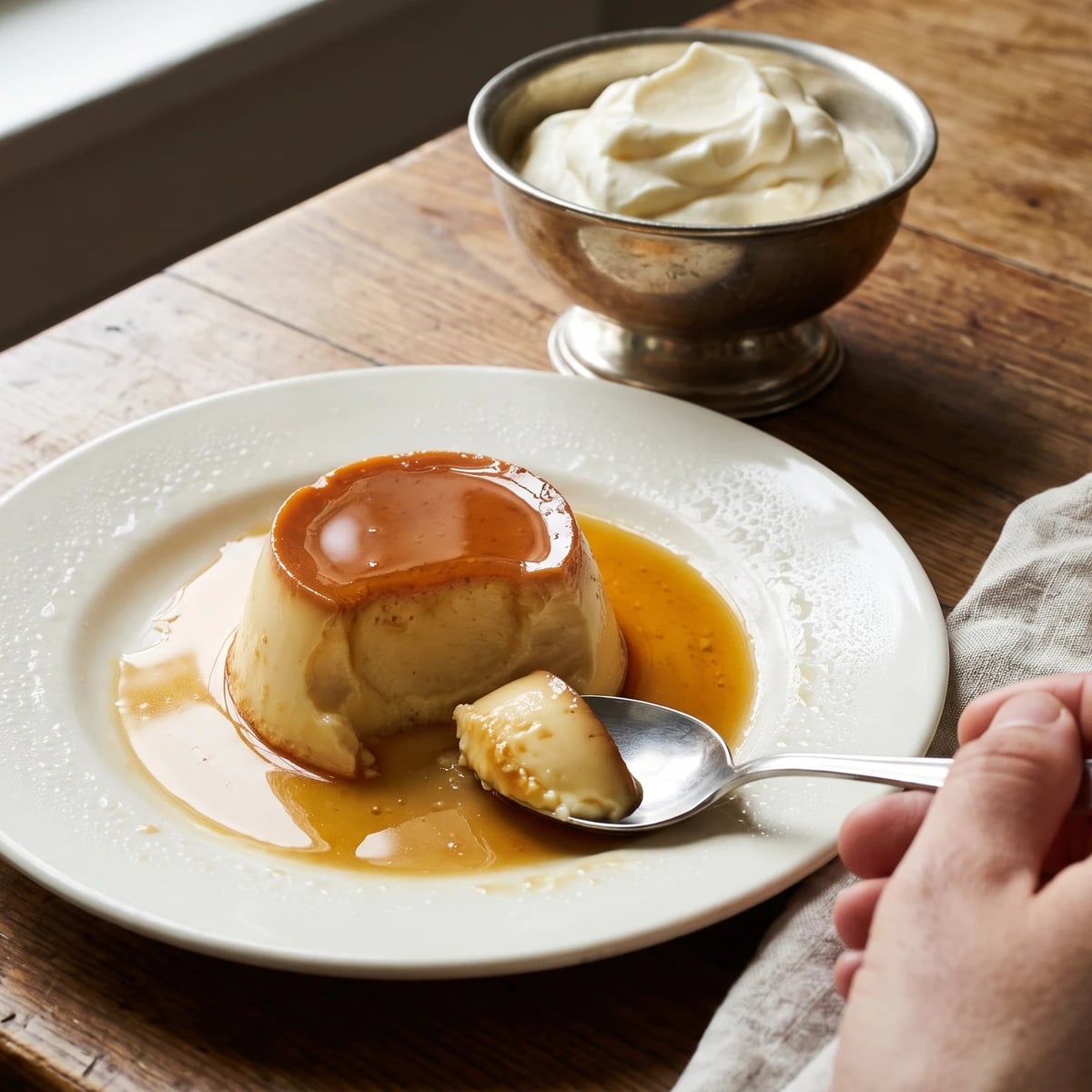
One family, two techniques: a crème moulée held by gentle egg coagulation, and crème Chantilly held by air, each cold, delicate, and made for tonight’s home table.
Crèmes froides teach one true principle: temperature decides what holds. A crème moulée sets because eggs meet gentle heat without boiling; crème Chantilly gains its body because cold cream traps air without turning grainy. C’est la même grammaire, control the structure and the cream stays delicate.
The source entry is a map of these two families rather than a formula with proportions, so nothing can be scaled mechanically. This version gives one canonical specimen of each: six crèmes moulées au caramel and a home bowl of Chantilly. The original service assumed ranks of special pots and moulds, a dedicated bain-marie, and pastry hands available to whip cream close to the table. Six ramekins, a roasting tin, and a hand mixer do the same work for one cook, one stove, one evening.
Rows of silver bowls were brigade scaffolding and can go. The gentle water bath for the crème moulée and the thoroughly chilled bowl for Chantilly are the dishes themselves, and they stay. Before you touch the pan, arrange the water bath and chill the whipping bowl; temperature is the step that decides both.
Ingredients
granulated sugar, for the caramel
Quantity
½ cup (120 ml / 100 g)
water, for the caramel
Quantity
2 tablespoons (30 ml / 30 g)
whole milk
Quantity
2 cups (475 ml / 490 g)
| Ingredient | Quantity |
|---|---|
| granulated sugar, for the caramel | ½ cup (120 ml / 100 g) |
| water, for the caramel | 2 tablespoons (30 ml / 30 g) |
| whole milk | 2 cups (475 ml / 490 g) |
Where cooking meets culture.
Culinary guides, cultural storytelling, and the editorial depth that makes cooking meaningful.
Discover Culinary Explorer