
Chef Juliette
Various Almond Preparations
Five almond preparations, one discipline: remove the skins cleanly, dry every kernel through, then cut, toast, or cloak it in pale caramel without letting its fragrant oils escape.
A cooking platform built around craft, culture, and the stories behind what we eat.
Created by Chef Juliette
Based on No. 2595, Pommes à la Condé, from Le Guide Culinaire (1907) by Auguste Escoffier
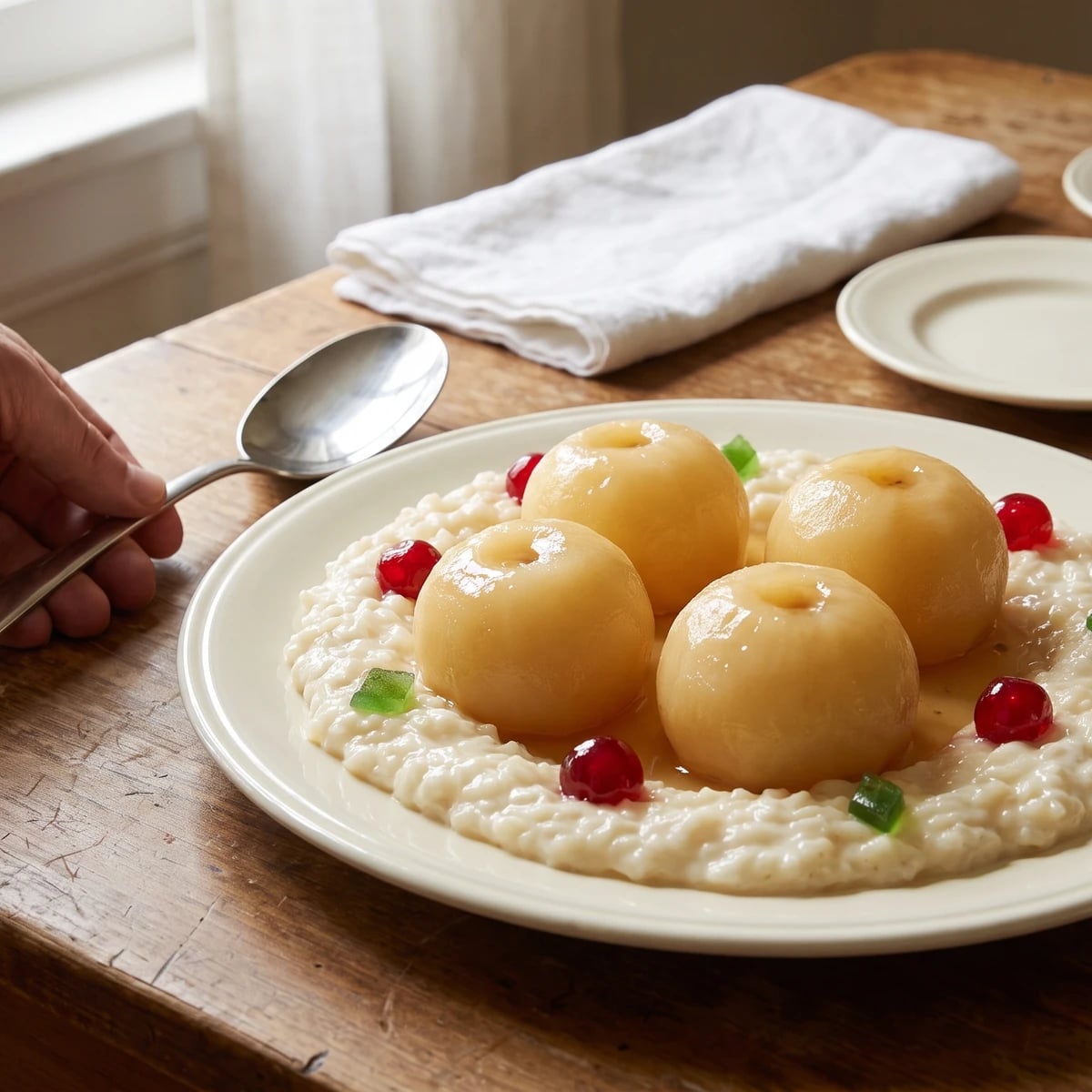
Four whole apples, vanilla-poached until tender but intact, sit proudly on sweet Condé rice beneath a Kirsch-apricot gloss, with jewel-red cherries and green angelica marking the classical garnish.
Pommes à la Condé (vanilla-poached apples on sweet rice) teaches the discipline of pocher au sirop, poaching in syrup: the liquid must barely tremble. A rolling boil batters the peeled fruit, opens its sides, and turns an elegant whole apple into compote. Gentle heat carries the vanilla through while the flesh remains tender and intact.
The book assumes that the vanilla sweet rice and Kirsch-flavoured apricot syrup from Apricots à la Condé (No. 2551) are already waiting, along with a buttered border mould and enough hands to manage a service platter. Here the quantity becomes four apples, the speciality mould gives way to a damp spoon and an ordinary bowl, and a narrow saucepan plus parchment lid keeps the fruit evenly surrounded by syrup. The mould was brigade scaffolding. The sweet rice, whole-fruit poach, candied garnish, and brilliant apricot coating are the dish, so they stay. One cook, one stove, one evening.
When it comes together, the apples gleam above a creamy vanilla rice border, cherries burn ruby against the ivory, and strips of angelica bring the green accent the preparation has always worn. Guard the tremble during poaching. That is the one step that decides the dish.
Pommes à la Condé belongs to the Parisian classical entremets repertoire, where à la Condé identifies syrup-poached fruit presented with vanilla-scented sweet rice and a brilliant fruit glaze. The name is not a claim of origin in an apple-growing province; it comes from the courtly naming language attached to the Condé house, while the practical preparation moved readily from grand dining rooms to bourgeois tables because both rice and fruit could wait for service. Apples became one member of a whole Condé family that also welcomed apricots, peaches, and pears, with the garnish changing less than the fruit.
Quantity
2½ cups (590 ml / 560 g), prepared as part of Apricots à la Condé (No. 2551)
cooled until firm enough to shape
Quantity
½ cup (120 ml / 135 g), prepared as part of Apricots à la Condé (No. 2551)
Quantity
4 medium, about 1½ pounds (680 g) total
Quantity
4 cups (950 ml / 950 g)
Quantity
2 cups (475 ml / 400 g)
Quantity
1
split lengthwise
Quantity
¼ cup (60 ml / 55 g)
halved if large
Quantity
2 tablespoons (30 ml / 25 g)
cut into narrow diamonds
| Ingredient | Quantity |
|---|---|
| prepared vanilla-flavoured sweet ricecooled until firm enough to shape | 2½ cups (590 ml / 560 g), prepared as part of Apricots à la Condé (No. 2551) |
| prepared Kirsch-flavoured apricot syrup | ½ cup (120 ml / 135 g), prepared as part of Apricots à la Condé (No. 2551) |
| firm cooking apples | 4 medium, about 1½ pounds (680 g) total |
| water | 4 cups (950 ml / 950 g) |
| granulated sugar | 2 cups (475 ml / 400 g) |
| vanilla beansplit lengthwise | 1 |
| glacé cherrieshalved if large | ¼ cup (60 ml / 55 g) |
| candied angelicacut into narrow diamonds | 2 tablespoons (30 ml / 25 g) |
Have the vanilla-flavoured sweet rice and Kirsch-flavoured apricot syrup from Apricots à la Condé (No. 2551) finished before starting the apples. Keep the rice covered and cool, but not icy, so it will shape without cracking. Keep the apricot syrup covered until glazing.
Combine the water and sugar in a narrow, deep saucepan just wide enough to hold the apples. Scrape in the vanilla seeds, add the pod, and bring the syrup to a full boil, stirring only until the sugar dissolves. Boil for 2 minutes, then lower the heat until the surface barely moves. The brief boil dissolves the sugar; the gentler temperature is for the fruit.
Peel each apple smoothly from stem to base. Use an apple corer or melon baller from the blossom end to remove the core without cutting through the stem end, then pare the base just enough for the apple to stand. Lower each apple into the warm syrup as soon as it is peeled so the flesh does not discolor.
Cut a cartouche, a parchment lid, to fit inside the saucepan and lay it directly over the apples. Hold the syrup between 180 and 185°F (82 and 85°C), with only an occasional lazy bubble, and turn the apples gently with two spoons every 5 minutes. Begin testing after 18 minutes; a thin skewer should enter the thickest part with slight resistance, usually after 20 to 30 minutes. Remove each apple as it becomes ready. If a side begins to split, lift that apple out immediately and let it cool with the split facing downward. Ça se rattrape: the glaze will seal the surface, and the damaged side can face the centre of the platter.
Set the apples upright on a rack over a tray and leave them until completely cool. Strain and reserve a little vanilla syrup for adjusting the glaze, then save the remainder for another batch of fruit. Do not leave the cooked apples soaking while they cool; hot syrup keeps tenderizing them after the pan leaves the stove.
Set an inverted 4-inch (10 cm) bowl in the centre of a 10 to 11-inch (25 to 28 cm) round serving platter. Spoon the prepared vanilla rice from Apricots à la Condé (No. 2551) around it, forming an even border about 2 inches (5 cm) wide and 1½ inches (4 cm) high. Smooth the top and sides with a spoon dipped in cold water, then lift away the bowl. If the border slumps, chill the platter for 15 minutes and shape it again. A speciality border mould saves a few movements, nothing more.
Set the four cooled apples upright and evenly spaced on the rice border. Arrange the glacé cherries around their bases and place the angelica diamonds between them. Warm the Kirsch-flavoured apricot syrup from Apricots à la Condé (No. 2551) only until fluid, then brush it generously over the apples, rice, cherries, and angelica. If it is too stiff to brush, loosen it with a teaspoon of reserved vanilla syrup; if it runs straight off, let it cool for a minute before continuing. Serve cool rather than refrigerator-cold, while the rice is creamy and the vanilla remains fragrant. À table!
1 serving (about 345g)
Culinary guides, cultural storytelling, and the editorial depth that makes cooking meaningful.
Discover Culinary Explorer
Chef Juliette
Five almond preparations, one discipline: remove the skins cleanly, dry every kernel through, then cut, toast, or cloak it in pale caramel without letting its fragrant oils escape.

Chef Juliette
A pastry pantry lesson in one tray: filberts warmed only until their red skins release, rubbed clean, cooled, and chopped into a fragrant mise-en-place for cakes, creams, pralines, and petits fours.

Chef Juliette
The smallest pâtisserie discipline decides whether a cake leaves its mould intact: clarified butter in every corner, followed by the lightest veil of dry flour or fécule.

Chef Juliette
Four whites, one spotless bowl, and a patient change of speed: whisk gently until loosened, then briskly to glossy stiffness, with powdered sugar waiting if the foam begins to granulate.