
Chef Juliette
Various Almond Preparations
Five almond preparations, one discipline: remove the skins cleanly, dry every kernel through, then cut, toast, or cloak it in pale caramel without letting its fragrant oils escape.
A cooking platform built around craft, culture, and the stories behind what we eat.
Created by Chef Juliette
Based on No. 2533, Hilda Soufflé, from Le Guide Culinaire (1907) by Auguste Escoffier
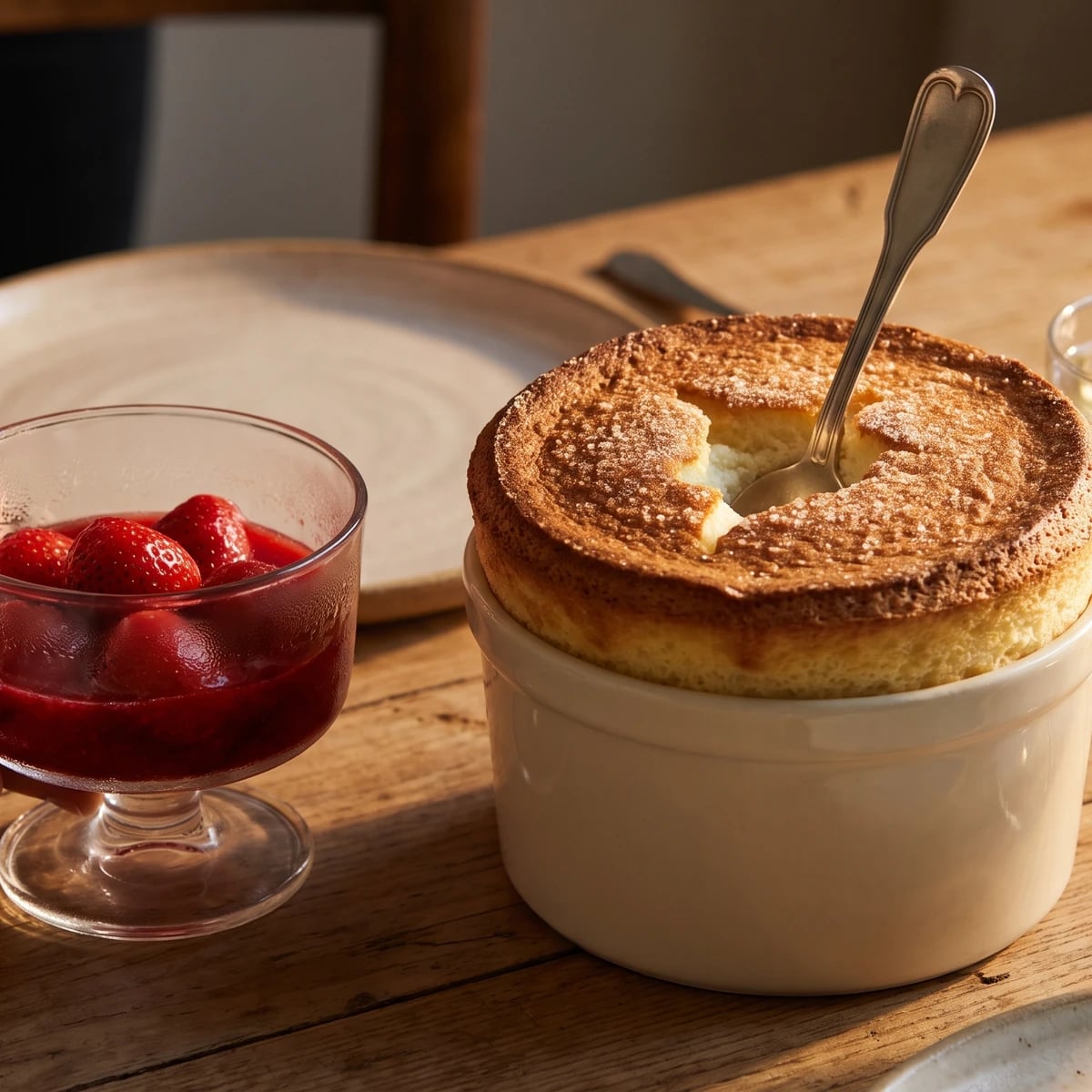
Soufflé Hilda rises warm, high, and tender beside cold strawberries veiled in raw raspberry purée, a precise lesson in timing, temperature, and the restraint that keeps fresh fruit brilliantly alive.
Soufflé Hilda (lemon soufflé with chilled berries) teaches the central truth of every hot soufflé: the lift is made in the whites, but its survival depends on a base light enough to rise and strong enough to hold. Beside it, cold strawberries in uncooked raspberry purée give the warm lemon crumb its sharp edge. The fruit must stay raw. Heat dulls the raspberry, and the whole plate loses its nerve.
The original service assumed a pâtissier, the pastry cook, whipping to order, a hot oven kept free, and another pair of hands chilling the berries and carrying the soufflé before it fell. At home, make the fruit first, use one straight-sided soufflé dish and an ordinary fine sieve, then bake only when everyone is ready. The separate stations are brigade scaffolding and can go; the uncooked purée, careful folding, and immediate service are the dish and must stay. One cook, one stove, one evening.
The one step that matters most is the whites: stop when they stand glossy and supple, not dry. If they go grainy, a fresh white brings them back. Ça se rattrape. Fold gently, fill the dish, and let the oven do its honest work.
Soufflé Hilda belongs to the Parisian grand-kitchen repertoire of named desserts, where a familiar soufflé mixture took its identity from a precise flavoring and accompaniment rather than from a province. Its defining contrast is service practice: lemon soufflé leaves the oven warm while fine strawberries arrive thoroughly cold beneath fresh raspberry purée, an uncooked finish that keeps the fruit vivid. The name makes no regional claim, and the structure moves readily to the home table because it needs an oven, a whisk, and attention rather than a brigade.
Quantity
1 tablespoon (15 ml / 14 g)
softened, for the dish
Quantity
½ cup (120 ml / 100 g)
divided into 2 tablespoons (30 ml / 25 g), ¼ cup (60 ml / 50 g), and 2 tablespoons (30 ml / 25 g)
Quantity
1 cup (240 ml / 245 g)
Quantity
3 tablespoons (45 ml / 24 g)
Quantity
1 pinch
Quantity
4
Quantity
2 lemons, yielding 2 tablespoons (30 ml / 30 g) juice
finely zested and juiced
Quantity
5
at room temperature
Quantity
1
for rescuing overbeaten whites
Quantity
2 cups (475 ml / 340 g)
hulled
Quantity
1½ cups (355 ml / 185 g)
| Ingredient | Quantity |
|---|---|
| unsalted buttersoftened, for the dish | 1 tablespoon (15 ml / 14 g) |
| superfine sugardivided into 2 tablespoons (30 ml / 25 g), ¼ cup (60 ml / 50 g), and 2 tablespoons (30 ml / 25 g) | ½ cup (120 ml / 100 g) |
| whole milk | 1 cup (240 ml / 245 g) |
| all-purpose flour | 3 tablespoons (45 ml / 24 g) |
| fine sea salt | 1 pinch |
| large egg yolks | 4 |
| medium unwaxed lemonsfinely zested and juiced | 2 lemons, yielding 2 tablespoons (30 ml / 30 g) juice |
| large egg whitesat room temperature | 5 |
| additional large egg white (optional)for rescuing overbeaten whites | 1 |
| small ripe strawberrieshulled | 2 cups (475 ml / 340 g) |
| fresh raspberries | 1½ cups (355 ml / 185 g) |
Rinse the strawberries and raspberries briefly, then dry them thoroughly. Leave small strawberries whole and halve only the larger ones. Press the raspberries through a fine-mesh sieve into a cold bowl until only the seeds remain, then fold this fresh, uncooked purée around the strawberries without crushing them. Cover and chill for at least 30 minutes. Do not cook the purée or leave it beside the oven; heat dulls the raspberry, and this cold, vivid contrast is the Hilda accompaniment.
Set a rack in the lower third of the oven and heat it to 400°F (200°C conventional / 180°C fan). Butter a 1½-quart (1.4-liter) straight-sided soufflé dish evenly from base to rim. Coat the interior with the first 2 tablespoons (30 ml / 25 g) sugar, tipping out the excess, then refrigerate the dish while you make the base. The cold butter and sugar form a fine crust that gives the rising mixture something to grip.
Make a crème pâtissière citronnée (lemon pastry-cream base). Bring the milk and lemon zest just below a boil, then remove the pan from the heat for 3 minutes. Whisk the yolks with the ¼ cup (60 ml / 50 g) sugar until smooth, add the flour and salt, then pour in the hot milk gradually while whisking. Return everything to the saucepan and cook over medium heat, whisking constantly, until it bubbles and thickens; continue for 1 minute so the flour loses its raw taste. Remove from the heat and whisk in the lemon juice gradually. If the base catches or forms lumps, lift it from the heat, whisk hard, and press it through a clean sieve. Ça se rattrape. Cover the surface directly and cool until barely warm, about 15 minutes.
Put the 5 egg whites in a completely clean, dry bowl and whisk until they form soft peaks. Add the remaining 2 tablespoons (30 ml / 25 g) sugar gradually, then continue only until the whites are glossy and hold a medium-firm peak whose tip bends slightly. Dry, clotted whites cannot expand properly. If they begin to look grainy, add the optional fresh white a spoonful at a time and whisk gently by hand just until the mixture becomes smooth and supple again.
Whisk one quarter of the whites firmly into the lemon base to loosen it. Add the remaining whites in two batches, folding with a flexible spatula by cutting through the centre and sweeping up from the bottom. Turn the bowl as you work and stop when only a few fine white traces remain; more folding drives out the air you just built. Spoon the mixture into the prepared dish, filling it no more than three quarters full, level the surface lightly, and run a clean thumb around the inside rim to free the edge.
Put the soufflé straight into the oven and lower the temperature to 375°F (190°C conventional / 170°C fan). Bake for 28 to 32 minutes without opening the door during the first 24 minutes. It is ready when it stands well above the rim, the top is deep butter-gold, and the centre gives a gentle tremble rather than a liquid slosh. A slight lean is no catastrophe. Do not stab it with a skewer; the centre should remain tender.
Bring the chilled strawberries to the table as the soufflé leaves the oven. Break through the golden cap with a serving spoon, give each person a generous portion, and spoon the cold strawberries and raw raspberry purée alongside, never over the top where their weight would flatten it. The warm lemon crumb and cold sharp fruit must meet on the plate. À table!
1 serving (about 275g)
Culinary guides, cultural storytelling, and the editorial depth that makes cooking meaningful.
Discover Culinary Explorer
Chef Juliette
Five almond preparations, one discipline: remove the skins cleanly, dry every kernel through, then cut, toast, or cloak it in pale caramel without letting its fragrant oils escape.

Chef Juliette
A pastry pantry lesson in one tray: filberts warmed only until their red skins release, rubbed clean, cooled, and chopped into a fragrant mise-en-place for cakes, creams, pralines, and petits fours.

Chef Juliette
The smallest pâtisserie discipline decides whether a cake leaves its mould intact: clarified butter in every corner, followed by the lightest veil of dry flour or fécule.

Chef Juliette
Four whites, one spotless bowl, and a patient change of speed: whisk gently until loosened, then briskly to glossy stiffness, with powdered sugar waiting if the foam begins to granulate.