Culinary Explorer
A cooking platform built around craft, culture, and the stories behind what we eat.
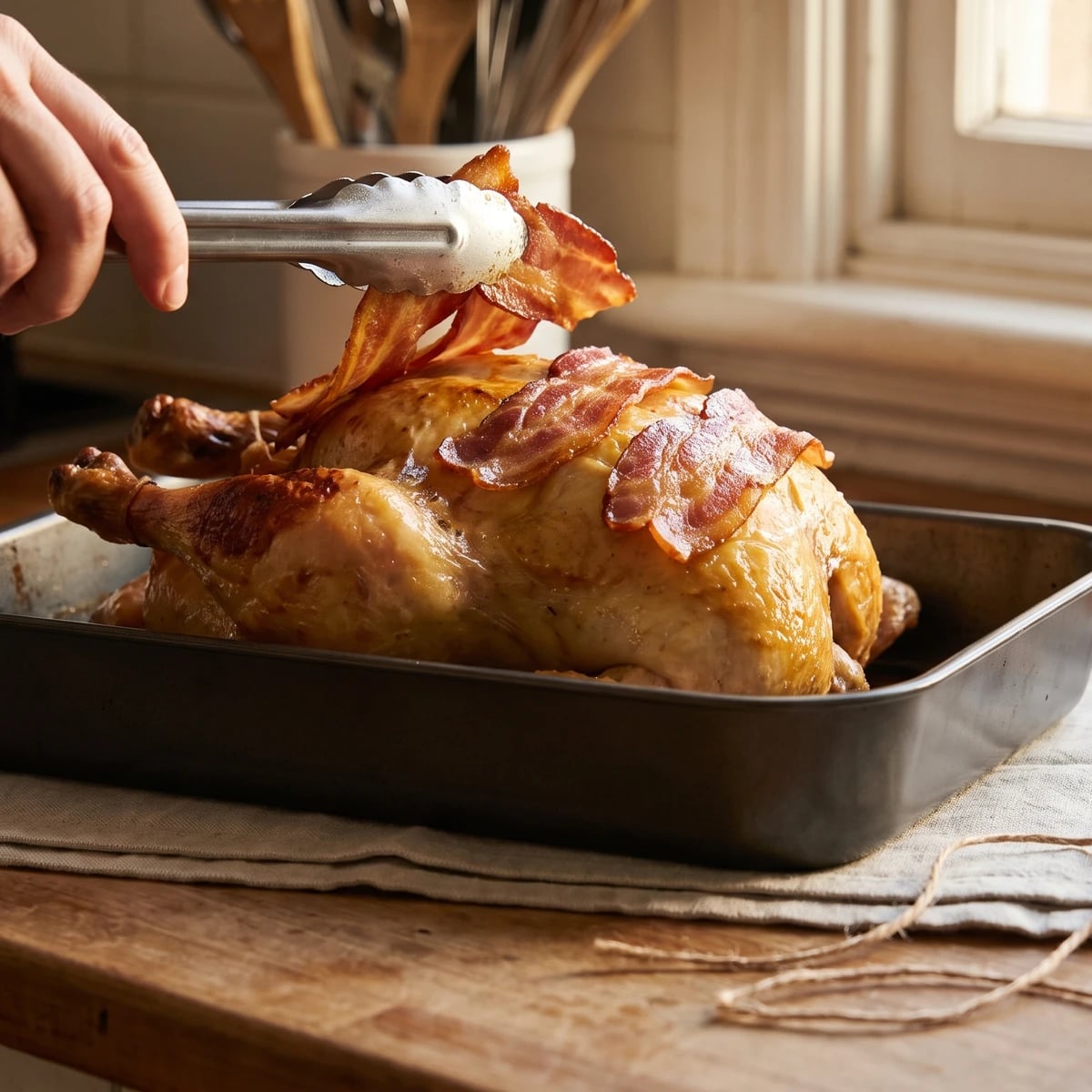
Larding Bacon For Roasts
Created by Chef Juliette
A thin bard of unsmoked bacon protects the delicate breast while the legs catch up, then lifts away so the skin can bronze: one modest preparation that makes a holiday bird roast evenly.
Bardage au lard d’une volaille (barding a bird with larding bacon) teaches one true thing about roasting: protect the part that cooks first. A bird's breast is lean and exposed, while its jointed, muscular legs need longer heat. Cover the breast completely and leave the legs bare, and both arrive at the table succulent instead of negotiating a surrender.
The original preparation assumed the fierce radiant heat of a roasting fire and a larder able to cut one broad, nearly translucent sheet of larding bacon. Your honest equivalents are a conventional oven, a wire rack, and overlapping paper-thin slices of unsmoked fatback tied over one chicken for four. The brigade's tray of birds becomes one bird. A saucier, standing stockpot, and salamander have no work here, because this entry is about protection, not sauce. What changed is the equipment and scale, never the intent. One cook, one stove, one evening.
Repeated basting is brigade scaffolding and can go; a complete barde and an accurate temperature check are the dish and must stay. The bacon comes off only after the legs have gained their necessary lead, giving the breast skin time to bronze at the finish. Before the chicken meets the oven, check the lower edges of the barde closely. Complete coverage is the step that decides the roast.
Ingredients
whole chicken
Quantity
1 bird, about 4 lb (1.8 kg)
giblets removed and bird thoroughly dried
unsmoked larding bacon or fresh pork fatback
Quantity
6 oz (170 g)
sliced paper-thin into broad sheets
fine sea salt
Quantity
2 teaspoons (10 ml / 12 g)
| Ingredient | Quantity |
|---|---|
| whole chickengiblets removed and bird thoroughly dried | 1 bird, about 4 lb (1.8 kg) |
| unsmoked larding bacon or fresh pork fatbacksliced paper-thin into broad sheets | 6 oz (170 g) |
| fine sea salt | 2 teaspoons (10 ml / 12 g) |
Where cooking meets culture.
Culinary guides, cultural storytelling, and the editorial depth that makes cooking meaningful.
Discover Culinary Explorer