Culinary Explorer

A cooking platform built around craft, culture, and the stories behind what we eat.
Discover Culinary Explorer
Sago Pudding

Sago Pudding

Created by Chef Juliette

Based on No. 2494, Sago Pudding, from Le Guide Culinaire (1907) by Auguste Escoffier

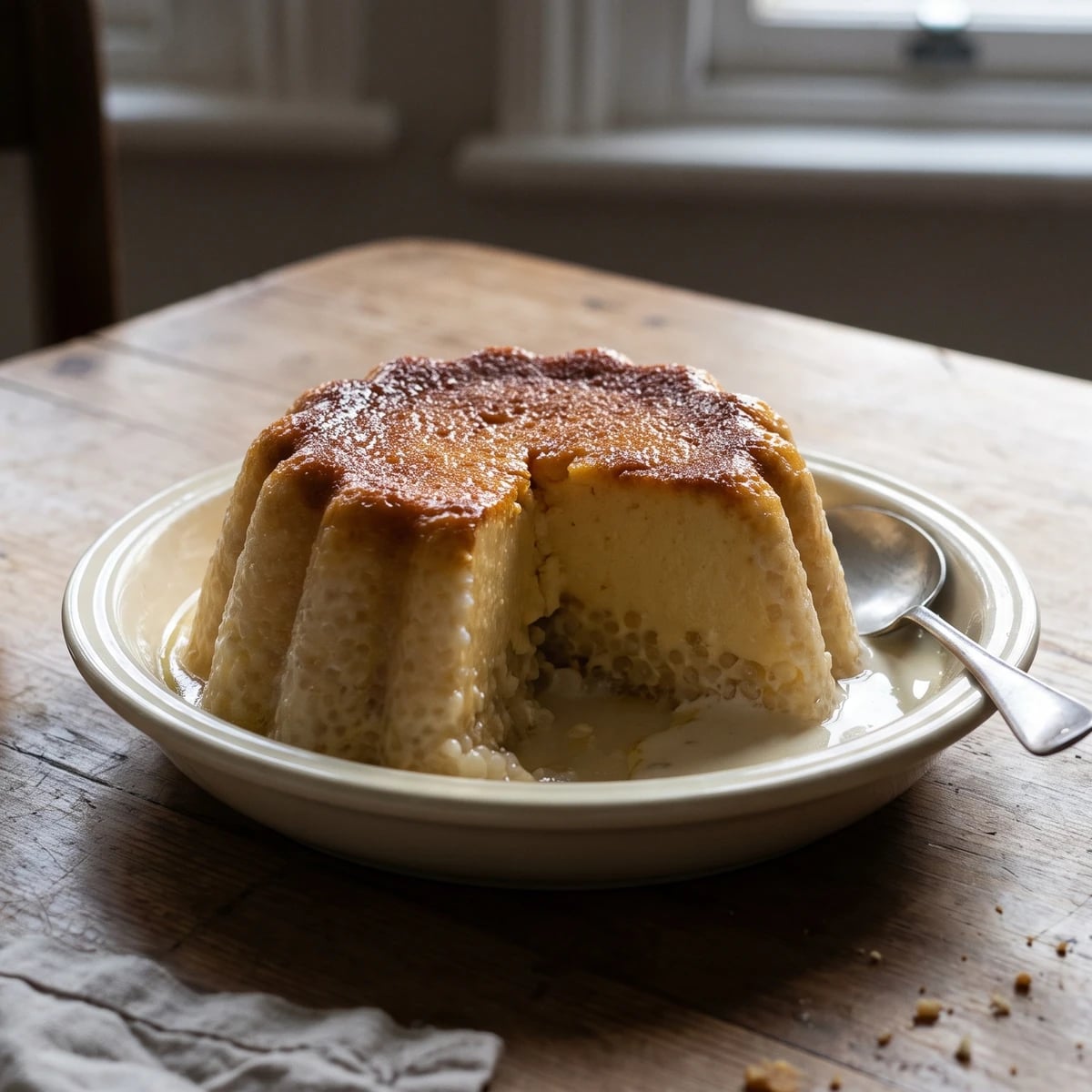
Pouding au sagou rises softly in its sago-dusted mould, then turns out with a pearled edge and tender vanilla centre, proving that patient swelling, not richness or fuss, makes a fine starch pudding.

Desserts
French
Comfort Food
Budget Friendly
Make Ahead
25 min
Active Time
1 hr cook2 hr total
Yield6 servings

Pouding au sagou (sago pudding) teaches the quiet discipline behind every good starch pudding: swell the grains completely before sugar and eggs enter the pan. Rush that first cooking and the centre stays gritty, however handsome the mould may look. Let each pearl turn nearly translucent, and the finished pouding will be tender, coherent, and light enough to tremble under the spoon.

The canonical entry assumed the cook had the tapioca formula open beside it, with service moulds prepared and a controlled poaching oven ready. For one cook at home, that becomes a single 1.25-litre charlotte mould and a roasting tin used as a bain-marie, a hot-water bath. The separate moulding station was brigade scaffolding and can go. Complete swelling, folded egg whites, and the sago coating inside the mould are the dish and must stay.

That coating isn't decoration. The butter catches the dry pearls, giving the mixture a lightly rough wall to climb and leaving a delicate pearled edge when the pouding is turned out. Watch the sago in the saucepan, stir along the bottom, and don't add the sugar until the grains have softened. That is the step that decides everything.

Pouding au sagou found its French home on the bourgeois and hotel dessert tables of Paris, where imported sago joined rice, semolina, and tapioca in the classical family of economical moulded puddings. Sago and tapioca were often treated as interchangeable pantry starches, but they are not the same: true sago comes from the pith of Southeast Asian palms, while tapioca is made from cassava. The canonical direction to replace tapioca with sago both in the pudding and around its mould preserves the shared method while giving sago a distinct texture of its own.

The technique, the tradition, and the story behind every dish.

Discover Culinary Explorer

Ingredients

small pearl sago

Quantity

1/2 cup (120 ml / 100 g)

additional small pearl sago

Quantity

2 tablespoons (30 ml / 24 g)

for the mould

whole milk

Quantity

3 cups (720 ml / 740 g)

vanilla bean

Quantity

1

split lengthwise

caster sugar

Quantity

1/2 cup (120 ml / 100 g)

fine sea salt

Quantity

1/4 teaspoon (1.25 ml / 1.5 g)

unsalted butter

Quantity

2 tablespoons (30 ml / 28 g)

softened and divided

large eggs

Quantity

4

separated

heavy cream (optional)

Quantity

1/2 cup (120 ml / 120 g)

cold, for serving

Equipment Needed

  • 1.25-litre (5-cup) charlotte or pudding mould
  • 2-litre heavy-bottomed saucepan
  • Deep roasting tin for the bain-marie
  • Balloon whisk
  • Broad flexible spatula

Instructions

  1. 1

    Prepare the mould

    Heat the oven to 325°F (160°C) and bring a kettle of water to the boil. Coat the inside of a 1.25-litre charlotte or pudding mould with half the softened butter, reaching cleanly into every flute and corner. Add the moulding sago and roll the mould slowly until the base and sides wear an even scattering of pearls; tap out only those that remain completely loose. Set the mould in the cold while you make the pudding so the coating holds fast.

    Bare patches usually mean the butter was spread too thinly. Touch those places with a little more butter and roll the sago around again.
  2. 2

    Swell the sago

    Combine the pudding sago, milk, and split vanilla bean in a heavy saucepan. Leave them together for 15 minutes, then bring the milk slowly to a bare simmer over medium-low heat. Cook for 25 to 35 minutes, stirring frequently and scraping the bottom and corners, until nearly every pearl is translucent with no more than a pinprick of white at its centre. The mixture should resemble loose porridge. If it clumps before the pearls soften, remove it from the heat and whisk in 1 tablespoon of warm milk at a time until it loosens. Ça se rattrape. Don't scrape up a scorched patch; transfer the unburnt mixture immediately to a clean pan.

  3. 3

    Enrich the base

    Remove the vanilla bean. Whisk the egg yolks with the sugar and salt until smooth, then whisk in a ladleful of the hot sago to warm them gradually. Stir this tempered mixture back into the saucepan over the gentlest heat and cook for 2 minutes, stirring constantly, until it thickens slightly without boiling. Take the pan off the heat and stir in the remaining butter. Let the base cool for about 10 minutes, stirring twice, until warm rather than hot; folded whites collapse against a scalding mixture.

  4. 4

    Fold in the whites

    Beat the egg whites in a clean bowl until they form supple medium peaks, firm enough to hold a curve but not dry or grainy. Stir one-quarter of the whites into the sago base to lighten it, then fold in the remainder in two additions with a broad spatula, turning from the bottom of the bowl until no white streaks remain. Work gently but decisively. If the whites begin to weep while waiting, whisk them briefly until smooth again before folding.

  5. 5

    Bake in bain-marie

    Spoon the mixture into the prepared mould, leaving at least 2.5 cm at the top for its rise, and smooth the surface without pressing out the air. Set the mould in a deep roasting tin and pour in enough boiling water to come halfway up its sides. Bake for 45 to 55 minutes, until the pouding is lightly golden, risen, and set around the edges while the centre retains a small, unified tremble. A thermometer inserted at the centre should read about 172°F to 176°F (78°C to 80°C). If the water begins boiling hard, lower the oven and add a little cool water to the tin; violent heat curdles the custard at the edge.

  6. 6

    Rest and unmould

    Lift the mould from the bain-marie and let the pouding settle for 15 minutes. Place a shallow serving dish over the mould, hold both firmly, and invert them together in one confident movement. Wait several seconds before lifting the mould. If the pouding refuses to release, wrap the base and sides in a hot, damp cloth for 20 seconds and try again; don't carve around it and sacrifice the pearled edge. Serve warm or at room temperature, with cold heavy cream passed separately if you like. À table!

Chef Tips

  • Buy true small pearl sago from a South Asian or Southeast Asian grocer and read the label carefully. Tapioca pearls will set a pudding, but the source specifically calls for sago in the mixture and around the mould.
  • Add the sugar only after the grains are nearly tender. Sugar competes for moisture and can leave the centres stubbornly opaque if it enters too early; patient swelling is the whole technique.
  • A metal charlotte mould gives the cleanest rise and release. A straight-sided metal mixing bowl of the same capacity will work, though the finished pouding will be domed rather than fluted.
  • A vanilla bean gives the milk a round perfume without obscuring the sago. If the bean isn't sensible for the budget, stir in 2 teaspoons (10 ml / 9 g) vanilla extract after the saucepan leaves the heat.
  • The pouding is deliberately gentle in sweetness. Pass cold cream at the table rather than burying it beneath a complicated sauce; cooking well is not cooking fancy.

Advance Preparation

  • The pouding can be baked one day ahead. Let it cool completely in its mould, cover, and chill; bring it out 30 minutes before unmoulding so the butter softens enough to release cleanly.
  • For the lightest texture, the cooked sago base may be prepared up to 30 minutes before the egg whites are folded in. Keep it covered and warm, because a cold, firmly set base will knock the air from the whites.
  • Leftovers keep covered in the cold for up to two days. Serve them cool or let them lose their chill naturally; reheating can tighten the custard.

Frequently Asked Questions

Nutrition Information

1 serving (about 200g)

Calories
365 calories
Total Fat
18 g
Saturated Fat
10 g
Trans Fat
0 g
Unsaturated Fat
7 g
Cholesterol
170 mg
Sodium
205 mg
Total Carbohydrates
42 g
Dietary Fiber
0 g
Sugars
24 g
Protein
9 g

Note: Chef personas and recipes are created with AI assistance. Cook with care: follow safe food-handling practices, check doneness with a thermometer when needed, and adapt for allergies and your kitchen.

Where cooking meets culture.

Culinary guides, cultural storytelling, and the editorial depth that makes cooking meaningful.

Discover Culinary Explorer

More from Entremets (Sweets) - Puddings

Browse the full collection