
Chef Juliette
Flan aux Carottes
A pale short-paste shell holds silken, lightly sweet carrot purée beneath neat glazed half-discs, their butter syrup catching the light: a classical tart poised between vegetable course and sweet.
A cooking platform built around craft, culture, and the stories behind what we eat.
Created by Chef Juliette
Based on No. 2425, Hot Viennese Fritters, from Le Guide Culinaire (1907) by Auguste Escoffier
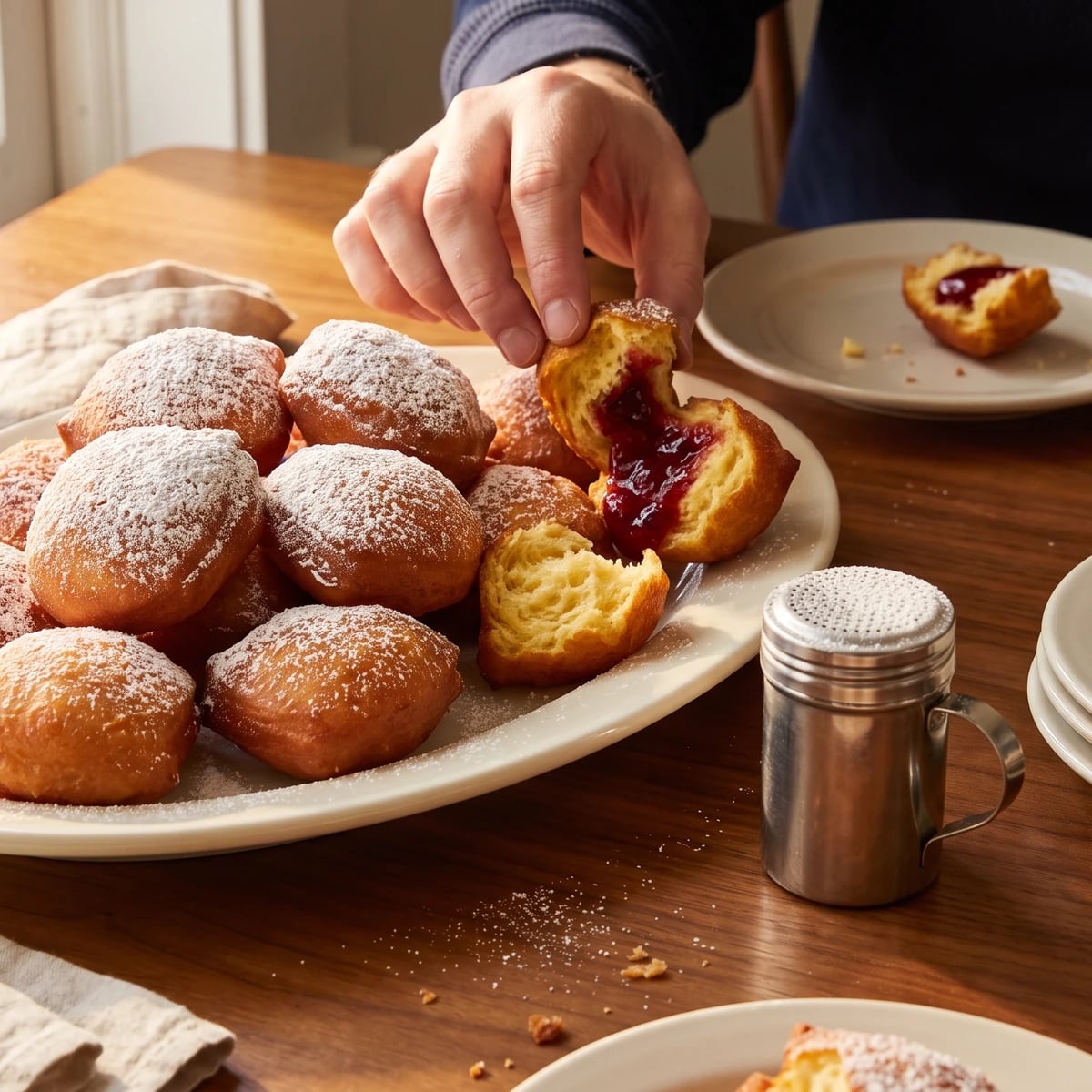
Two thin rounds of pâte viennoise hold a heart of jam, prove together, and fry to a bronze shell with a feather-soft crumb. The seal is the dish: press it well, then pass the sugar.
Beignets viennois chauds (hot Viennese fritters) teach the discipline of a seal. Two sheets of pâte viennoise (enriched yeast paste) enclose a spoonful of fruit, and the whole success rests on one clean ring of joined dough. Keep jam away from that ring, moisten it sparingly, and press firmly with the blunt back of a cutter before stamping out each beignet. If the join is careless, the filling escapes into the fat. That is the one true thing to know before touching the pan.
The original entry assumed a pastry station with the paste already fermented, a long tray dressed in floured linen, and a deep bath of fat whose heat an experienced cook judged by sight. Here, one small dough makes eight beignets, parchment replaces the linen, and a thermometer guards a contained pot of neutral oil. The floured cloth and napkin service were brigade scaffolding; they can go. The two thin sheets, the cutter-pressed join, the thirty-minute proof, and plenty of steady hot fat are the dish itself, so they stay.
Fried correctly, the beignets rise round and light, with bronze sides, a tender buttery crumb, and hot fruit waiting beneath the icing sugar. Don't hurry the seal, and don't crowd the pot. One cook, one stove, one evening.
Beignets viennois chauds sit at the meeting point of Vienna's jam-filled Krapfen tradition and the French classical beignet repertoire. French pastry kitchens recast the idea as two thin sheets of enriched yeast paste sealed around fruit before frying, then served the beignets hot under icing sugar, sometimes with sabayon à la crème. The filling is not injected afterward in this version: enclosing it before the thirty-minute proof is the defining practice and the reason the cutter seal matters.
Quantity
2 cups (475 ml / 250 g)
Quantity
2 tablespoons (30 ml / 25 g)
Quantity
2¼ teaspoons (11 ml / 7 g)
Quantity
¾ teaspoon (3.75 ml / 4 g)
Quantity
½ cup (120 ml / 123 g)
warmed to 80 to 86°F (27 to 30°C)
Quantity
1 large egg (about 50 g out of shell)
at room temperature
Quantity
3 tablespoons (45 ml / 42 g)
very soft but not melted
Quantity
¼ cup (60 ml / 30 g)
for rolling and dusting
Quantity
½ cup (120 ml / 160 g)
chilled
Quantity
1 tablespoon (15 ml / 15 g)
for sealing
Quantity
8 cups (1.9 L / about 1.75 kg)
Quantity
½ cup (120 ml / 60 g)
for finishing
Quantity
1 cup (240 ml / about 240 g)
for serving
| Ingredient | Quantity |
|---|---|
| all-purpose flour | 2 cups (475 ml / 250 g) |
| granulated sugar | 2 tablespoons (30 ml / 25 g) |
| instant yeast | 2¼ teaspoons (11 ml / 7 g) |
| fine sea salt | ¾ teaspoon (3.75 ml / 4 g) |
| whole milkwarmed to 80 to 86°F (27 to 30°C) | ½ cup (120 ml / 123 g) |
| large eggat room temperature | 1 large egg (about 50 g out of shell) |
| unsalted buttervery soft but not melted | 3 tablespoons (45 ml / 42 g) |
| all-purpose flourfor rolling and dusting | ¼ cup (60 ml / 30 g) |
| thick jam or well-drained stewed fruitchilled | ½ cup (120 ml / 160 g) |
| waterfor sealing | 1 tablespoon (15 ml / 15 g) |
| neutral frying oil | 8 cups (1.9 L / about 1.75 kg) |
| icing sugarfor finishing | ½ cup (120 ml / 60 g) |
| finished Sabayon à la crème flavored with vanilla, lemon, orange, coffee, or kirsch (optional)for serving | 1 cup (240 ml / about 240 g) |
Combine the flour, sugar, yeast, and salt in a large bowl. Add the warm milk and egg, then mix until no dry flour remains. Knead for about 5 minutes, until the rough dough begins to gain elasticity. Work in the soft butter a little at a time, adding each portion only after the previous one disappears, then knead for another 8 to 10 minutes. The finished pâte should be smooth, supple, and lightly tacky, not wet. If melted butter makes it greasy and slippery, chill the dough for 10 minutes and resume kneading. Ça se rattrape.
Shape the pâte into a ball and place it in a lightly buttered bowl. Cover and leave it in a comfortably warm place for 60 to 75 minutes, until it looks aerated and has grown by roughly half. Rich dough rises more quietly than bread dough, so don't wait for an enormous dome. Press out the gas gently. If the pâte feels too soft to roll cleanly, flatten it into a thick rectangle and chill it for 15 minutes.
Divide the pâte into two equal pieces. On a lightly floured surface, roll each into a matching rectangle exactly ⅕ inch (5 mm) thick. Keep the corners square enough that the sheets will cover one another. Lay one sheet before you and arrange eight level tablespoons of cold jam at regular intervals, leaving at least 1¼ inches (3 cm) of clean dough around every mound. Thick, cold filling stays where it belongs; loose fruit syrup will find the seam.
Brush a very thin film of water around each mound, never over the jam. Lay the second sheet on top and ease it down from the centre outward, pressing out trapped air without flattening the filling. Centre the blunt back of a 2-inch (5 cm) round cutter over each mound and press firmly to join the two layers in a complete ring. Stamp out the beignet with a sharp 2½-inch (6.5 cm) cutter. Inspect every edge. If jam has touched the join or a gap opens, don't trust it in the oil: wipe the spot clean, patch it with a thin piece of dough, and press the ring again. Ça se rattrape.
Set the fritters well apart on a parchment-lined tray lightly dusted with flour, the home equivalent of the original floured linen. Cover loosely and prove for 30 minutes in a warm, draught-free place. They should look slightly puffed and feel lighter, but the seams must remain distinct. Begin heating the oil halfway through the proof so the beignets can go straight into steady heat.
Pour the oil into a deep, heavy pot, leaving the vessel no more than half full, and heat it to 350°F (175°C). Lower in two or three beignets without crowding. Fry until deep golden underneath, about 1½ to 2 minutes, then turn and fry the second side for another 1½ minutes. Keep the oil between 340 and 350°F (170 and 175°C). If the beignets darken before they swell, lower the heat; if they remain pale and drink oil, pause between batches and restore the temperature. If one leaks, lift it out immediately and skim away the escaped fruit before it burns.
Lift the beignets onto a wire rack set over absorbent paper and let them drain for 2 minutes. Dust them generously with icing sugar while they are still hot, then arrange them on a warm platter. Serve at once, with the finished Sabayon à la crème alongside if desired, flavored with vanilla, lemon, orange, coffee, or kirsch as the original entry permits. The crisp bronze shell and tender crumb wait for no one. À table!
1 serving (2 fritters, about 190g)
Culinary guides, cultural storytelling, and the editorial depth that makes cooking meaningful.
Discover Culinary Explorer
Chef Juliette
A pale short-paste shell holds silken, lightly sweet carrot purée beneath neat glazed half-discs, their butter syrup catching the light: a classical tart poised between vegetable course and sweet.

Chef Juliette
A hot mushroom flan under a butter-gold lattice, with cream reduced close around barely opened caps and a crisp short-paste base protected by one discipline: cool the filling completely.

Chef Juliette
Four little mushroom flans, latticed and gilded, baked hard and fast until butter-gold: a classical garnish scaled to the meat it accompanies and served before its crispness has time to fade.

Chef Juliette
Morels surrender their liquor, then take it back as a glossy cream-and-butter sauce inside burnished puff pastry. The lesson is simple and absolute: reduce with patience, then heat gently and never boil.