
Chef Juliette
Flan aux Carottes
A pale short-paste shell holds silken, lightly sweet carrot purée beneath neat glazed half-discs, their butter syrup catching the light: a classical tart poised between vegetable course and sweet.
A cooking platform built around craft, culture, and the stories behind what we eat.
Created by Chef Juliette
Based on No. 2375, Ramequins and Gougère Paste, from Le Guide Culinaire (1907) by Auguste Escoffier
Pâte à gougère teaches the order that makes savory choux rise: milk in the pan, eggs absorbed completely, diced Gruyère folded in last, then a confident bake to bronzed, hollow puffs.
Pâte à ramequins et à gougère (Gruyère choux paste) teaches one true thing: order builds structure. Milk replaces water, sugar and orange-flower water disappear, and diced Gruyère enters only after every egg has been absorbed. Add the cheese sooner and its fat interferes with the paste before it can gather the strength to rise.
The original formula assumed a pastry station, sixteen eggs, and enough paste for a full service. At home, one quarter of the Ordinary Pâte à Choux (No. 2373) formula gives four people a generous plateful, mixed in an ordinary saucepan and shaped with two spoons. I changed the scale, not the proportions. The brigade quantity was scaffolding; drying the panade properly, absorbing the eggs, and folding the cheese last are the dish itself. One cook, one stove, one evening.
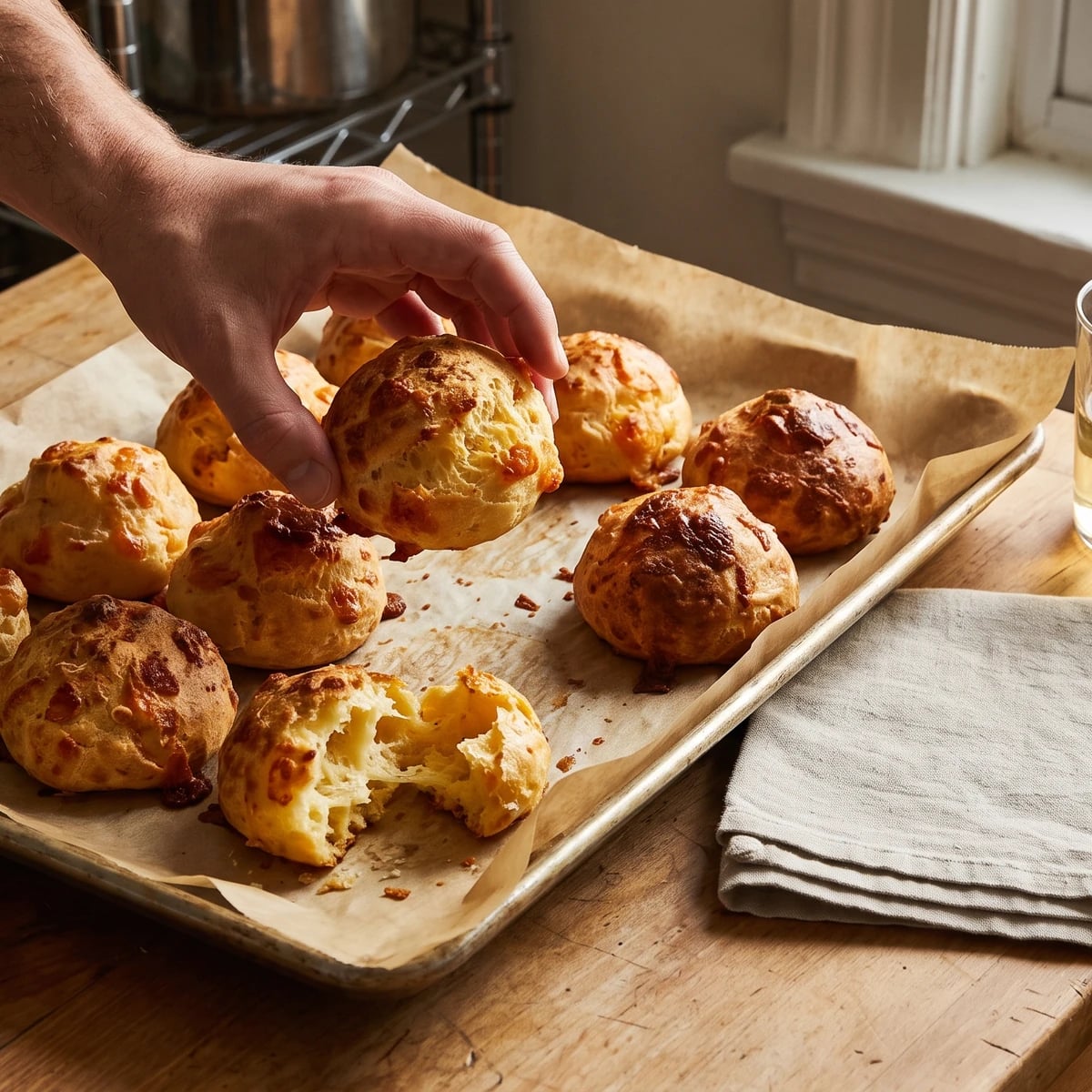
When the gougères are right, their ridges are deeply bronzed, little pockets of Gruyère blister at the edges, and the interior is light and hollow beneath a crisp shell. Before you touch the pan, remember the step that decides everything: cheese last.
Gougère belongs to Burgundy, particularly the Auxerrois and the Yonne, where warm cheese choux accompanies local wine at tastings, dinners, and celebrations. It traveled easily from vineyard cellars and family tables into the classical hors-d'oeuvre repertoire, sometimes baked as a ring and sometimes as individual puffs. In this entry, ramequins share the same savory paste family, and the diced Gruyère is folded through the paste rather than scattered over it.
Quantity
1/4 formula Ordinary Pâte à Choux (No. 2373)
Make at one-quarter scale with 1/2 cup plus 1 1/2 tablespoons (140 ml / 144 g) whole milk replacing the water; omit the sugar and orange-flower water
Quantity
1/2 cup (120 ml / 57 g)
cut into 1/4-inch dice
| Ingredient | Quantity |
|---|---|
| Ordinary Pâte à ChouxMake at one-quarter scale with 1/2 cup plus 1 1/2 tablespoons (140 ml / 144 g) whole milk replacing the water; omit the sugar and orange-flower water | 1/4 formula Ordinary Pâte à Choux (No. 2373) |
| fresh Gruyèrecut into 1/4-inch dice | 1/2 cup (120 ml / 57 g) |
Set a rack in the middle of the oven and heat it to 400°F (200°C). Line a large, heavy baking sheet with parchment. The oven must be fully heated before the paste is ready, because choux left waiting in a cool kitchen loses some of the force that should lift it.
Prepare one quarter of the Ordinary Pâte à Choux (No. 2373) formula, replacing its water with the measured whole milk and omitting both sugar and orange-flower water. Follow its panade and egg method until every addition of egg has disappeared completely into the paste. If the paste turns slick or separates as the egg enters, stop adding more and beat firmly until it closes into a smooth mass again. Ça se rattrape.
Only when all the eggs have been absorbed, fold in the diced Gruyère. Turn the paste just until the cheese is evenly distributed, keeping the dice intact. Do not add the cheese while the eggs are still being worked in; its fat coats the paste and weakens the rise. Cheese last is not ceremony. It is the structure of the gougère.
Drop rounded tablespoons of paste onto the prepared sheet, making 20 to 24 mounds and leaving about 2 inches (5 cm) between them. Two damp teaspoons work perfectly well, so a piping bag is optional. Tuck in any long points with a wet fingertip, since thin peaks color before the centers have finished baking.
Bake for 10 minutes at 400°F (200°C), then lower the oven to 375°F (190°C) without opening the door. Continue for 12 to 15 minutes, until the gougères are deeply golden, firm along their ridges, and light when lifted. Keep the door closed for at least the first 18 minutes. Open it early and the fragile shells can collapse before they have set.
Pierce the side of each gougère once with the tip of a small knife, turn off the oven, and return them for 5 minutes with the door slightly ajar. This lets trapped moisture escape so the shells stay crisp rather than softening from within. Bring them to the table warm, while the diced Gruyère remains tender inside. À table!
1 serving (about 75g)
Culinary guides, cultural storytelling, and the editorial depth that makes cooking meaningful.
Discover Culinary Explorer
Chef Juliette
A pale short-paste shell holds silken, lightly sweet carrot purée beneath neat glazed half-discs, their butter syrup catching the light: a classical tart poised between vegetable course and sweet.

Chef Juliette
A hot mushroom flan under a butter-gold lattice, with cream reduced close around barely opened caps and a crisp short-paste base protected by one discipline: cool the filling completely.

Chef Juliette
Four little mushroom flans, latticed and gilded, baked hard and fast until butter-gold: a classical garnish scaled to the meat it accompanies and served before its crispness has time to fade.

Chef Juliette
Morels surrender their liquor, then take it back as a glossy cream-and-butter sauce inside burnished puff pastry. The lesson is simple and absolute: reduce with patience, then heat gently and never boil.