
Chef Juliette
Sandwiches
Five classical fillings between bread buttered to every edge, cut into tidy rectangles and held under a light weight: a French buffet lesson in softness, proportion, and restraint.
A cooking platform built around craft, culture, and the stories behind what we eat.
Created by Chef Juliette
Based on No. 2337, Bookmaker Sandwiches, from Le Guide Culinaire (1907) by Auguste Escoffier
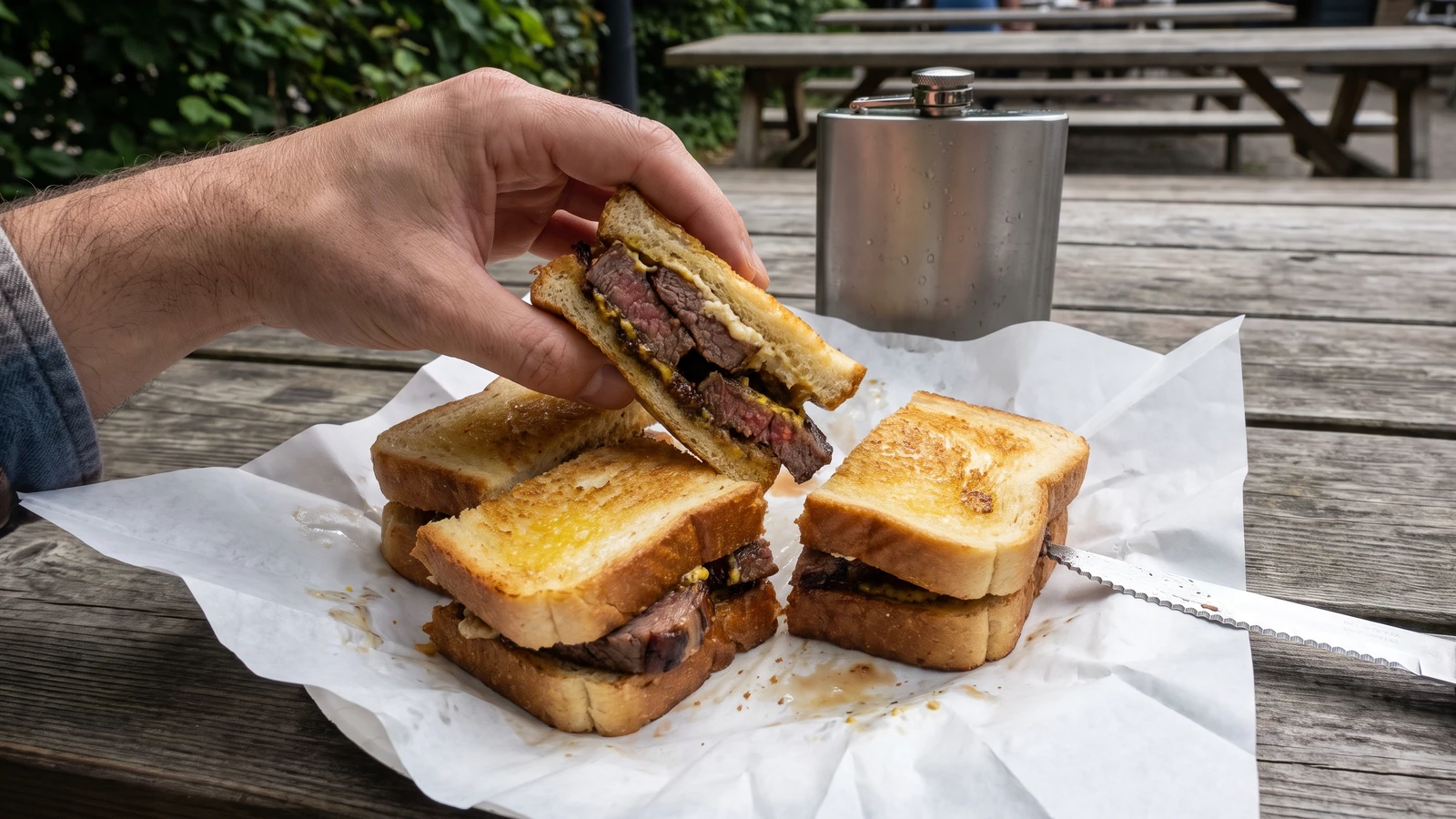
Steak grilled dark at the edges, cooled, sharpened with horseradish and mustard, then pressed between buttered loaf heels until the crumb catches every juice: a race-day sandwich substantial enough to be supper.
Sandwichs de bookmaker (pressed steak sandwiches) teach a useful truth: bread is not merely wrapping, it is part of the cooking. The two heel crusts form a closed case, and gradual pressure draws the seasoned beef juices into their shallow crumb instead of letting them run into the picnic paper. Cut those heels correctly before you touch the pan. That one-third inch of crumb is the vessel.
This entry never depended on a saucier, a perpetual stockpot, or a salamander. Its old kitchen assumptions were a whole English tin loaf, sheets of blotting paper, galantine stringing, and a letter press. At home, one square Pullman loaf, butcher’s twine, parchment, a clean towel, two boards, and a few kilograms of pantry weights do the same work. I have fixed the loaf and steak at a size that feeds four, while keeping the original flavourings, sequence, and proportions intact. The outer wrapping is scaffolding. Buttered crust caps, cooled grilled steak, horseradish, mustard, and gradual pressing are the dish. One cook, one stove, one evening, and no office machinery.
Grill the steak until its surface is deeply bronzed, then let it cool before assembling. Hot beef would flood the crumb and turn it pasty, while rested beef gives up its juices slowly under pressure. The step that decides the sandwichs de bookmaker is the press: add the weight gradually for the full half hour, and the loaf becomes a compact, savoury meal fit to travel.
Sandwichs de bookmaker belong first to the English racecourse hamper, where a whole grilled steak sealed between the heel crusts of a tin loaf made a portable meal for bookmakers and racing crowds. French culinary manuals received the sandwich through their study of cuisine anglaise and preserved its peculiar method: the parcel was trussed like a galantine, wrapped in blotting paper, and tightened beneath a letter press. Its name describes the company that favoured it, not a named inventor, and its defining act is pressing, which turns the bread into a vessel for the beef juices.
Quantity
1 loaf (about 2 lb / 900 g)
Quantity
1 steak (about 1 1/4 lb / 570 g), 1 1/2 inches / 4 cm thick
trimmed to the footprint of the loaf
Quantity
3 tablespoons (45 ml / 43 g)
softened
Quantity
2 tablespoons (30 ml / 24 g)
finely grated
Quantity
1 1/2 tablespoons (22 ml / 23 g)
Quantity
1 teaspoon (5 ml / 6 g)
Quantity
1/2 teaspoon (2.5 ml / 1 g)
| Ingredient | Quantity |
|---|---|
| large unsliced square white Pullman or English tin loaf | 1 loaf (about 2 lb / 900 g) |
| thick boneless strip or sirloin steaktrimmed to the footprint of the loaf | 1 steak (about 1 1/4 lb / 570 g), 1 1/2 inches / 4 cm thick |
| unsalted buttersoftened | 3 tablespoons (45 ml / 43 g) |
| fresh horseradishfinely grated | 2 tablespoons (30 ml / 24 g) |
| prepared strong English mustard | 1 1/2 tablespoons (22 ml / 23 g) |
| fine sea salt | 1 teaspoon (5 ml / 6 g) |
| freshly ground black pepper | 1/2 teaspoon (2.5 ml / 1 g) |
Cut both end crusts from the unsliced loaf, leaving exactly 1/3 inch / 8 mm of crumb attached to each crust. Set the middle of the loaf aside for another use. Spread the softened butter evenly over both exposed crumb faces, working it right to the crust edge. Do not replace these heels with ordinary slices. Their unbroken outer crust contains the meat juices when the sandwich is pressed.
Pat the steak completely dry and season both faces and the edges with the salt and pepper. Heat a heavy grill pan or cast-iron skillet over high heat until thoroughly hot. If the steak has a fat edge, hold that edge against the pan for a minute to render a thin film, then lay the steak flat. Grill without tugging at it until the first face develops a dark Maillard crust, about 4 to 5 minutes. Turn and cook the second face for another 4 to 5 minutes, then colour the edges. Aim for 130°F / 54°C at the centre for medium-rare, or continue to your preferred degree. If the exterior colours too quickly while the centre remains cold, lower the heat and turn the steak every minute until it is ready. Ça se rattrape.
Set the steak on a plate and leave it untouched for 10 minutes so its juices settle. Turn it once through any juices on the plate, then continue cooling for 15 to 20 minutes, until it is no longer warm but has not dried at the edges. Cooling is part of the method, not dead time. A hot steak releases its liquid too quickly and makes the bread sodden before pressure can distribute it.
Spread half the English mustard over each face of the cooled steak, then press half the grated horseradish into each mustard-coated side. Place one loaf heel crust-side down, settle the whole steak onto its buttered crumb, and cover it with the second heel, buttered side against the beef and crust facing outward. Keep the steak whole. Slicing it now would open channels through which the juices could escape.
Ficelez comme une galantine (truss it as for a galantine): tie the parcel snugly with parallel loops of butcher’s twine every 1 1/2 inches / 4 cm, then add one loop around its length. Wrap it in two sheets of parchment and then in a clean, unperfumed kitchen towel, the food-safe home equivalent of the original blotting paper. Set the parcel between two flat boards or rimless baking sheets. Add about 4 lb / 2 kg of evenly balanced weight for 10 minutes, then increase the total to about 9 lb / 4 kg and press for 20 minutes more. If the crust begins to split or juice appears at a seam, lift the upper board, remove half the weight, retie the weak spot, and finish under gentler pressure. Ça se rattrape. The object is saturation, not demolition.
Remove the weights, towel, parchment, and twine. The loaf should be compact and firm, with the crumb visibly darkened by butter, mustard, and beef juice while the outer crust remains intact. For immediate serving, use a sharp serrated knife to cut the sandwich into four equal portions. For a picnic, leave it whole, rewrap it tightly in fresh parchment or plain white food paper, place it in a close-fitting box, and refrigerate until departure. Carry it in a chilled cooler and cut it when everyone is ready. À table!
1 serving (about 355g)
Culinary guides, cultural storytelling, and the editorial depth that makes cooking meaningful.
Discover Culinary ExplorerChef Juliette
Five classical fillings between bread buttered to every edge, cut into tidy rectangles and held under a light weight: a French buffet lesson in softness, proportion, and restraint.

Chef Thomas
Back bacon crisped in a hot pan, a ripe tomato that actually tastes of something, crisp lettuce and real butter on proper toast. A sandwich that earns its place in the notebook.

Chef Isabel
Almussafes is Valencian bar-counter food: a crusty roll filled with sobrasada, cheese, and onion, then pressed on the plancha until the bread crisps and the filling runs together.

Chef Takumi
A sausage on a stick, sweet batter, clean hot oil, and no cornmeal. Amerikan doggu is festival food made plain, with the batter thick enough to cling.