
Chef Juliette
Smelt (Éperlans)
Tiny éperlans, lightly floured and fried until their tails stand crisp, arrive in a generous heap on a napkin with fried parsley and grooved lemon, a weeknight lesson in heat and restraint.
A cooking platform built around craft, culture, and the stories behind what we eat.

Created by Chef Juliette
Based on No. 2318, Brochettes d’Huîtres Lucifer, from Le Guide Culinaire (1907) by Auguste Escoffier
Six oysters to a skewer, barely poached in their own liquor, sharpened with mustard, coated à l’anglaise, and fried at the last moment until crisp outside and tender within.
Brochettes d’Huîtres Lucifer (mustarded fried oyster skewers) teach one uncompromising thing: the oysters must be dry before they're coated. An oyster wet with its own liquor cannot hold mustard, flour, egg, and crumbs; the crust slides away in the fat while the oyster overcooks beneath it.
The original kitchen assumed a poissonnier opening and trimming oysters, Anglaise (for Egg-and-bread-crumbing) (No. 174) already prepared, and a fryer held fiercely hot through service. At home, use 24 plump local oysters, four short skewers, a small pot of oil, and a thermometer. The dedicated station and extra hands are brigade scaffolding, so they go. Poaching in the oysters' own liquor, thin mustard, six oysters per skewer, the coating à l’anglaise, and last-moment frying are the dish, so every one stays. One cook, one stove, one evening.
Blot each poached oyster until the towel comes away nearly clean, then wait to fry until everyone is ready to eat. If the coating slips, stop and rebuild that patch rather than sending it bare into the oil. Ça se rattrape. Drying is the step that decides the dish.
Brochettes d’Huîtres Lucifer belong to the Parisian classical hot-hors-d’œuvre repertoire, where oysters moved from raw shellfish service into the grand kitchen through brief poaching, panure à l’anglaise, and last-moment frying. In French kitchen grammar, à l’anglaise names the egg-and-crumb coating; it does not make this a British regional dish. The Lucifer title points to the mustard's sting and the fierce heat of the frying fat, while the source formula adds no chile, sauce, or theatrical garnish.
Quantity
24
scrubbed, shucked, with all liquor reserved
Quantity
¼ cup (60 ml / 60 g)
Quantity
½ cup (120 ml / 60 g)
Quantity
½ cup (120 ml / 115 g) Anglaise (for Egg-and-bread-crumbing) (No. 174)
Quantity
1½ cups (360 ml / 135 g)
Quantity
6 cups (1.4 L / 1.3 kg)
or enough for a 2-inch (5 cm) depth
| Ingredient | Quantity |
|---|---|
| plump medium oysters in the shellscrubbed, shucked, with all liquor reserved | 24 |
| thin prepared French mustard | ¼ cup (60 ml / 60 g) |
| all-purpose flour | ½ cup (120 ml / 60 g) |
| Anglaise (for Egg-and-bread-crumbing) | ½ cup (120 ml / 115 g) Anglaise (for Egg-and-bread-crumbing) (No. 174) |
| fine dry white breadcrumbs | 1½ cups (360 ml / 135 g) |
| neutral frying oilor enough for a 2-inch (5 cm) depth | 6 cups (1.4 L / 1.3 kg) |
Set a fine-mesh strainer over a bowl, shuck the oysters over it, and catch every drop of their liquor. Keep the oysters whole and inspect them carefully for shell fragments. Strain the liquor again through dampened muslin or a coffee filter; grit hidden in the liquor will remain grit after cooking.
Pour the strained oyster liquor into the smallest shallow pan that will hold the oysters snugly. Bring it only to a tremble, add the oysters in batches if necessary, and poach for 30 to 60 seconds, turning once, until their edges just begin to ruffle. Do not boil them. If the liquor is shallow, tilt the pan and spoon it over the oysters rather than adding water; their own liquor is the foundation specified by the dish. Lift them out immediately and let them cool.
Trim away any tough, dark frilled beard and remove any final shell fragments. Lay the oysters between clean kitchen towels and blot them thoroughly, changing the towels until the surfaces feel tacky rather than wet. Dip each oyster lightly in the thin mustard, let the excess fall away, and thread six oysters onto each short skewer, leaving a narrow space between them so the coating can crisp all around.
Paner à l’anglaise means to coat first with flour, then the prepared egg mixture, then crumbs. Roll each loaded skewer lightly in the flour and tap away every loose patch. Coat it thoroughly with the Anglaise (for Egg-and-bread-crumbing) (No. 174), let the excess drain, then press it gently into the fine breadcrumbs. If the coat slides or exposes an oyster, don't heap more crumbs over the wet patch. Ça se rattrape: remove the loose coating, blot the oyster again, dust it with flour, and repeat the anglaise and crumbs.
Heat the oil in a deep, heavy pot to 375°F (190°C). Lower one or two skewers away from you, according to the width of the pot, and fry for 60 to 90 seconds, turning once, until the crust sets immediately and becomes an even deep gold. Keep the oil above 350°F (175°C); cooler fat gives a greasy coat. If a batch emerges pale, let the oil recover fully and return it for 15 seconds to crisp, no longer, because the oysters are already cooked.
Lift the skewers onto a wire rack and drain them for 30 seconds, never onto a flat pile where the undersides soften. Arrange them at once on a folded white napkin set over a warm platter, preserving the source's service without asking the napkin to do the rack's work. Serve immediately, with no added sauce or garnish to hide the mustard, oyster liquor, and crisp panure. À table!
1 serving (about 185g)
Culinary guides, cultural storytelling, and the editorial depth that makes cooking meaningful.
Discover Culinary ExplorerChef Juliette
Tiny éperlans, lightly floured and fried until their tails stand crisp, arrive in a generous heap on a napkin with fried parsley and grooved lemon, a weeknight lesson in heat and restraint.

Chef Juliette
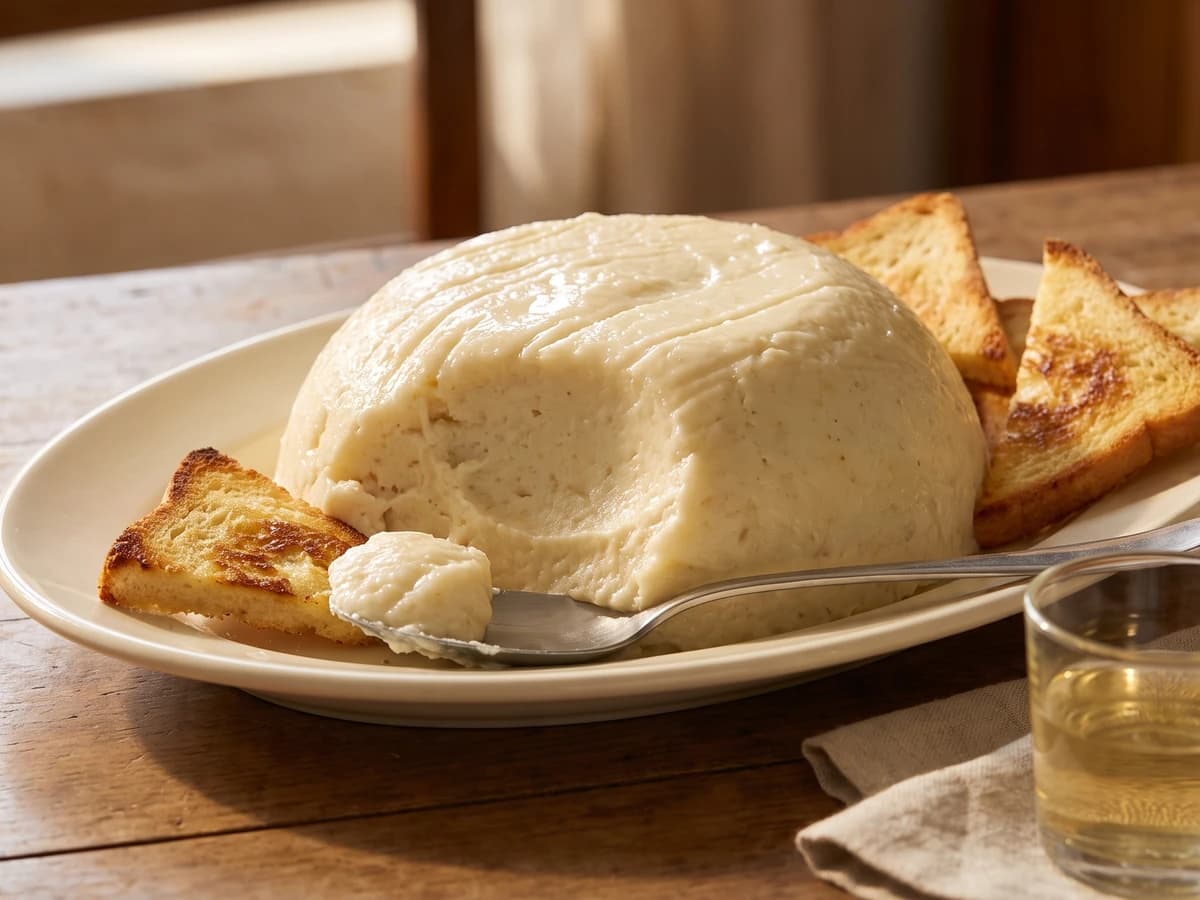
Brandade de Morue turns salt cod, warm olive oil, and milk into a pale, silky emulsion: keep everything warm and add the oil slowly, then crown the generous dome with butter-fried bread.
Chef Juliette
Salt cod worked warm with cream, one patient spoonful at a time, until the rough flakes become a glossy Nîmes paste, domed generously and ringed with butter-fried croutons for the table.

Chef Juliette
Wine-poached char packed in its earthenware crock beneath butter gold: a make-ahead first course that turns careful cooling, thorough boning, and one unbroken seal into quiet abundance.