
Chef Juliette
Smelt (Éperlans)
Tiny éperlans, lightly floured and fried until their tails stand crisp, arrive in a generous heap on a napkin with fried parsley and grooved lemon, a weeknight lesson in heat and restraint.
A cooking platform built around craft, culture, and the stories behind what we eat.

Created by Chef Juliette
Based on No. 231, Batter for Various Fritters, from Le Guide Culinaire (1907) by Auguste Escoffier
Pâte à frire turns four plain ingredients and a frothy egg white into a crisp, close-fitting coat. Turn the batter gently, because stirring makes it elastic enough to abandon the food.
Pâte à frire teaches the discipline of not stirring. If you mean to fry at once, turn the flour, fat, and barely warm water over and over with the spoon; circular stirring makes the batter elastic, and an elastic batter draws back from the very thing it should coat. That is the one true thing to know before you touch the bowl. Get it right and the coating clings thinly, puffs just enough, and fries crisp and gold.
The book's pound of flour assumed brigade portions and a frying bath already kept hot. It needed no saucier, stockpot, or salamander; scale was its only professional convenience. Here every fixed quantity is halved, the smallest clean division that uses one whole egg white, and a deep saucepan with a thermometer stands in for the fryer. It gives four generous appetizer servings, one cook, one stove, one evening.
The brigade quantity is scaffolding and can go. The turning motion, the rest if you do stir, and the frothy white folded in at the last moment are the dish and must stay. Prepare and dry everything you intend to dip before you begin, because once the white enters, the batter should go straight to the hot fat.
Pâte à frire was codified in the Parisian classical kitchen as the neutral coating for a broad family of beignets, even though fritters themselves belonged equally to household and fairground cooking across France. The written formula carried that everyday frying habit into brigade service by fixing flour, salt, fat, and egg white while leaving the water to the cook's eye. Beer, yeast, and elaborate seasoning belong to other batters; here, lightness comes from frothy egg white and adhesion from a restrained hand.
Quantity
1⅞ cups (445 ml / 227 g)
sifted
Quantity
⅝ teaspoon (3 ml / 3.5 g)
Quantity
1½ teaspoons (7.5 ml / 7 g)
butter melted and cooled until fluid, if using
Quantity
1 to 1¼ cups (240 to 300 ml / 240 to 300 g)
barely lukewarm, as needed
Quantity
1 large (2 tablespoons / 30 ml / 30 g)
at room temperature
| Ingredient | Quantity |
|---|---|
| plain floursifted | 1⅞ cups (445 ml / 227 g) |
| fine salt | ⅝ teaspoon (3 ml / 3.5 g) |
| neutral oil or unsalted butterbutter melted and cooled until fluid, if using | 1½ teaspoons (7.5 ml / 7 g) |
| waterbarely lukewarm, as needed | 1 to 1¼ cups (240 to 300 ml / 240 to 300 g) |
| large egg whiteat room temperature | 1 large (2 tablespoons / 30 ml / 30 g) |
Prepare the pieces called for by your chosen fritter recipe before making the batter. They must be cool enough not to set the coating on contact and impeccably dry; surface moisture thins the batter and makes hot fat spit. Fill a deep, heavy saucepan no more than one-third full with the frying fat specified for those fritters, then heat it to 350°F to 355°F (175°C to 180°C). If the filling needs longer to cook than the crust, precook it or cut it smaller according to its own recipe.
Sift the flour and salt into a wide bowl. Add the oil or melted butter and 1 cup (240 ml / 240 g) of the barely lukewarm water. If you'll use the batter at once, scoop underneath with a large spoon and turn the mixture over itself repeatedly, just until no dry flour remains. Do not stir around the bowl or beat it smooth. Add more water a tablespoon at a time until the batter falls from the spoon in a slow, heavy ribbon. A few small lumps do less harm than an elastic batter.
If you're preparing the base ahead, you may stir the flour, salt, fat, and initial cup of water until smooth. Cover it and rest it for at least 1 hour, or refrigerate it for up to 8 hours. Let chilled batter stand for 20 minutes before use, then turn in enough barely lukewarm water to restore the slow ribbon. The rest is not decoration; it is what removes the elasticity created by stirring. Skip this step when using a gently turned batter immediately.
Whisk the egg white until it becomes a loose white froth that mounds softly but does not hold stiff peaks. Fold one-third into the batter to lighten it, cutting down through the centre, lifting from underneath, and turning it over. Fold in the remainder in two additions. Do not stir. Stop as soon as only the faintest white streaks remain; the batter should look aerated and fall in a broad ribbon.
Dip one dry test piece and lift it above the bowl. The pâte à frire should hold as a thin, opaque coat while the excess falls away slowly. If it sits too heavily, turn in the remaining water one teaspoon at a time. If it slides off, dry the piece again and rest the batter for 15 minutes before retesting; wet food and overworked batter are the two usual culprits.
Turn a few pieces through the batter without agitating it, lift them one at a time, and let each drain over the bowl for one heartbeat. Lower them into the hot fat away from you. Fry without crowding until the coating is crisp, evenly golden, and set around the filling, turning once if necessary. Follow the chosen filling's recipe for doneness, because a golden coat does not prove that a thick or raw centre is cooked. Let the fat return to 350°F to 355°F (175°C to 180°C) before adding another batch.
Lift the fritters onto a wire rack set over a tray, leaving space between them so the undersides remain crisp. Season or sauce them only as their own recipe directs; this pâte à frire is intentionally neutral so it can carry savory or sweet fillings. Serve at once. Once the egg white has been folded in, the batter will not improve by waiting. À table!
1 serving (about 100g)
Culinary guides, cultural storytelling, and the editorial depth that makes cooking meaningful.
Discover Culinary ExplorerChef Juliette
Tiny éperlans, lightly floured and fried until their tails stand crisp, arrive in a generous heap on a napkin with fried parsley and grooved lemon, a weeknight lesson in heat and restraint.

Chef Juliette
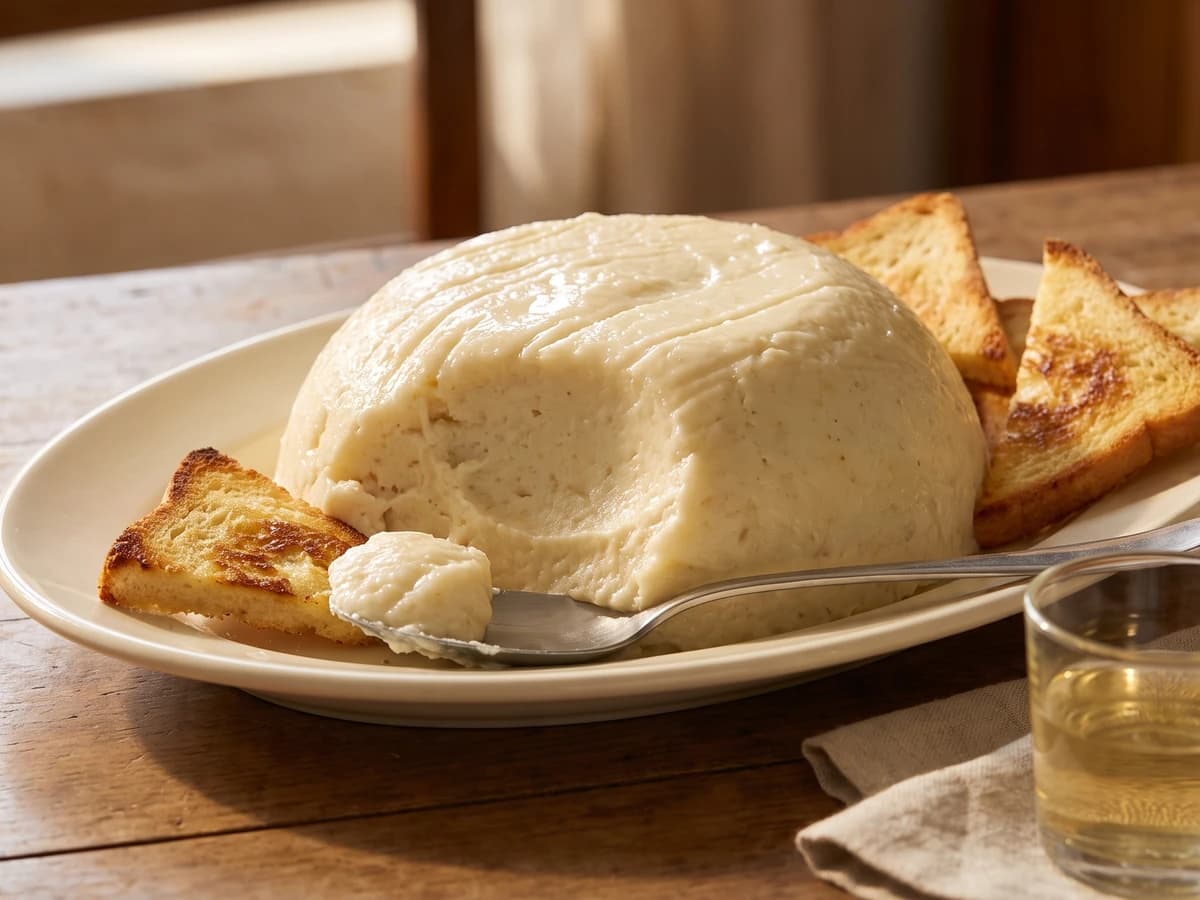
Brandade de Morue turns salt cod, warm olive oil, and milk into a pale, silky emulsion: keep everything warm and add the oil slowly, then crown the generous dome with butter-fried bread.
Chef Juliette
Salt cod worked warm with cream, one patient spoonful at a time, until the rough flakes become a glossy Nîmes paste, domed generously and ringed with butter-fried croutons for the table.

Chef Juliette
Wine-poached char packed in its earthenware crock beneath butter gold: a make-ahead first course that turns careful cooling, thorough boning, and one unbroken seal into quiet abundance.