
Chef Juliette
Suet Dumpling
Boulettes au suif, poached beside salt beef, turn equal weights of flour and finely chopped suet into tender, rich dumplings. Keep the beef liquor at a bare tremble and the old garnish works beautifully at home.
A cooking platform built around craft, culture, and the stories behind what we eat.
Created by Chef Juliette
Based on No. 2244, Pommes de Terre Schneider, from Le Guide Culinaire (1907) by Auguste Escoffier
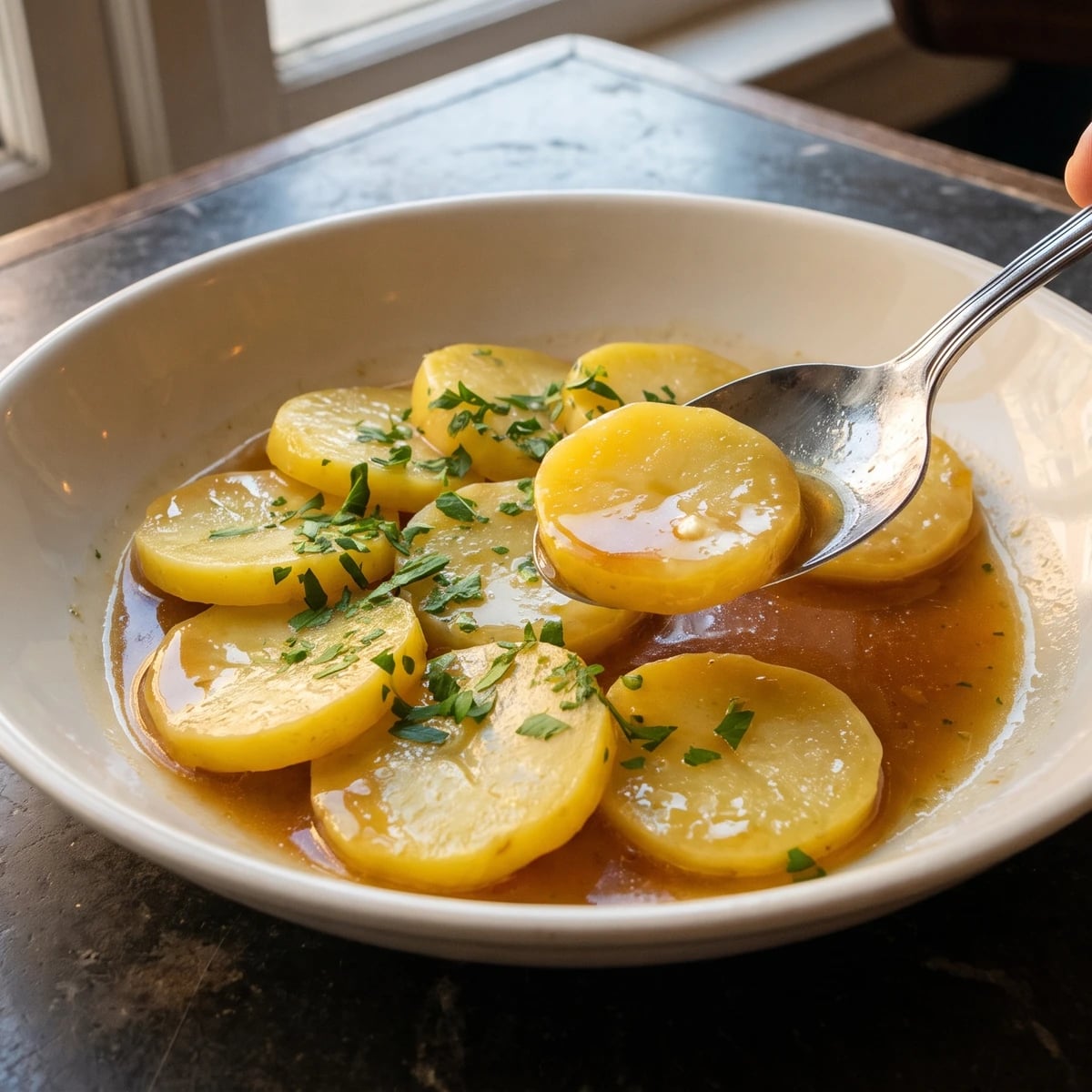
Hot potato rounds drink in clear consommé until nearly dry, then take butter, glace de viande, and parsley: a spare classical side whose success rests entirely on patient reduction.
Pommes de Terre Schneider (Schneider potatoes) teaches reduction as seasoning. The one true thing to know before touching a pan is this: boiling consommé must meet potato roundels that are still hot, so the liquid reduces around them instead of cooling the pan and soaking them to paste. This is not a potato stew. It is controlled absorption followed by a buttered glaze.
The original entry assumes Pommes de Terre à la Maître-d’Hôtel (No. 2230) is station knowledge, a saucier keeps clear consommé and glace de viande (meat glaze) ready, and another pair of eyes can watch the reduction. At home, prepare the linked potato base only through its hot-roundel stage, use good low-sodium consommé and a spoonful of real glace de viande, then work in one wide pan. A separate stockpot and formal timbale are brigade scaffolding and may go. The boiling consommé, complete reduction, butter, glaze, and parsley are the dish and must stay. One cook, one stove, one evening.
When it is right, the rounds remain intact beneath a clear amber gloss, rich with meat and butter but still unmistakably potato. Keep the pan wide, the simmer steady, and the spoon out of it. That patient reduction is the step that decides the dish.
Pommes de Terre Schneider sits in the codified Parisian grand-kitchen repertory rather than a regional potato tradition. Its method branches directly from Pommes de Terre à la Maître-d’Hôtel (No. 2230): consommé stands where milk stood, while butter, glace de viande, and parsley complete the reduction. The Schneider name survives without an identified namesake in the formula, so the honest history lies in the technique rather than a tidy invention story.
Quantity
1 home-scale batch Pommes de Terre à la Maître-d’Hôtel (No. 2230), from about 5 cups sliced (1.2 L / 800 g) medium waxy potatoes
stopped at the hot-roundel stage, before its milk and finishing parsley
Quantity
2 cups (480 ml / 480 g)
preferably low-sodium
Quantity
¼ teaspoon (1.25 ml / 0.6 g)
Quantity
up to ¼ teaspoon (1.25 ml / 1.5 g)
Quantity
3 tablespoons (45 ml / 42 g)
cut into small pieces
Quantity
1 tablespoon (15 ml / 20 g)
warmed until pourable
Quantity
3 tablespoons (45 ml / 12 g)
finely chopped
| Ingredient | Quantity |
|---|---|
| Pommes de Terre à la Maître-d’Hôtelstopped at the hot-roundel stage, before its milk and finishing parsley | 1 home-scale batch Pommes de Terre à la Maître-d’Hôtel (No. 2230), from about 5 cups sliced (1.2 L / 800 g) medium waxy potatoes |
| clear beef consommépreferably low-sodium | 2 cups (480 ml / 480 g) |
| finely ground white pepper | ¼ teaspoon (1.25 ml / 0.6 g) |
| fine salt (optional) | up to ¼ teaspoon (1.25 ml / 1.5 g) |
| unsalted buttercut into small pieces | 3 tablespoons (45 ml / 42 g) |
| glace de viandewarmed until pourable | 1 tablespoon (15 ml / 20 g) |
| flat-leaf parsleyfinely chopped | 3 tablespoons (45 ml / 12 g) |
Prepare the home-scale Pommes de Terre à la Maître-d’Hôtel (No. 2230) through its hot-roundel stage. Stop before adding its milk, seasoning, or finishing parsley, because the Schneider formula replaces and completes those elements itself. Keep the roundels warm and loosely covered while the consommé comes to the boil. Cold potatoes resist the liquid at first and then break before it reduces, so hot must meet hot.
Bring the consommé to a full boil in a small saucepan. Taste it before seasoning, since packaged consommé and glace de viande can carry considerable salt. Add the white pepper and only as much salt as the liquid needs. Reserve ¼ cup (60 ml / 60 g) of the boiling consommé for correcting the reduction or butter finish.
Arrange the warm potato roundels in a wide sauté pan, overlapping them lightly rather than piling them deeply. Pour over the remaining boiling consommé; it should nearly cover the potatoes. Return it promptly to a steady simmer and cook uncovered for 12 to 18 minutes, tilting the pan occasionally but never stirring, until no free consommé remains and an amber glaze clings to the rounds. If the pan dries before the glaze forms, add the reserved consommé one tablespoon at a time. If the potatoes begin breaking while too much liquid remains, lift them into a warm bowl, reduce the liquid alone, then return them gently. Ça se rattrape.
Remove the pan from the heat while its bottom is still moist. Add the butter in three additions, tilting and swirling after each until the reduction turns glossy, then spoon in the warm glace de viande and swirl once more. Do not stir through the potatoes. If the butter separates into a greasy pool, Ça se rattrape: add a teaspoon of the reserved hot consommé or boiling water and swirl firmly until the glaze comes back together.
Lift the roundels into a warmed shallow serving bowl and spoon every trace of the reduced glaze over them. Scatter the chopped parsley generously across the top, as the original directs, rather than folding it into the potatoes. Serve at once while the butter sheen is bright and the rounds are still tender. À table!
1 serving (about 245g)
Culinary guides, cultural storytelling, and the editorial depth that makes cooking meaningful.
Discover Culinary Explorer
Chef Juliette
Boulettes au suif, poached beside salt beef, turn equal weights of flour and finely chopped suet into tender, rich dumplings. Keep the beef liquor at a bare tremble and the old garnish works beautifully at home.

Chef Juliette
Bread, flour, frangipane, and rice become four cool, supple panades for binding forcemeats, each changing body and flavor while preserving tenderness. The finest Mousselines need none, and knowing that distinction is the lesson.

Chef Juliette
Panade au pain is bread, milk, salt, heat, and attention: stir until the paste releases cleanly, butter it against a skin, and you have the quiet binder behind tender French farces.

Chef Juliette
Panade de farine teaches the drying stroke behind pâte à choux: flour meets boiling buttered water, then stays over the fire until the paste gathers, smooths, and quits the pan cleanly.