
Chef Juliette
Suet Dumpling
Boulettes au suif, poached beside salt beef, turn equal weights of flour and finely chopped suet into tender, rich dumplings. Keep the beef liquor at a bare tremble and the old garnish works beautifully at home.
A cooking platform built around craft, culture, and the stories behind what we eat.
Created by Chef Juliette
Based on No. 2243, Pommes de Terre à la Saint-Florentin, from Le Guide Culinaire (1907) by Auguste Escoffier
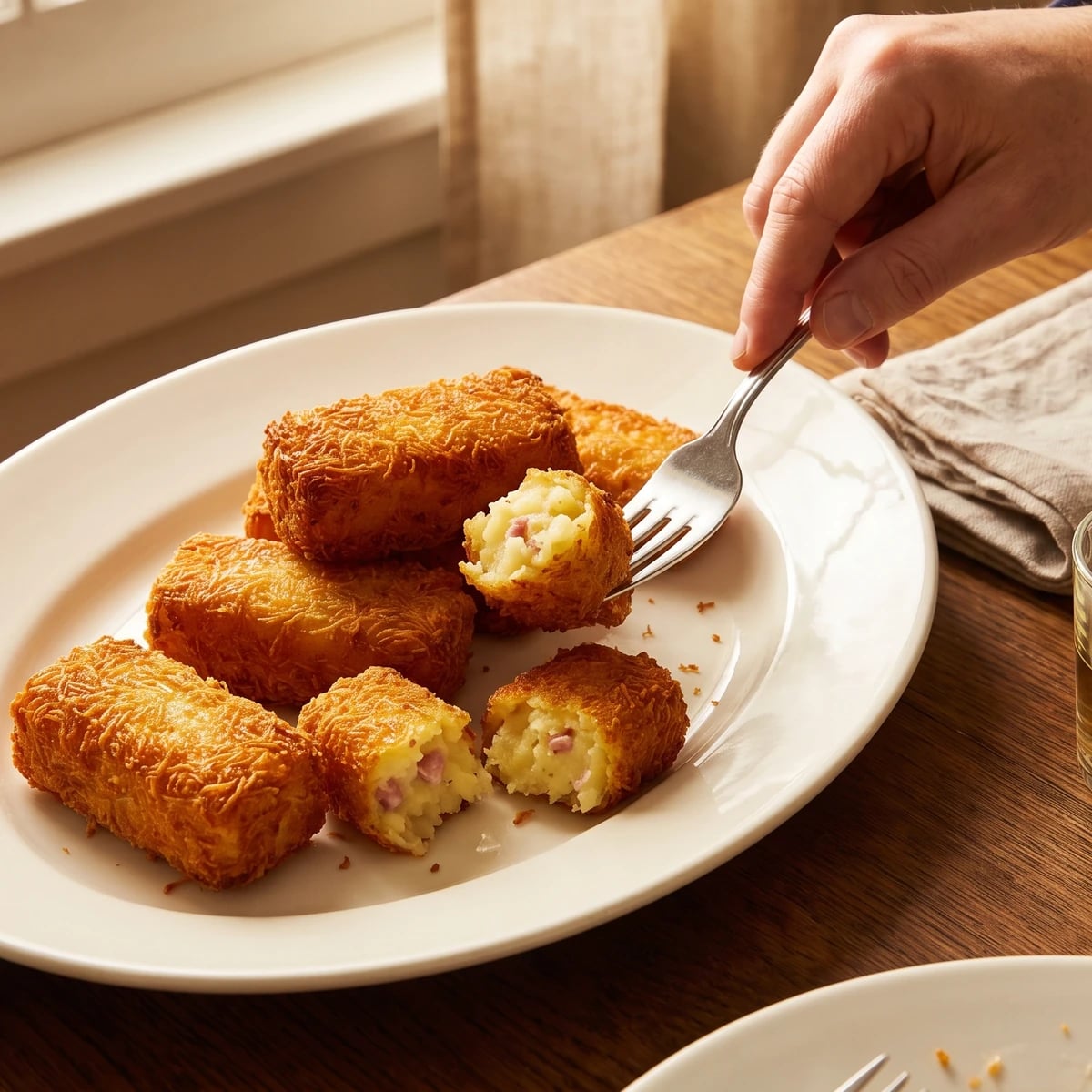
Lean ham-studded potato croquette paste, pressed into rectangles and wrapped in vermicelli, fries into a deeply golden side whose crisp shell gives way to a buttery, seasoned heart.
Pommes de Terre à la Saint-Florentin (potato-and-ham croquettes in a vermicelli crust) teach one true thing: a croquette succeeds through contrast. The centre must remain soft and buttery while the outside becomes crisp, and here that outside is dry vermicelli, not breadcrumbs. The vermicelli crust is not decoration. It is the dish.
The brigade formula assumed Potato Croquettes (No. 219) paste waiting cold in the larder, cooks shaping whole trays, and a deep kettle of frying fat held ready for service. At home, one pound of paste, a heavy pot, and a thermometer do the same work. Only the quantity and vessel have changed because one table doesn't need a service tray or a vat of fat; the ratio of two ounces of lean ham per pound of paste, the egg coating, the vermicelli, and the very hot fry remain exactly where the canon put them. One cook, one stove, one evening.
Bulk production was brigade scaffolding, so it can go. Cold paste, the coating, and the flattening after coating must stay. The one step that decides the Saint-Florentin croquettes is the frying temperature: let the fat reach its full heat and return there between batches, or the crust drinks fat before it can set.
Pommes de Terre à la Saint-Florentin belongs to the codified French grand-kitchen repertory, where a basic croquette paste could become a distinct garnish through one addition and a new coating. The name points to Saint-Florentin in Yonne, at Burgundy's northern edge, but the formula carries no specifically Burgundian seasoning and is better understood as a classical named variation than a documented local household specialty. Its lean ham and dry vermicelli jacket are the identity, separating it from the breadcrumb-coated croquettes that traveled more widely onto bourgeois tables.
Quantity
1 pound (about 2 cups / 454 g) Potato Croquettes (No. 219)
thoroughly chilled
Quantity
2 ounces by weight (about 1/3 cup / 57 g)
finely chopped
Quantity
2 (about 7 tablespoons / 100 ml / 100 g without shells)
beaten
Quantity
3 1/2 ounces by weight (about 1 cup / 100 g)
broken into pieces no longer than 1/4 inch (6 mm)
Quantity
2 quarts (1.9 L / about 1.7 kg)
refined sunflower or peanut oil
| Ingredient | Quantity |
|---|---|
| Potato Croquettes pastethoroughly chilled | 1 pound (about 2 cups / 454 g) Potato Croquettes (No. 219) |
| lean cooked hamfinely chopped | 2 ounces by weight (about 1/3 cup / 57 g) |
| large eggsbeaten | 2 (about 7 tablespoons / 100 ml / 100 g without shells) |
| fine dried wheat vermicellibroken into pieces no longer than 1/4 inch (6 mm) | 3 1/2 ounces by weight (about 1 cup / 100 g) |
| neutral high-heat frying fatrefined sunflower or peanut oil | 2 quarts (1.9 L / about 1.7 kg) |
Set the thoroughly chilled Potato Croquettes (No. 219) paste in a wide bowl and fold in the finely chopped lean ham with a flexible spatula. Mix only until the ham is evenly dispersed; kneading warms the butter and turns a firm croquette paste sticky. If the mixture begins to smear rather than hold a clean ridge, stop and chill it for 15 minutes. Ça se rattrape.
Divide the mixture into 12 portions of about 1 1/2 ounces (43 g) each. With cold, dry hands, roll every portion into a short cork about 2 1/2 inches (6 cm) long, keeping the ends blunt and the surface free of cracks. Set them on a parchment-lined tray. If they cling to your fingers, return the tray to the cold rather than working flour into the paste; added flour would make the centre heavy.
Put the beaten eggs in one shallow dish and the broken, uncooked vermicelli in another. Roll each cork through the egg, let the excess fall away, then roll it in vermicelli and press very lightly so the short strands take hold. Cover the entire surface, including both ends. Bare potato will open in the frying fat, so touch any gap with a little egg and more vermicelli rather than coating the whole piece twice.
Set each coated cork back on the tray and press the top gently to flatten it, then square the two long sides with your fingers to make a compact rectangular croquette. This order matters: flattening after coating seats the vermicelli into the egg and gives the crust its close, deliberate shape. Press just enough to form the rectangle, never enough to squeeze paste through the coating.
Pour the frying fat into a heavy 5-quart pot, filling it no more than halfway, and heat it to 375°F (190°C). Hold the shaped croquettes in the refrigerator while the fat heats. A thermometer is the honest home equivalent of the brigade fryer: very hot means measured, not guessed. Keep the pot dry, leave room above the fat, and have a lid nearby for safety without ever covering the hot oil during frying.
Lower three croquettes at a time into the 375°F (190°C) fat and fry for 2 to 3 minutes, turning once, until the vermicelli is crisp and evenly golden and the croquettes feel firm beneath the spider. Let the fat recover fully between batches. If one cracks and leaks, lift it out at once; the paste was too warm or the fat too cool. Ça se rattrape: chill the remaining croquettes for 15 minutes, return the fat to temperature, and continue. If the vermicelli darkens in less than a minute, lower the fat slightly to 365°F (185°C). Drain on a rack, never in a covered dish, and serve at once. À table!
1 serving (about 165g)
Culinary guides, cultural storytelling, and the editorial depth that makes cooking meaningful.
Discover Culinary Explorer
Chef Juliette
Boulettes au suif, poached beside salt beef, turn equal weights of flour and finely chopped suet into tender, rich dumplings. Keep the beef liquor at a bare tremble and the old garnish works beautifully at home.

Chef Juliette
Bread, flour, frangipane, and rice become four cool, supple panades for binding forcemeats, each changing body and flavor while preserving tenderness. The finest Mousselines need none, and knowing that distinction is the lesson.

Chef Juliette
Panade au pain is bread, milk, salt, heat, and attention: stir until the paste releases cleanly, butter it against a skin, and you have the quiet binder behind tender French farces.

Chef Juliette
Panade de farine teaches the drying stroke behind pâte à choux: flour meets boiling buttered water, then stays over the fire until the paste gathers, smooths, and quits the pan cleanly.