
Chef Juliette
Suet Dumpling
Boulettes au suif, poached beside salt beef, turn equal weights of flour and finely chopped suet into tender, rich dumplings. Keep the beef liquor at a bare tremble and the old garnish works beautifully at home.
A cooking platform built around craft, culture, and the stories behind what we eat.
Created by Chef Juliette
Based on No. 2208, Pommes de Terre Château, from Le Guide Culinaire (1907) by Auguste Escoffier
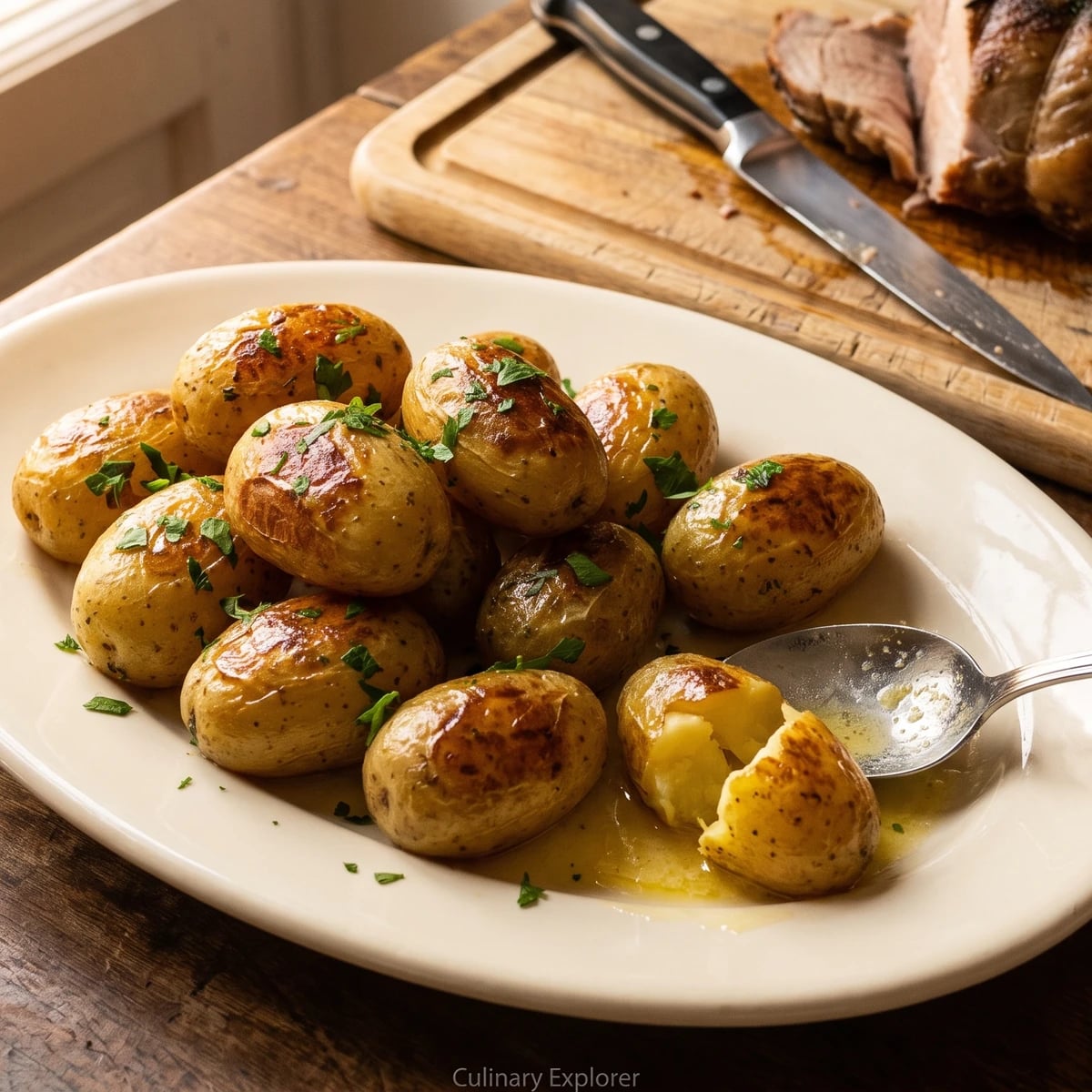
Large olive-shaped potatoes, slowly gilded in clarified butter until their centres yield, then finished with parsley: the roast's companion and a clear lesson in patient, even heat.
Pommes de terre Château (large olive-shaped potatoes cooked in clarified butter) teach control: each piece must become soft at the same pace its curved faces turn gold. That is the one true thing to know before touching the pan. If colour arrives while the centre is still hard, the heat is too high, not the potato too stubborn.
The brigade entry assumed a commis turning a service tray of potatoes, clarified butter already waiting beside the range, and enough pan space to give every piece attention. It needs neither a saucier's stockpot nor a salamander; its brigade luxuries were hands, space, and time. The honest home equivalent is twelve potatoes, a small knife, and one heavy pan. The batch and dedicated commis are scaffolding and can go. The tournage (shaping each potato evenly), seasoning before cooking, gentle clarified butter, and last-minute parsley stay because they are the dish. Only the quantity and butter workflow have changed, scaled for one cook, one stove, one evening.
Done properly, the pommes Château arrive butter-gold and glossy, with rounded bronze faces and centres soft enough to yield without crumbling. Save every trimming for soup or mash. The step that matters is the slow butter cooking: listen for a quiet sizzle, turn the potatoes patiently, and never let colour outrun tenderness.
Pommes de terre Château belong to the Parisian classical garniture repertoire and the bourgeois roast table, where shaped potatoes shared the platter with beef, lamb, or game. The château designation lives in the menu language of grand cuts and is especially associated with Chateaubriand, but the method traveled easily into home kitchens because it asks for no stock or sauce, only a knife, butter, and steady heat. Tournage is often mistaken for decoration alone; its even, rounded shape also helps every piece cook at the same rate and roll through butter without thin corners burning.
Quantity
12 medium-large (about 3 lb / 1.36 kg before trimming)
peeled and turned into large olive shapes
Quantity
1 cup (240 ml / 225 g), yielding about 3/4 cup (180 ml / 165 g) clarified butter
clarified
Quantity
1 1/4 teaspoons (6 ml / 7 g)
Quantity
1/8 teaspoon (0.6 ml / 0.3 g)
Quantity
2 tablespoons (30 ml / 8 g)
finely chopped
| Ingredient | Quantity |
|---|---|
| firm yellow potatoes, such as Yukon Goldpeeled and turned into large olive shapes | 12 medium-large (about 3 lb / 1.36 kg before trimming) |
| unsalted butterclarified | 1 cup (240 ml / 225 g), yielding about 3/4 cup (180 ml / 165 g) clarified butter |
| fine sea salt | 1 1/4 teaspoons (6 ml / 7 g) |
| finely ground white pepper | 1/8 teaspoon (0.6 ml / 0.3 g) |
| flat-leaf parsleyfinely chopped | 2 tablespoons (30 ml / 8 g) |
Melt the butter in a small saucepan over the lowest heat without stirring. When it separates, skim away the pale foam and pour the clear golden butterfat through a fine strainer, leaving the milky sediment behind. Measure about 3/4 cup (180 ml / 165 g). Clarified butter is not brigade scaffolding here: removing the milk solids lets the potatoes cook long enough to soften without the butter blackening. If some sediment slips through, let the butter stand for a minute and decant it again. Ça se rattrape.
Peel the potatoes and trim both ends. Holding one potato firmly, draw seven smooth, curved cuts from top to bottom with a small knife, forming a plump olive or short barrel about 2 1/2 inches long and 1 1/2 inches across (6 cm by 4 cm), without sharp corners. Repeat with the remaining potatoes, keeping their thickness as consistent as you can. Size matters more than perfect symmetry. If one becomes lopsided, don't keep shaving until it disappears; use its thickest point as your guide and match the others. Keep every trimming for soup, mash, or a galette.
Rinse the turned potatoes briefly to remove loose surface starch, then dry them thoroughly with clean towels. Season all over with the salt and white pepper immediately before cooking. A wet potato spits in the butter and delays browning, while a dry one begins taking colour cleanly from the first turn.
Warm the clarified butter in a 12-inch (30 cm) heavy sauté pan over medium-low heat until it shimmers quietly. Add the potatoes in one uncrowded layer; the butter should rise a few millimetres around them. Adjust the burner until you hear a faint, steady sizzle, then cook uncovered for 35 to 45 minutes, rolling each potato a quarter turn every 4 to 5 minutes and spooning butter over the upper surfaces. They are ready when every face is evenly golden and a thin skewer passes through the centre without resistance. If they brown while the centres remain firm, take the pan off the heat for 2 minutes, lower the burner, then cover and cook for 5 to 8 minutes at the gentlest heat before uncovering and rolling them again. Ça se rattrape. If they become tender while still pale, raise the heat slightly for the final few turns.
Lift the potatoes onto a warm oval platter with a slotted spoon, leaving the excess butter in the pan but keeping their surfaces glossy. Sprinkle them moderately with the chopped parsley just before serving and roll them once so the herb catches irregularly across their rounded faces. Taste one and add a small pinch of salt if needed. Bring them directly to the table beside the roast. À table!
1 serving (about 230g)
Culinary guides, cultural storytelling, and the editorial depth that makes cooking meaningful.
Discover Culinary Explorer
Chef Juliette
Boulettes au suif, poached beside salt beef, turn equal weights of flour and finely chopped suet into tender, rich dumplings. Keep the beef liquor at a bare tremble and the old garnish works beautifully at home.

Chef Juliette
Bread, flour, frangipane, and rice become four cool, supple panades for binding forcemeats, each changing body and flavor while preserving tenderness. The finest Mousselines need none, and knowing that distinction is the lesson.

Chef Juliette
Panade au pain is bread, milk, salt, heat, and attention: stir until the paste releases cleanly, butter it against a skin, and you have the quiet binder behind tender French farces.

Chef Juliette
Panade de farine teaches the drying stroke behind pâte à choux: flour meets boiling buttered water, then stays over the fire until the paste gathers, smooths, and quits the pan cleanly.